Scientist of the Day - William Hogarth

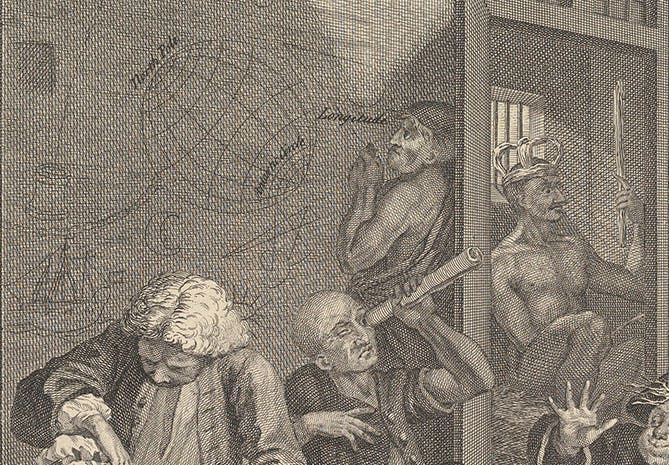
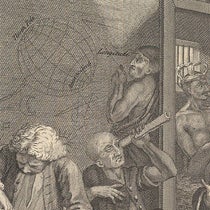
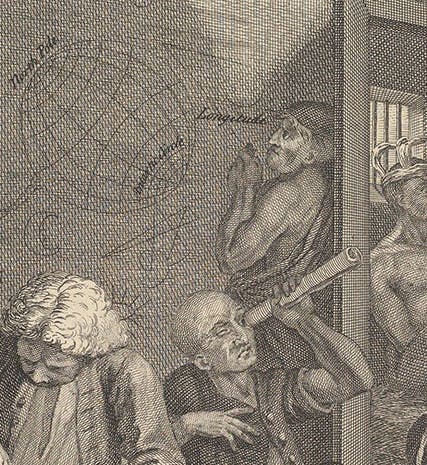
A “lunatick” attempting to solve the longitude problem, detail of A Rake's Progress, plate 8, engraving by William Hogarth, 1735, Metropolitan Museum of Art (metmuseum.org)
William Hogarth, an English artist and satirist, was born Nov. 10, 1697, in London. He had very humble beginnings, but he took an art class with James Thornhill, the noted portrait painter, married his daughter, and once he reconciled with his father-in-law (the couple had eloped), Hogarth began to move in higher circles.

Self-portrait of William Hogarth and his dog, 1745, Tate Britain (Wikimedia commons)
Hogarth is best known for inventing serial art, where he would paint a series of four to eight paintings that told a story, usually including a moral lesson or two. Examples are A Harlot's Progress (1731), and A Rake's Progress (1732-34), each a tale in six or eight panels. Hogarth then engraved the scenes, and they sold very well. In a way, Hogarth invented the graphic novel, although with a minimum of text.
Hogarth is also notable for being one of the very few artists of any era to pop up more than once in the lives of contemporary scientists. I have already mentioned Hogarth twice in this series, without him being the focus. Today he gets center stage, and we will introduce two more examples of Hogarthian science, and provide links to the two that have already come up.

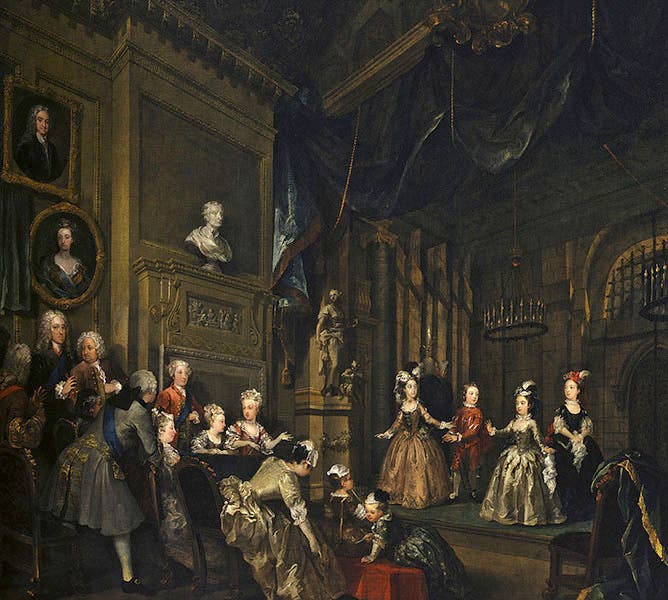
A Scene from "The Indian Emperour, or the Conquest of Mexico by the Spaniards”, oil on canvas, by William Hogarth, 1732-35, private collection, from a blog by David Bridgwater (english18thcenturyportraitsculpture.blogspot.com)
One of Hogarth's most praised paintings was an early effort, painted between 1732 and 1735, depicting a curious scene, the children of John and Catherine Conduit, performing a play in their home for family and invited guests (third image). It is curious because the play they were acting out was The Indian Emperour, by John Dryden (1666). We know this, because the painting is titled: A Scene from "The Indian Emperour, or the Conquest of Mexico by the Spaniards”. It was hardly a play for children, even though the small audience seems delighted with the show.
To a historian of science, what jumps out is a bust of Isaac Newton on the mantle at the left, near two wall portraits of John and Catherine Conduitt. That seems appropriate enough, since Catherine (née Barton) was Newton’s half-niece, and his only relative, and indeed his heir (Newton had died in 1727). John was supposedly writing a family biography of Sir Isaac (which never appeared).
Newton’s bust has the entire upper left quarter to itself There is no clutter of attributing “things” in the area - no prisms, apples, coins (Newton was Master of the Mint, as was Conduit), or stray copies of the Principia lying about. We are meant to recognize him by the bust alone, which is indeed recognizable, a sculpture by Michael Rysbrack.
Why is Newton in the painting at all? Art historians do not agree. Is he disapproving of the festivities? Are Newton's accomplishments, symbolized by the bust, meant as a rebuke to the pretensions of the Conduits? This would be odd, since the Conduits commissioned the painting. But given Hogarth's barbed brush, it is not impossible.
Historians of science paid little attention to Newton’s bust in Hogarth's painting until Patricia Fara featured it in her recent book, Life after Gravity: Isaac Newton's London Career (2021). I am sure it will now be a more prominent topic of discussion.

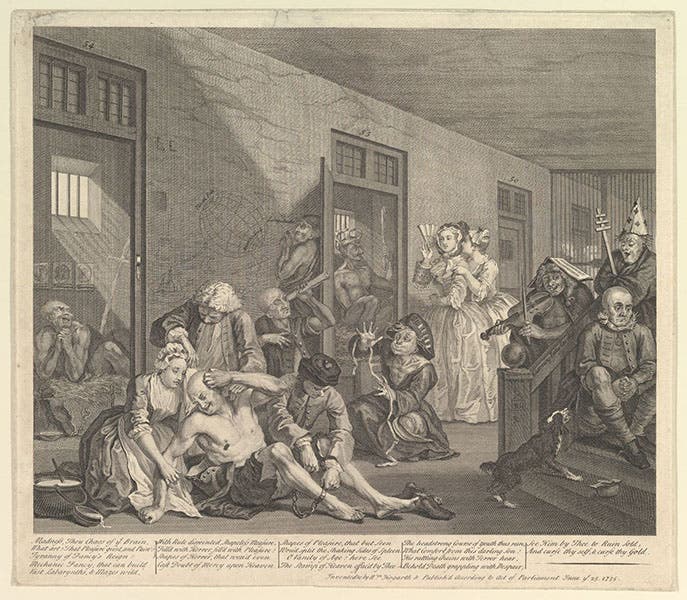
A Rake's Progress, plate 8, engraving by William Hogarth, 1735, Metropolitan Museum of Art (metmuseum.org)
A completely different scientific reference by Hogarth appears in panel 8 of A Rake's Progress (1732-34; engraved 1735; the paintings are in the John Soames Museum in London; a set of the engravings is in the Metropolitan Museum of Art). In this last scene of the series, Tom Rakewell, after surviving debtor's prison, has come to his sad end in Bedlam, along with an abundance of other "lunatics," as the residents were called in Hogarth's time (fourth image).
One of these, sketching on the wall in the center, has drawn a globe, a ship, and has written the word "longitude" (detail, first image). Hogarth is slyly referring to "the longitude problem," the search for a method of determining longitude at sea, a reward for which had been offered by a new institution, the Board of Longitude. In 1732, a solution was nowhere on the horizon, and Hogarth seemed to suggest it was a problem for the criminally insane. But it would be solved, by John Harrison around 1760, without the help of the residents of Bedlam.

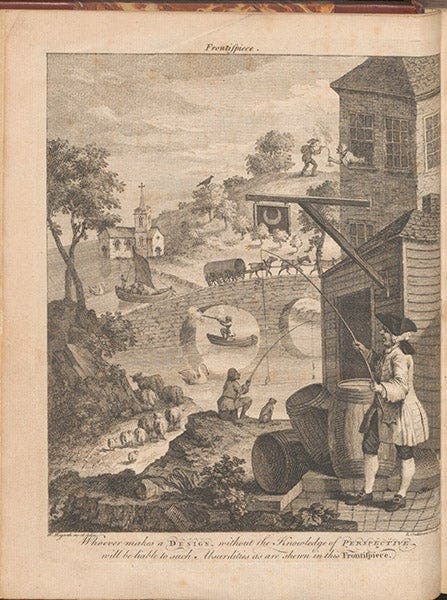
“False perspective,” by William Hogarth, engraved frontispiece, Dr. Brook Taylor's Method of Perspective Made Easy, by Joshua Kirby, 2nd ed., 1755 (Linda Hall Library)
The other two Hogarth nods to science, which we alluded to above, are, first, his reference to the English solution to the "Calendar Problem," whereby England in 1752 finally accepted the Gregorian reform of 1582 and removed 11 days from everyone's lives, or so it seemed. We discussed Hogarth's visual reference in the first paragraph of our post on George Parker.
Hogarth also contributed a frontispiece to Joshua Kirby’s book, Dr. Brook Taylor's Method of Perspective Made Easy (1755). Hogarth was a friend of Kirby, whom we mentioned in a post on Taylor. The engraving, after a drawing by Hogarth which we include again here (last image), is a kind of precursor to Maurits Escher, including a variety of impossible physical situations, which perspectival subterfuge makes acceptable to our eyes.
Hogarth died on Oct. 26, 1764, at the age of 66. For a portrait, I like the terra-cotta bust in the National Portrait Gallery. But for this occasion, I show his self-portrait of 1745, because it includes his dog, a pup named Trump (second image).
William B. Ashworth, Jr., Consultant for the History of Science, Linda Hall Library and Associate Professor emeritus, Department of History, University of Missouri-Kansas City. Comments or corrections are welcome; please direct to ashworthw@umkc.edu.