Scientist of the Day - Erasmus Bartholin

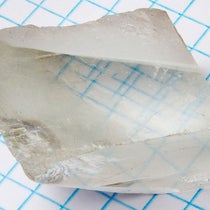
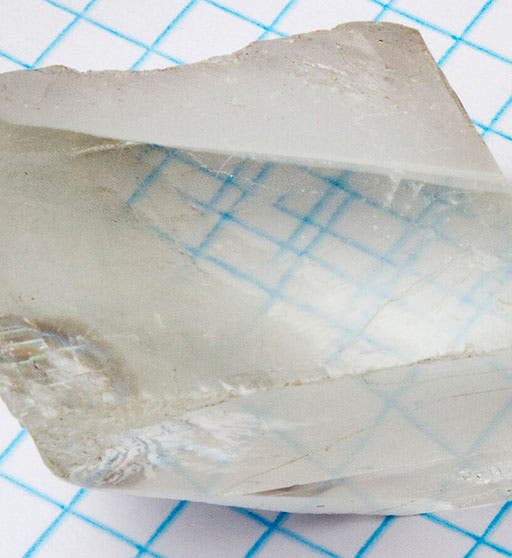
Iceland spar, exhibiting the phenomenon of double refraction, recent photograph (Wikimedia commons)
Erasmus Bartholin, a Danish physician, died Nov. 4, 1698, at the age of 73; he had been born on Aug. 13, 1625, in Roskilde, just west of Copenhagen. Erasmus was part of a famous Danish medical family; his father, Caspar the Elder, was professor of medicine at the University of Copenhagen and author of a standard textbook on anatomy, although he died when Erasmus was just 4. Erasmus’ older brother Thomas not only discovered the lymphatic system, but published a book arguing that the proverbial unicorn horn is actually the tusk of a narwhal. We have written a post on Thomas.

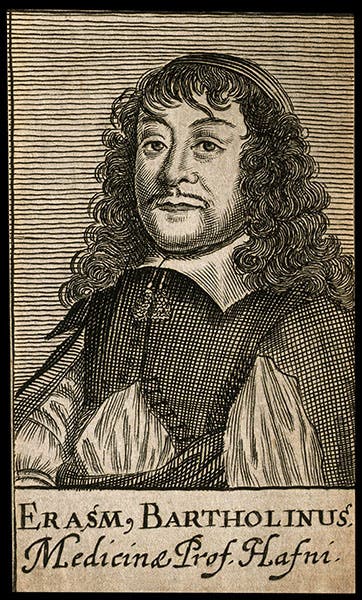
Portrait of Erasmus Bartholin, engraving, 1688, Wellcome Collection, London (wellcomecollection.org)
Erasmus, for his education, spent quite a few years in Holland, France, and Italy, where he studied mathematics and medicine and indulged a fondness for observational astronomy. He also became a Cartesian, a follower of René Descartes. When he returned home, he was appointed professor of mathematics at Copenhagen, but he soon switched to medicine. In 1664, he was asked by the King to edit the manuscripts of the great Danish astronomer Tycho Brahe, which the King had acquired from the heirs of Johannes Kepler. Unfortunately, the king died, the project was abandoned, and Tycho's manuscripts ended up being published by Albert Curtz, whose Historia Coelestis (1668) we just happen to have in our collections (see our post on Curtz).


Beginning of table of contents, showing, “An accompt of Sundry experiments, made and communicated by that Learn’d Mathematician, Dr. Erasmus Bartholin, upon a Chrystal-like body, sent to him out of Island,” [transl. by Henry Oldenburg], Philosophical Transactions of the Royal Society of London, vol. 6, no. 67, p. 2039, 1671 (The Linda Hall)
Erasmus is best known for his work in optics; more specifically, for his discovery of the unusual optical properties of Iceland spar, a variety of calcite that, at the time, was known only from Iceland. Erasmus discovered that if you look at an object through a good clear piece of Iceland spar, you will see two images, slightly overlapping each other. He called this phenomenon "double refraction," and you can see an example of the Iceland spar effect in a modern photograph (first image). Erasmus experimented extensively with double refraction and wrote a treatise about his work: Experimenta crystalli islandici disdiaclastici (Experiments with the doubly-refracting Iceland spar, 1669). We do not, alas, have a copy of Bartholin's book in the History of Science Collection, although we have tried to find an affordable copy. But Erasmus did send a copy to the Royal Society of London, and the secretary, Henry Oldenburg, was so impressed that he included an 11-page summary in English, with a diagram, in the Philosophical Transactions of the Society, which we have, in several copies, in our collections.


Diagram of the double refraction of Iceland spar, “An accompt of Sundry experiments, made and communicated by that Learn’d Mathematician, Dr. Erasmus Bartholin, upon a Chrystal-like body, sent to him out of Island,” [transl. by Henry Oldenburg], Philosophical Transactions of the Royal Society of London, vol. 6, no. 67, p. 2045, 1671 (The Linda Hall)
Bartholin was correct in pointing out that the Iceland spar birefringence was a double refraction, and that reflection was not involved. But he tried to explain the effect using Descartes' theory of light, which did not work so well. However, Christiaan Huygens read Bartholin's book and came up with a much better explanation, using a wave theory of light, and he published it in his Traité de lumière (1690), which we have in our collections, and the full title reveals Huygens’ debt to Bartholin: Traité de la lumière: ou sont expliquées les causes de ce qui luy arrive dans la réflexion & dans la réfraction. Et particuličrement dans l'étrange réfraction du cristal d'Islande (Treatise on light: in which are explained the causes of that which occurs in reflection, & in refraction and particularly in the strange refraction of Iceland crystal). We have written several posts on Huygens, on his discovery of Saturn’s ring, and his pendulum clock, but we have not written about his wave theory of light, where he took exception to the particle theory of Isaac Newon. We will try to write such an article soon.
As important as Huygens' Traité was in establishing a wave theory of light, it was not completely successful in explaining the double refraction of Iceland spar, for to do so, you need to know about the polarization of light, and that was not discovered until the early 19th century. Augustin Fresnel tied up all the loose ends in 1820, a story for another day. Meanwhile, let’s see if we can find a copy of Bartholin’s 1669 book for our collections.
William B. Ashworth, Jr., Consultant for the History of Science, Linda Hall Library and Associate Professor emeritus, Department of History, University of Missouri-Kansas City. Comments or corrections are welcome; please direct to ashworthw@umkc.edu.