Scientist of the Day -

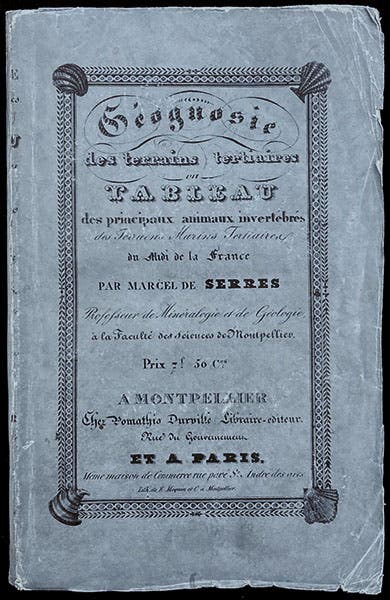
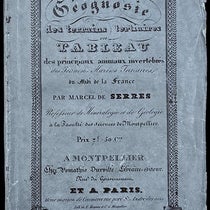
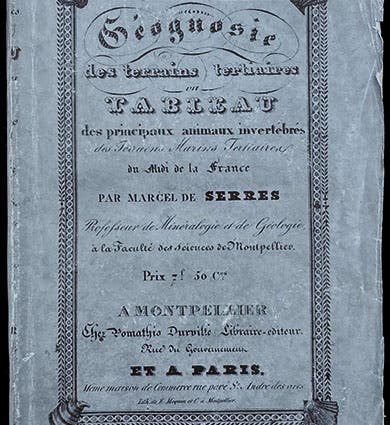
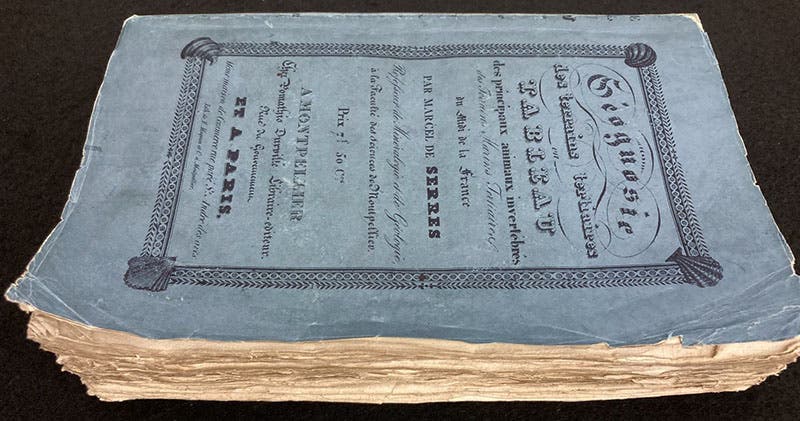
Front paper cover, lithographed, Géognosie des terrains tertiaries, by Marcel de Serres, 1829 (The Linda Hall)
Marcel de Serres, a French geologist, fossil collector, and cave explorer, was born somewhere in southern France, probably Montpellier, on Nov. 3, 1780. His early years are undocumented, and there is no surviving portrait. We know that he ended up teaching geology at the University of Montpellier near the French Mediterranean coast, and that he taught there for 47 years. At Montpellier, he followed in the distant footsteps of Guillaume Rondelet, who, along with Pierre Belon, founded French natural history in the 1550s.

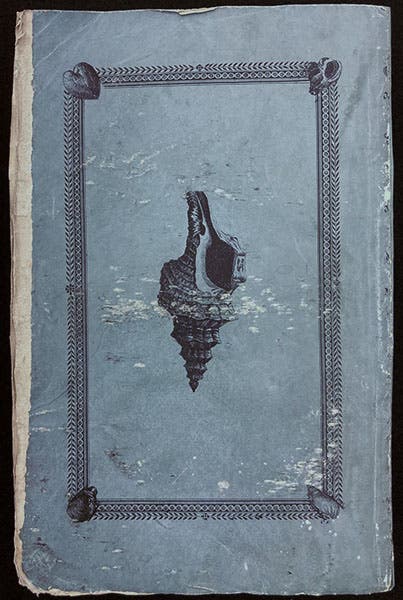
Rear paper cover, lithographed, Géognosie des terrains tertiaries, by Marcel de Serres, 1829 (The Linda Hall)
Serres is not known for much, except for arguing occasionally that human remains and artifacts have been found in caves with the fossils of extinct animals, suggesting that humans have been on Earth longer than allowed by Biblical chronologies. He also had a student, Jules Christol, who made the same arguments, a little more loudly, in the 1830's, although no one paid much attention until the early 1860s. Serres was also one of the first to find fossils of insects and to see them as important stratigraphic evidence.

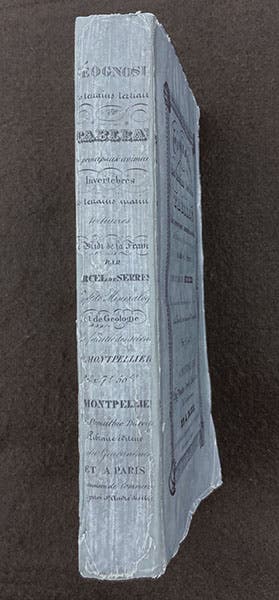
Paper spine, lithographed, Géognosie des terrains tertiaries, by Marcel de Serres, 1829 (The Linda Hall)
Serres wrote many books, geology textbooks mostly. We have only three, and two of those are not in very good shape. But the third is in excellent condition, and it is the main reason we are writing a post on Serres, to show you why physical, three-dimensional books are desirable as historic objects and are worth seeking out. The book is called Géognosie des terrains tertiaires (“geognosy” was a 19th-century word for theory-free geology) and it was printed in 1829 in Montpellier. If your mind's-eye rare book is bound in leather, that is an appropriate mental image, but that is not how a book came from the printer or appeared in a bookshop in 1829. Instead, a newly printed book looked like this (first four images), with the pages sewn together and a piece of paper glued on to form the covers and the spine. Sometimes the coves were blank, although perhaps in color; sometimes a paper label was attached; often the covers and spine were printed. For the Geognosie, the covers were lithographed, printed from a stone. Lithography as a printing technique was only 30 years old, but it was taking the print world by storm, and it was perfect for a decorative paper book cover, since you could print text, decoration, and images all at once, and cheaply. If you chose to bind your book in leather, the paper covers were removed or covered by endpapers and lost. Our Geognosie retains its original state

Uncut edges of book block, Géognosie des terrains tertiaries, by Marcel de Serres, 1829 (The Linda Hall)
There is one feature of the original book that has been modified in our copy. A book with its original paper cover typically has ragged, untrimmed pages, and four of every eight pages will be inaccessible, as folds at the top need to be slit or cut. If the book was bound, the entire block of pages was cut close to the edge, which at once trimmed the ragged edges and allowed all the pages to be opened. In the parlance of a librarian, a book whose pages have not been trimmed is "uncut;" a book that still has pages sealed by folds is "unopened." Our copy of Serres' Geognosie is uncut but opened, slit by hand, fold by fold. You can see the marks of the knife if you look closely.

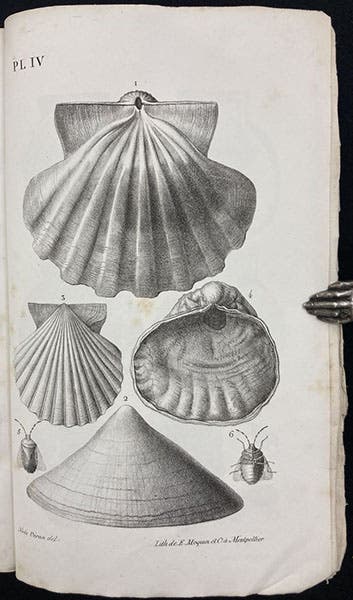
Tertiary fossil shells and insects, Géognosie des terrains tertiaries, by Marcel de Serres, plate 4 at end, 1829 (The Linda Hall)
We like books like this. They feel old and authentic. There is something appealing even in the imperfections, such as the scuffing of the decorative whelk on the back cover. We don't have a lot of books that are 200 years old and still have their paper covers. But is always a pleasure to pull them (carefully!) from the shelf.

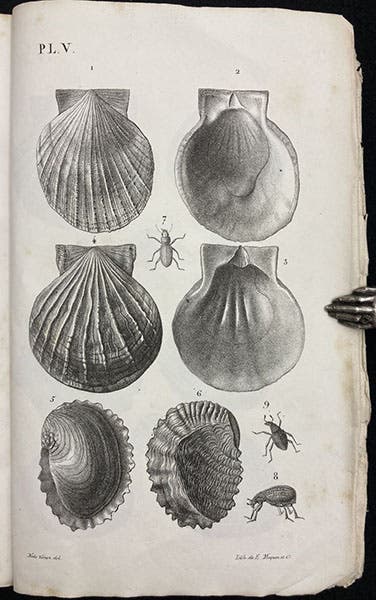
Tertiary fossil shells and weevils, Géognosie des terrains tertiaries, by Marcel de Serres, 1829 (The Linda Hall)
Lithography was not only suitable for paper book covers, but it was also ideal for printing illustrations of fossils. Serres' Geognosie has six lithographed plates of fossils at the end. We show you two of them (fifth and sixth images), as a kind of coda; we are not going to comment on them, except to point out that these are the only prints of fossils I have seen from this period that contain insects.
Serres lived to be 81, dying on July 22, 1862. I do not know if he was aware at the time of his death that his ideas on human antiquity had just been vindicated.
William B. Ashworth, Jr., Consultant for the History of Science, Linda Hall Library and Associate Professor emeritus, Department of History, University of Missouri-Kansas City. Comments or corrections are welcome; please direct to ashworthw@umkc.edu.