Scientist of the Day - Kamal el-Mallakh

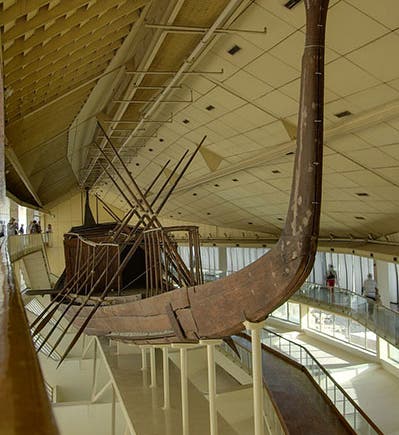
Khufu’s solar boat, on display in the old Giza Boat Museum, view of prow, photograph, 2009 (Wikimedia commons)
Kamal el-Mallakh, an Egyptian archaeologist, died Oct. 29, 1987, at the age of 69. He was a man of many vocations later in life, working as a newspaper editor, art critic, and film critic, but in his youth, he was an archaeologist. Armed with a degree in that field from Cairo University, he began working for the Antiquities Department in 1936. His "beat" was Giza, the site of the three large pyramids and the Sphinx, starting in 1936, and he became very familiar with the site. In 1950, he noticed some limestone slabs buried flush with the surface right next to the largest of the pyramids, that of Khufu (Cheops). Many other archaeologists and visitors must have trod upon them over the years and assumed they were part of the foundation of the pyramid. But el-Mallakh had noticed that some of the other pyramids up the Nile had pits alongside that once held funerary boats, although the boats had long since disappeared. He wondered if the limestone slabs might cover a boat pit or pits.

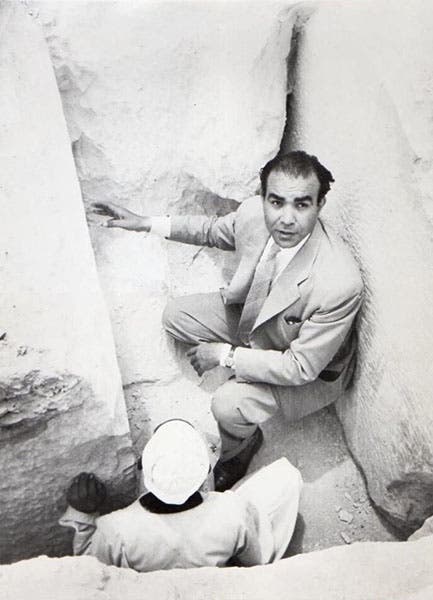
Portrait of Kamal el-Mallakh, photograph, undated (ebay.com)
El-Mallakh lobbied his superiors for permission to investigate, but permission was slow in coming – digging a hole right next to the only surviving Wonder of the Ancient World was serious business. But in 1954, el-Mallakh had his permits, and he slowly began to dig his way down between two of the slabs that had shifted enough to accommodate a human body. These slabs were enormous, many feet thick, weighing dozens of tons each. Eventually he squeezed through, and hanging by his feet, peering at a suspended mirror, he discovered that it was indeed a boat pit, and the boat was still there, although completely disassembled.

Disassembled ship of Khufu upon discovery, photographs, 1954 (Wikimedia commons)
Excavation now proceeded in earnest. The pieces of the boat were carefully arranged in layers – ropes and reed mats on top, then oars, decking, cabin, and planks. There were no instructions, but the reassemblers didn't really need them, although it must have been unsettling to discover that Khufu's ship was sewn together with thongs rather than fastened with rivets.

Excavated boat pit at the Great Pyramid of Khufu, which contained the solar boat (Wikimedia commons)
When assembly was finally complete, they had a boat 140 feet long, made entirely of cedar from Lebanon, which must have been very expensive. It was clearly a Nile River boat, powered by 8 long oars, with 2 steering oars at the stern, and no sails or keel. And it was by far the largest buried boat ever unearthed. It was also the oldest. Khufu ruled about 2600 BCE, so his boat is about 4600 years old. The famous Gokstad Viking ship on display in Oslo is about 1200 years old

Old Solar Boat Museum, next to the Great Pyramid at Giza, where Khufu’s Solar Boat was originally displayed, now dismantled (Wikimedia commons)
No one knows what funerary ships were for. They may have been actually used to carry the bodies of pharaohs from Memphis to Giza. And it is thought they were retained to provide transport in the afterlife, perhaps to accompany the Sun god Ra on his daily journey. Why this ship was disassembled is anyone's guess.

Cabin of Khufu’s solar boat, on display in former Giza Boat Museum (Wikimedia commons)
A special museum was built right at Giza to display Khufu's solar barque, as it is often called, and most of our photos show the ship there. It opened in 1982. In 2021, the ship was moved to the Grand Egyptian Museum, also at Giza, which finally opened in 2025.

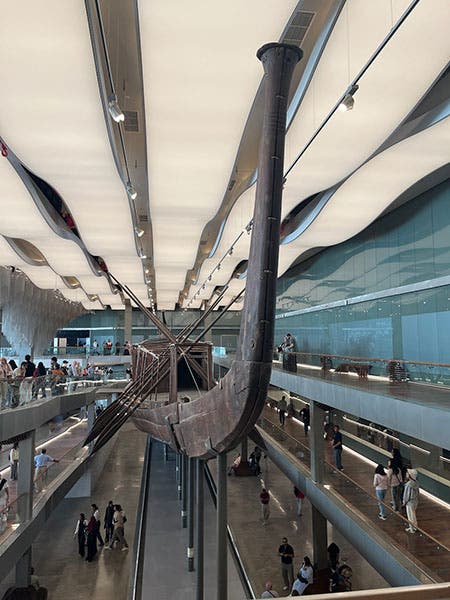
Khufu’s solar boat on display in the Solar Boat Wing of the Grand Egyptian Museum, Giza, photograph, 2025 (Sylvia Atalla)
When el-Mallakh began his original excavation in 1954, it was quickly noticed that there was a second boat pit right alongside the first. It was wisely decided to leave that one undisturbed for the time being, although a remote camera was inserted in the 1980s to confirm that a ship was there. I understand that the second ship has been or is now being excavated and reassembled, and that a display space for it has already been built into the new Giza museum.

View of Khufu’s solar boat from the stern, Grand Egyptian Museum, Giza, photograph, 2026 (Wikimedia commons)
Kamal el-Mallakh is not nearly as well known as he should be for discovering the oldest wooden ship ever found. When Howard Carter, discoverer of King Tut's tomb, died in 1939, he got a multicolumn front-page obituary in the New York Times, even though he was British. El-Mallakh, in 1987, got two column-inches, on page 33. But then, there is his ship at Giza, and it is hard to find a better monument than that.
Thanks to Karl Galle, Copernican scholar and former Cairo resident, for info about the old and new Giza museums, and to his wife Sylvia for a photograph of the solar boat in its new location.
William B. Ashworth, Jr., Consultant for the History of Science, Linda Hall Library and Associate Professor emeritus, Department of History, University of Missouri-Kansas City. Comments or corrections are welcome; please direct to ashworthw@umkc.edu.