Scientist of the Day - Penny Magazine

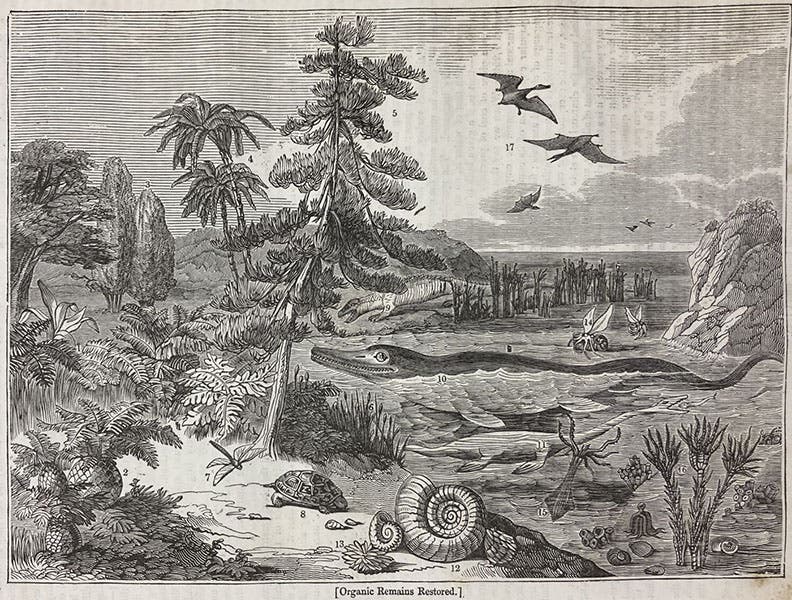
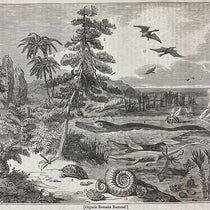
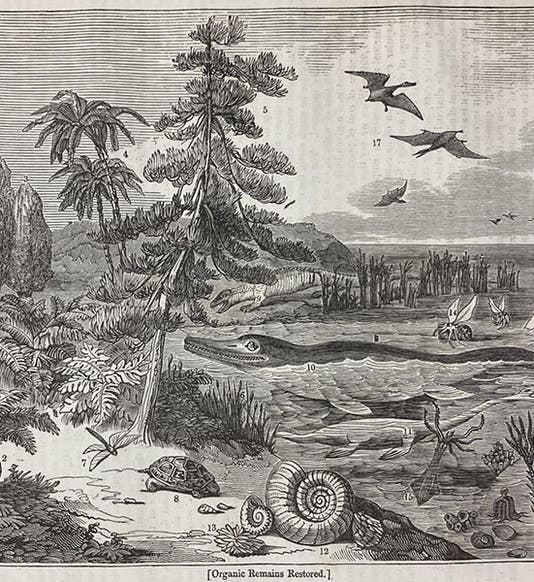
“Organic Remains Restored,” cover woodcut, The Penny Magazine, vol. 2, no. 100, p. 408, Oct. 26, 1833 (The Linda Hall)
On Oct. 26, 1833, The Penny Magazine, published in London, printed issue no. 100. The magazine had been founded just 18 months earlier, in the spring of 1832, by the Society for the Diffusion of Useful Knowledge. The editor was Charles Knight, who also wrote most of the articles. Each weekly issue of 16 pages contained a number of short essays, illustrated with woodcuts, on a variety of topics, quite a few scientific. You can see some examples from volume 1 in a post we wrote on Knight a few years ago.

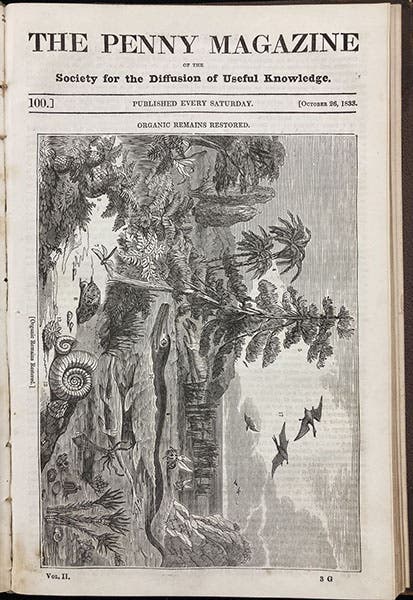
Entire front cover, The Penny Magazine, vol. 2, no. 100, p. 408, Oct. 26, 1833 (The Linda Hall)
The illustration on the cover of issue 100 was different. It was nearly full page, for one thing. And it depicted a prehistoric scene, which in 1833 was highly unusual. In fact, there had been only two images like it in England before this one, both printed in 1830, and both by the same geologist/artist, Henry de La Beche. The first, titled Duria antiquior (a more ancient Dorset) depicted a primeval waterscape populated by ichthyosaurs and plesiosaurs. It was printed as a lithograph, colored, and sold to colleagues to benefit Mary Anning, who discovered the first ichthyosaurs and plesiosaurs, and who had come on hard times. You can see it below, on the cover of Martin Rudwick's book, explained below (last image), or in this post on De la Beche.

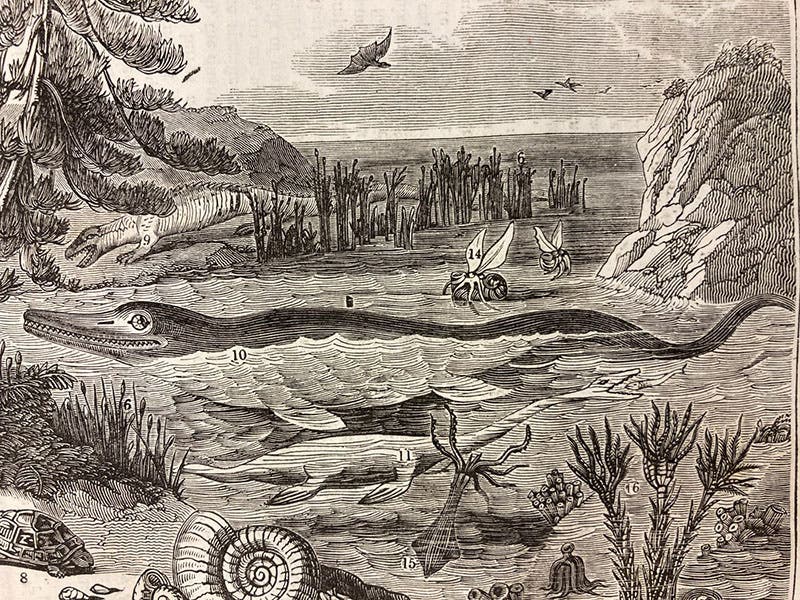
Megalosaurus (9), Ichthyosaurus (10) and Plesiosaurus (11), detail of woodcut, The Penny Magazine, vol. 2, no. 100, p. 408, Oct. 26, 1833 (The Linda Hall)
The second, a cartoon called "Awful Changes," requires some explanation, but not today, because we recently acquired a print of "Awful Changes" and we will discuss it in a future post, perhaps on the next birthday of De la Beche. In the mean time, you can see a version in the post on De la Beche.

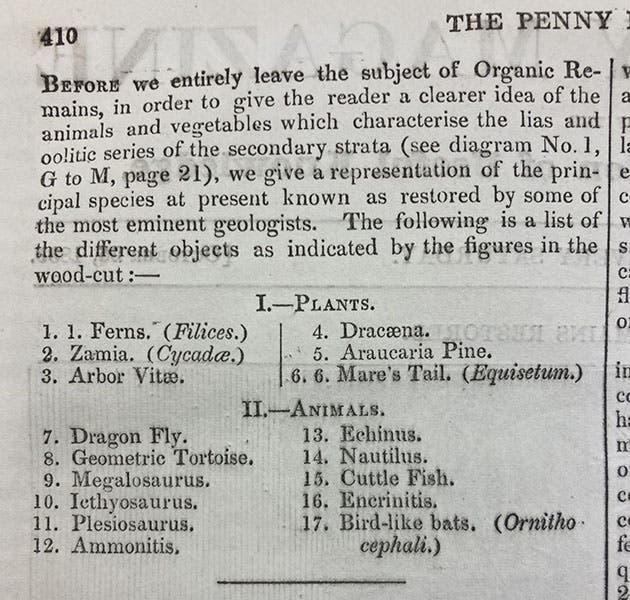
Identification key for cover woodcut, The Penny Magazine, vol. 2, no. 100, p. 409, Oct. 26, 1833 (The Linda Hall)
Neither of De la Beche's prints changed anyone's ideas about prehistory, because they were not circulated and hardly anyone saw them. The woodcut in Penny Magazine was different, for 100,000 people bought it and probably a half-million people saw it and were confronted with the claim, perhaps for the first time, that prehistoric life was different from life today, in every way.

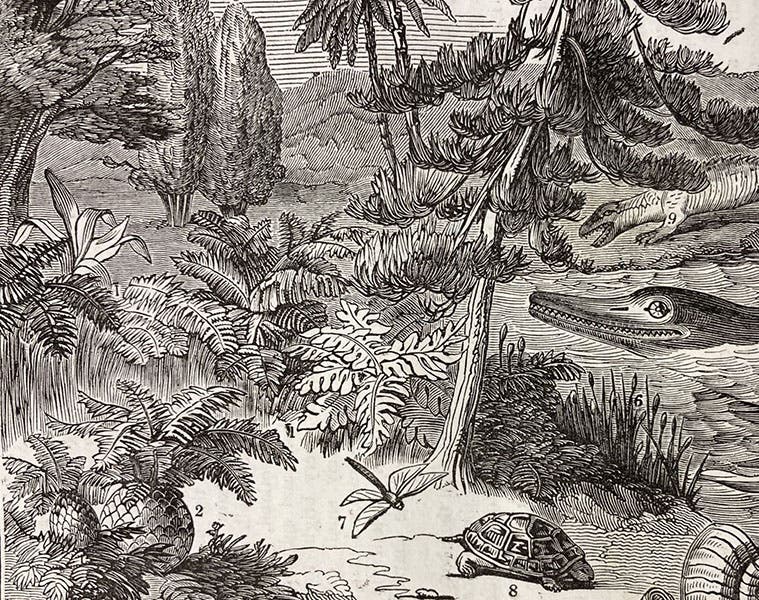
Cycads (2), Mare’s tail (6), dragonfly (7), detail of woodcut, The Penny Magazine, vol. 2, no. 100, p. 408, Oct. 26, 1833 (The Linda Hall)
One of the nice things about owning the original issue of Oct. 26, 1833 is that we can blow it up without losing resolution and walk around in this primordial swamp. Most of the plants and creatures were numbered, with the numbers explained in a key on the next page (fourth image), so in the details we provide, you can find the Megalosaurus (9), Ichthyosaurus (10), and Plesiosaurus (11), as well as some Cycads (2), Ammonites (12), and Pterosaurs (17).

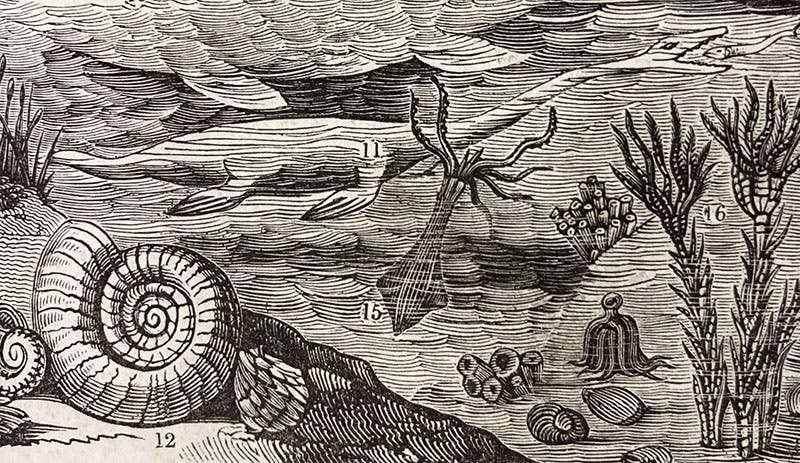
Ammonite (12), cuttlefish (15), encrinites (16), detail of woodcut, The Penny Magazine, vol. 2, no. 100, p. 408, Oct. 26, 1833 (The Linda Hall)
The front-page woodcut has a title – "Organic Remains Restored" – but no credited author or artist. Since it is followed by an article on geology, the latest in a series by John Phillips, it is assumed Phillips was responsible for the Penny Magazine tableau, and since he was part of De la Beche's circle, he was probably inspired by Duria antiquior. Whether he took any satisfaction from the fact that many more people saw his crude woodcut than either of De la Beche's more artful lithographs, we will never know. Phillips was only 32 when Penny Magazine first appeared, and just 47 when it went belly-up. He published some important geological maps and discovered several dinosaurs. We have 12 books by Phillips in our collections. I leafed through them all at one time, and never found a mention of "Organic Remains Restored." We have written one post on John Phillips and his work in the 1860s.

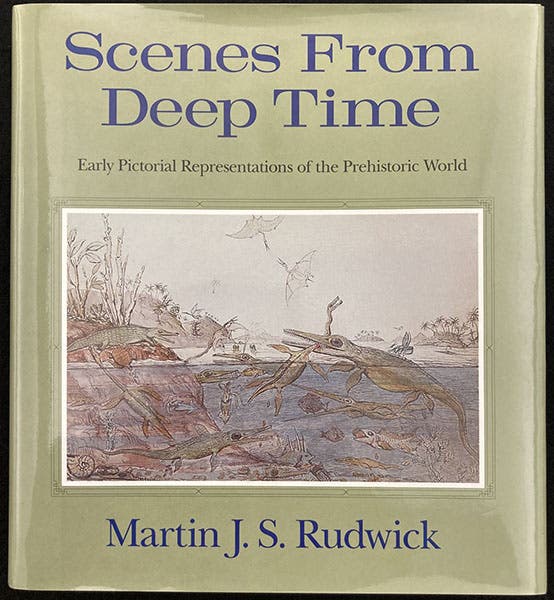
Dust jacket, showing the watercolor, Duria antiquior (1830) , by Henry De la Beche, Scenes from Deep Time, by Martin J.S. Rudwick, Univ. of Chicago Press, 1992 (author’s copy)
Martin J.S. Rudwick, my favorite historian of geology, discussed the first illustrations of prehistoric landscapes in a book called Scenes from Deep Time (1992). If you are interested in the topic, his book should be your first stop, and perhaps your last. It has scores of illustrations like the two we have discussed here, and a narrative that ties them all together. The dust jacket (seventh image) shows the original watercolor by De la Beche from which the lithographs of Duria antiquior were made. It is in the National Museum of Wales.
William B. Ashworth, Jr., Consultant for the History of Science, Linda Hall Library and Associate Professor emeritus, Department of History, University of Missouri-Kansas City. Comments or corrections are welcome; please direct to ashworthw@umkc.edu.