Scientist of the Day - George Beadle

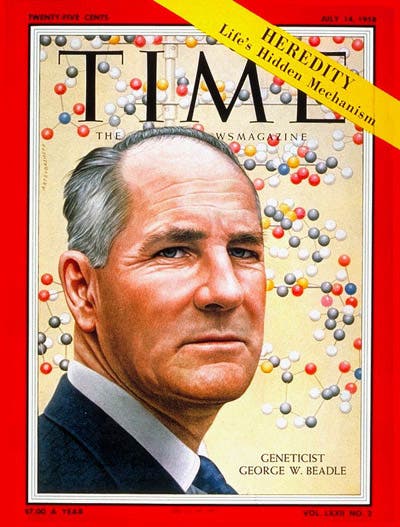
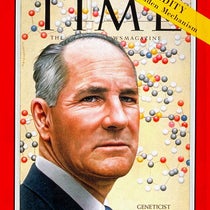
George Beadle, on the cover of Time Magazine, July 14, 1958, just before he was awarded a share of the Nobel Prize in Medicine/Physiology for 1958 (content.time.com)
George Wells Beadle, an American geneticist, was born on Oct. 22, 1903, in Wahoo, Nebraska. His father was a farmer and George was intended to do likewise, but after a high school teacher recognized Beadle's scientific aptitude and interest, he enrolled at the University of Nebraska, where he developed an interest in plant genetics. After picking up BS and MS degrees in Lincoln, he was off to Cornell, where he earned his PhD in 1931, working on corn hybridization.
Beadle then spent a long post-doc at Caltech in Pasadena, where he encountered Theodosius Dobzhansky, noted geneticist and evolutionary biologist, and one of the authors of the Darwinian Synthesis, which married Darwinian natural selection to Mendelian genetics. Presumably, it was Dobzhansky who awakened in Beadle an interest in Drosophila melanogaster, the fruit fly, which mutates easily when irradiated, and whose mutations can be tracked from generation to generation. If you want to understand how genes affect development – which no one knew anything about in 1935 – fruit flies seemed to provide the perfect avenue for experimentation. Beadle went to Paris for 6 months to collaborate with a Drosophila expert in bombarding fruit flies with X-rays. They focused on mutations that changed eye-color, and their work seemed to suggest that several genes might be involved for just that one trait, but with fruit flies, it was just too complicated to figure out.

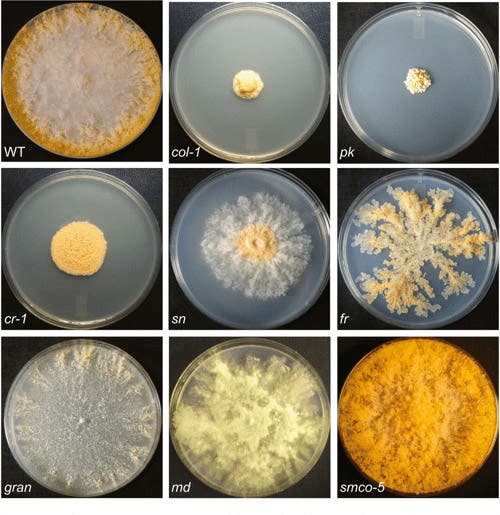
Mutated strains of Neurospora (bread mold), failing to thrive on their media, with wild unmutated bread mold at upper left. This is from a modern (2014) paper on Neurospora, not from any work of Beadle and Tatum, and is used here just to show what effect mutation has on Neurospora growth (semanticscholar.org)
Beadle came back to the U.S., and in 1936, he took a position at Stanford, where he teamed up with another geneticist, Edward Tatum. They decided to find a simpler organism than Drosophila on which to experiment and perhaps find out what a gene actually does. Remember, in 1936, no one knew that DNA was the stuff of the gene, much less how it was arranged in space. Beadle chose to experiment on Neurospora, or bread mold. Neurospora can be cultured on a variety of media, from which nutrients can be added or withheld. Beadle and Tatum planned to irradiate Neurospora and see how the resulting mutations affected its ability to grow on different media. They found that when a mutation would not grow on a bare-bones medium, nearly always the addition of a single nutrient would allow the culture to thrive. It was almost as if a mutation disabled one metabolic pathway. Examining hundreds of such mutations, they found no exceptions. Changing a gene disrupted its ability to produce a necessary enzyme, which is just a protein that catalyzes a particular reaction. And each gene controlled a different enzyme, usually in a specific order, which they could reconstruct. A colleague would later call it the "one gene-one enzyme" theory, a label that has stuck.

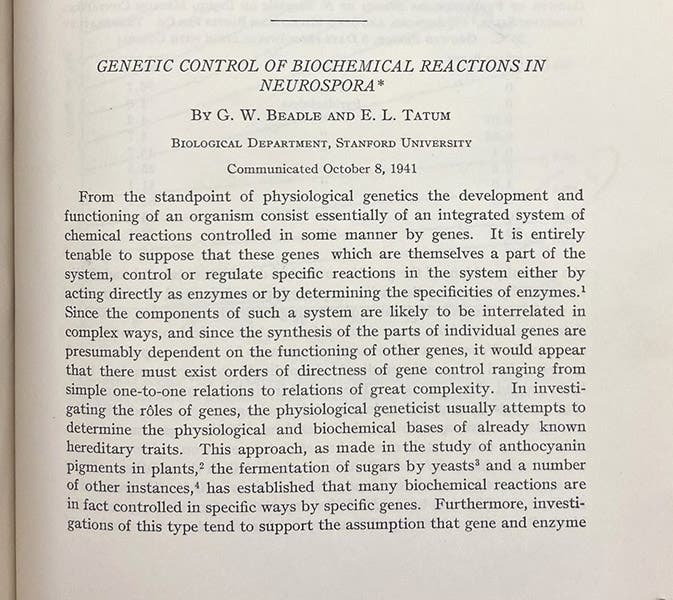
First paragraph, "Genetic control of biochemical reactions in Neurospora,” by George Beadle and Edward Tatum, Proceedings of the National Academy of Sciences, vol 27(11), p. 499, 1941 (The Linda Hall)
Beadle and Tatum announced their results at various meetings and in a paper in 1941 in the Proceedings of the National Academy of Sciences. It was sensational. No one yet knew what a gene was. But now they knew what a gene did: it made a protein. The DNA revolution was on. For their discovery, Beadle and Tatum were awarded a share of the 1958 Nobel Prize in Physiology/Medicine.
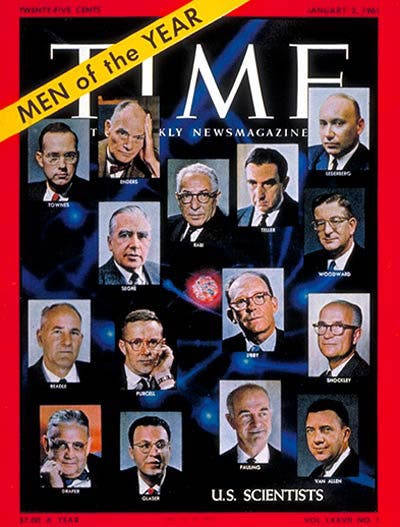
Cover of Time Magazine for Jan. 2, 1961, featuring 15 notable American scientists; George Beadle is at the left of the third row from the top. Four future Nobelists are missing – see text (content.time.com)
Beadle appeared twice on the cover of Time Magazine, once by himself, in 1958, just before he won the Nobel Prize (first image), and once on a curious cover that featured 15 notable American scientists; Beadle is at the left of the third row (third image). Missing were James Watson, Richard Feynman, Luis Alvarez, and Hans Bethe, each of whom was at the height of his career in 1961 and would win Nobel prizes before the decade was out. Hindsight is a wonderful thing; prognostication is still a work in progress.
Beadle later became President of the University of Chicago. He passed away on June 9, 1989, at the age of 85.
William B. Ashworth, Jr., Consultant for the History of Science, Linda Hall Library and Associate Professor emeritus, Department of History, University of Missouri-Kansas City. Comments or corrections are welcome; please direct to ashworthw@umkc.edu.