Scientist of the Day - Ignazio Danti

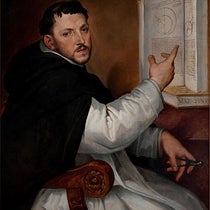
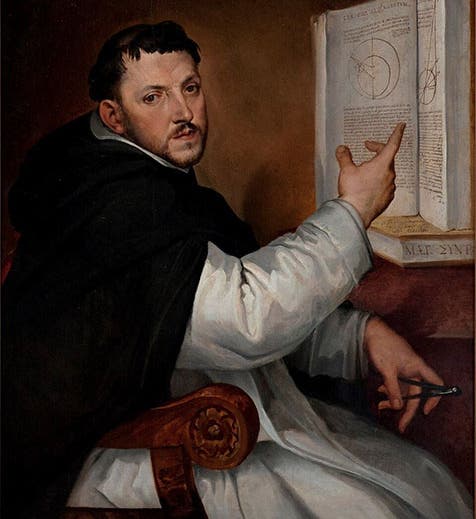
Portrait of Ignazio Danti, in Dominican garb, by Bartolomeo Passarotti, before 1586, Musée des beaux-arts de Brest (Wikimedia commons)
Ignazio Danti, an Italian mathematician, cartographer, and cleric, died in Rome on Oct. 19, 1586, at the age of 50. He had been born in Perugia in 1536, into a family with considerable artistic talent, his older brother in particular achieving fame as a sculptor. In 1555, Danti entered the Dominican order; unlike his near contemporary Giordano Bruno, he would remain a Dominican until his death.

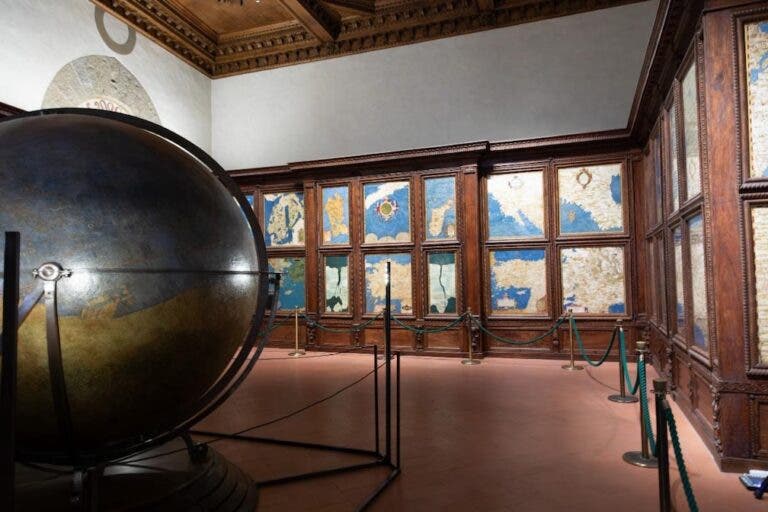
The Guardaroba in the Palazzo Vecchio in Florence, with maps and globe (originally) by Ignazio Danti, 1563-74, recent photo (Wikimedia commons)
Danti was well trained in mathematics, instrument-making, and cartography, and in 1562, he was transferred to the convent of San Marco in Florence, perhaps at the request of the Grand Duke, Cosimo I, whose service he entered. One of the Duke's first projects was the construction of a series of maps and a large globe in the Palazzo Vecchio in Florence. Danti was apparently in charge. The room was called the Guardaroba and it is still there, recently restored. The impressive globe in the center has been rebuilt several times, and apparently no traces of Danti's original globe survive. But the maps continue to impress tourists.

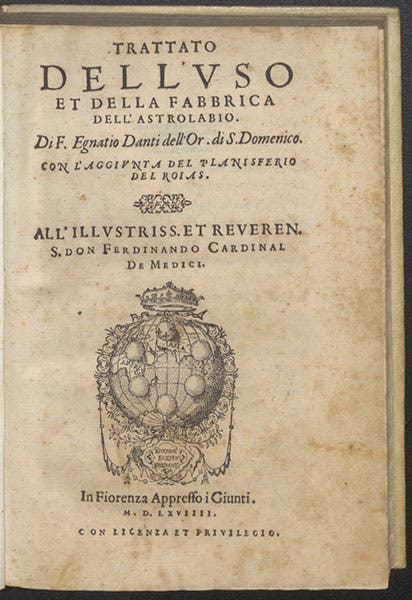
Title page, Trattato dell'uso et della fabbrica dell'astrolabio, by Ignazio Danti, 1569 (The Linda Hall)
In 1569, Danti began publishing scientific works, first a book on astrolabes (1569), and then a commentary on the optics of Euclid (1573), both of which we have in our history of science collections, the former in two editions (1569 and 1578).

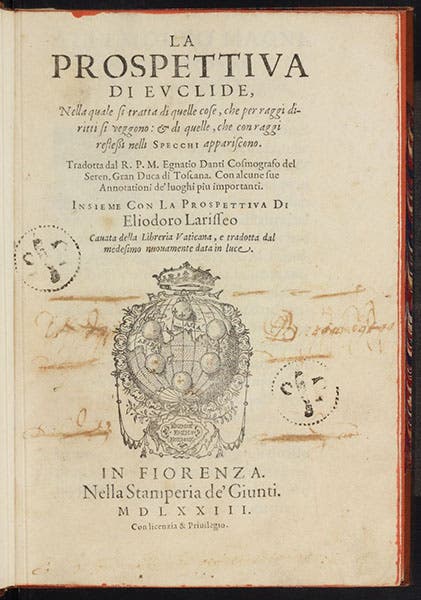
Title page, La prospettiva di Evclide, transl. and ed. by Ignazio Danti, 1573 (The Linda Hall)
While in Florence, Danti attempted to install a meridian in the church of Santa Maria Novella, consisting of an aperture near the rose window, which admitted a beam of light from the Sun, the annual path of which would then be traced on the floor. But he never finished, for when Cosimo died in 1574, he was succeeded by his son Francesco, who in 1575 exiled Ignazio, his former tutor, from Florence, for reasons unknown.

The Gallery of Maps in the Cortile del Belvedere, Vatican, engraving, 1765 (Wikimedia commons)
Danti then went to Bologna, where he taught math at the university, and started building a meridian in the basilica there (later completed by G. D. Cassini - see our post on this famous meridian). But Danti was then called to Rome, where he entered the service of Pope Gregory XIII, first as a consultant on calendar reform, and then as principal cartographer for the Gallery of Maps that the Pope commissioned for the Cortile del Belvedere near the Vatican. The maps, which line the walls, are enormous, and eye catching, and still attract hordes of tourists. It is known that Ignazio designed them, and it is thought that his older brother Vincenzo executed them. The maps of Florence and Venice, which are in fact bird’s-eye views, are especially striking (last image).

Map of Italy, fresco, design by Ignazio Danti, Galleria delle carte geografiche, 1580-82, Cortile del Belvedere, Vatican, photograph (Wikimedia commons)
Danti was rewarded with a bishopric in 1583, but he would serve for only three years, before his death from pneumonia in 1586.

Bird’s-eye view of Venice, fresco, design by Ignazio Danti, Galleria delle carte geografiche, 1580-82, Cortile del Belvedere, Vatican, photograph (Wikimedia commons)
Considering that the Dominicans are a mendicant order, I have always been impressed by the number of them who pop up in the history of science, beginning with Thomas Aquinas and Albertus Magnus and extending down to Danti and Tommaso Campanella (and the lapsed Giordano Bruno). You can read a little more about Dominicans and science in our post on St. Dominic.
William B. Ashworth, Jr., Consultant for the History of Science, Linda Hall Library and Associate Professor emeritus, Department of History, University of Missouri-Kansas City. Comments or corrections are welcome; please direct to ashworthw@umkc.edu.