Scientist of the Day - Cassini-Huygens spacecraft

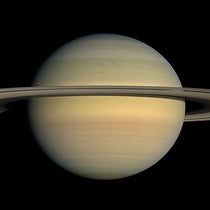
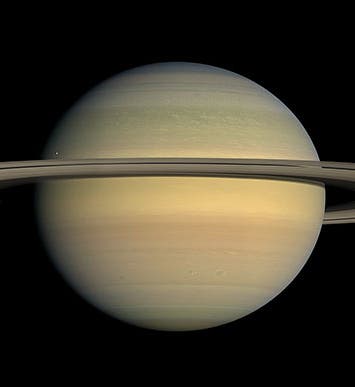
Saturn nearing equinox, with ring and 5 moons, as viewed from the Cassini spacecraft, July 23, 2008, NASA (Wikimedia commons)
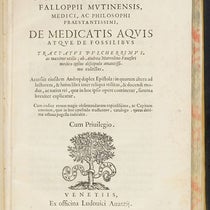
The Cassini-Huygens space probe was launched by NASA on Oct. 15, 1997, bound for Saturn. The probe was named after two of the early pioneers in the study of Saturn. Christiaan Huygens, a Dutch physical scientist, had solved the secret of Saturn's mysterious "ears" and "handles" by proposing that Saturn has a tilted ring, whose changing position relative to Earth causes Saturn's varying appearance. More pertinent for this NASA mission, Huygens had discovered Saturn's largest moon, Titan. Both of these discoveries were made in 1656 and announced in 1659 in his Systema Saturnium, which we have in our History of Science Collection.

The Cassini-Huygens spacecraft being loaded onto its launch vehicle adapter at Jet Propulsion Lab, July 22, 1997; Huygens is the bronze saucer shape at bottom left of Cassini (Wikimedia commons)
Giovanni Domenico Cassini was an Italian astronomer who moved to France in 1668 to become King Louis XIV's royal astronomer. In 1675, Cassini discovered that Saturn's ring is actually two rings, an inner and an outer, separated by a dark region now known as the Cassini division. Cassini also discovered four more moons of Saturn, all of them quite a bit smaller than Titan, and thus more difficult to spot and identify. So it would be hard to find two more appropriate astronomers to honor with a spacecraft than Cassini and Huygens, especially for a probe bound for Saturn.

Two views of Saturn’s outer and irregular moon, Phoebe, as Cassini flew by on June 11, 2004, never to return, NASA (Wikimedia commons)
Cassini-Huygens, the spacecraft, was not just one vehicle with a hyphenated name. There were actually two vehicles involved. Cassini was the larger, the intended orbiter. Huygens was a lander, carried by Cassini from Earth before it could embark on its own mission. In a photograph of the assembly room (second image), where Cassini-Huygens was being put together before launch, Huygens is the small golden half-saucer at the left, looking like a folded-up asparagus steamer behind its heat shield.

Mosaic of photos of Iapetus, taken by Cassini on Dec. 31, 2004; a large section of Iapetus is much darker than the rest, and there is a ridge that runs around most of the equator, NASA (Wikimedia commons)
Cassini-Huygens reached Saturn in July of 2004, almost 7 years after launch, and six months later, the Huygens lander separated from its mother craft and travelled to Titan, where it landed via parachute on Jan. 14, 2005.

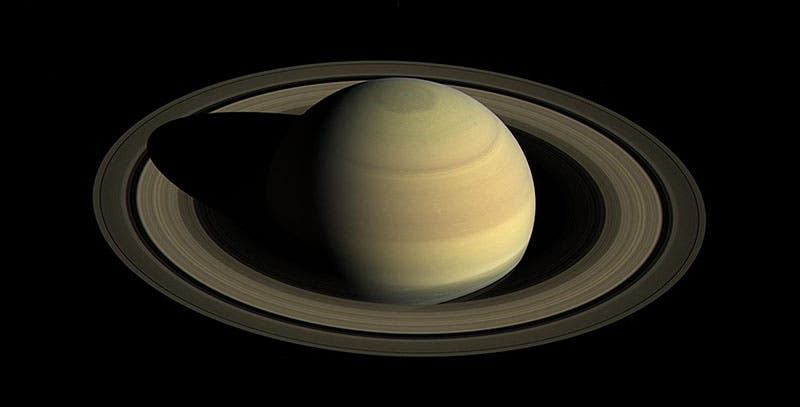
Saturn as seen by Cassini in 2016, NASA (science.nasa.gov)
The mission was hyphenated in another important way – it was a joint project among NASA, the European Space Agency (ESA), and the Italian Space Agency (ASI). ESA built the Huygens lander, with the aid of many European countries, ASI built the large antenna for Cassini (at the top in the photo), and NASA supervised the design and construction of the Cassini orbiter.

The Huygens probe, a replica displayed by the French manufacturer in Paris in 2005 (Wikimedia commons)
The Cassini-Huygens mission was successful by every measure. Much valuable data was gathered, and lots of wonderful photos were taken, just a few of which we include here. But instead of linking to other striking photos, I thought I would send you to a wonderful 3-minute video, where NASA takes you on a trip down to the surface of Titan, using images taken by both Cassini and Huygens, which results in a zoom of about a billion to one. It is sensational, and NASA has put it up on YouTube, where it still remains some 11 years later. You won’t take many journeys like this one.

High-solution image of the surface of Titan, created in 2009 from images taken by Huygens, Jan. 14, 2005 (Wikimedia commons)
The Cassini mission ended on Sep. 15, 2017, when Cassini was deliberately plunged into Saturn’s outer atmosphere and destroyed. This was done, it was said, to prevent Cassini, after control was lost, from accidentally crashing into any of the moons and contaminating them wih microbial mementos from Earth.
William B. Ashworth, Jr., Consultant for the History of Science, Linda Hall Library and Associate Professor emeritus, Department of History, University of Missouri-Kansas City. Comments or corrections are welcome; please direct to ashworthw@umkc.edu.