Scientist of the Day - Clemens Winkler

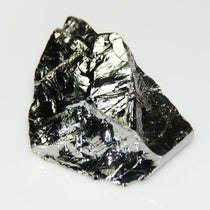
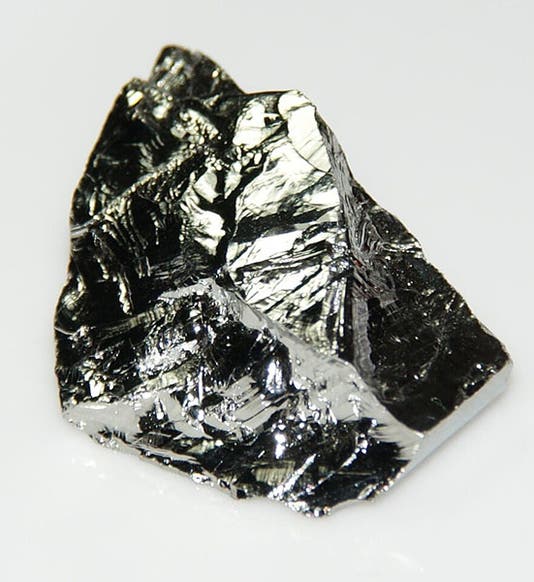
The metal germanium, the 32nd element, atomic weight 72.63, discovered by Clemens Winkler in 1886 (Wikimedia commons)
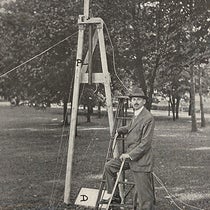
Clemens Winkler, a German chemist, died on Oct. 8, 1904, in Dresden, at the age of 65. Winkler was born in 1838 in Freiberg in what was then Saxony, now eastern Germany. Freiberg was an old mining town in the Erzgebirge, or Ore-Bearing Mountains of Saxony, and also the home of the mining school that Abraham Werner made world-famous. Winkler's father, also a chemist, studied with the great J. J. Berzelius in Stockholm, and Winkler became a skillful analytic chemist himself and a professor at the Freiberg School of Mines.

Portrait of Clemens Winkler, photograph, 1900 (Wikimedia commons)
Winkler was the third and last of what one might call the "eka”-chemists. When Dmitrii Mendeleev published his first periodic table in 1869, and again in 1871, he arranged most of the known elements on a grid in the order of their atomic weights, in such a way that elements in the same column had similar properties, so that lithium and potassium were in the same column, as were fluorine and chlorine, and magnesium and zinc (third image). But there were three "holes" in his first tables, places where elements with certain atomic weights and physical characteristics would fit nicely, but were not known to exist. So confident was Mendeleev in his periodic table that he indicated their presence with questions marks or dashes, and he tentatively named them after known elements that shared the same column. So just below boron was an empty space for an element like boron but heavier, with an atomic weight of 44 or so: Mendeleev referred to it as eka-boron. Similarly, there was a place for eka-aluminum and eka-silicon. You can see their places marked in a detail from Mendeleev’s 1871 table (third image).

![Detail of Mendeleev’s periodic table of 1871, with boron (B), aluminum (Al), and silicon (Si) at the top of columns 3 and 4, and with three empty dashes below them, at weights 44, 68, and 72, [Journal of the Russian Physical-Chemical Society], vol. 3, p. 31, 1871 (The Linda Hall)](https://preview-assets-us-01.kc-usercontent.com:443/9dd25524-761a-000d-d79f-86a5086d4774/8fc88aeb-fa49-4966-9a15-c5a4dfa41a4e/winkler3.jpg?w=800&h=537&auto=format&q=75&fit=crop)
Detail of Mendeleev’s periodic table of 1871, with boron (B), aluminum (Al), and silicon (Si) at the top of columns 3 and 4, and with three empty dashes below them, at weights 44, 68, and 72, [Journal of the Russian Physical-Chemical Society], vol. 3, p. 31, 1871 (The Linda Hall)
So it was a big deal when Paul Émile Lecoq de Boisbaudran in 1875 discovered a new element with the properties of aluminum but a weight of 69, very close to Mendeleev’s predicted weight for eka-aluminum. De Boisbaudran called it gallium, after his native country. It was the first confirmation of the predictive capability of Mendeleev's table. When he republished his table in his chemistry textbook of 1877, Mendeleev included gallium (Ga) where the question mark for eka-aluminum used to be (fourth image).

![Detail of periodic able of 1877, with 68 Ga marking the newly discovered gallium, replacing eka-aluminum; eka-boron (? 44), and eka-silicon (72 ?) were still unknown; [Principles of Chemistry] in Russian, by Dmitrii Mendeleev, 1877 (The Linda Hall)](https://preview-assets-us-01.kc-usercontent.com:443/9dd25524-761a-000d-d79f-86a5086d4774/88e400ca-2276-4146-a005-28df4e33aae0/winkler4.jpg?w=776&h=600&auto=format&q=75&fit=crop)
Detail of periodic able of 1877, with 68 Ga marking the newly discovered gallium, replacing eka-aluminum; eka-boron (? 44), and eka-silicon (72 ?) were still unknown; [Principles of Chemistry] in Russian, by Dmitrii Mendeleev, 1877 (The Linda Hall)
The second eka-element to be discovered was eka-boron, found by Lars Nilsson in Sweden in 1879. It had an atomic weight of 44, just what Mendeleev had predicted. Nilsson called it scandium, after his native country. We told that part of the story in a post on Nilsson.
.JPG#/media/File:Argyrodite_(Alice_Chodura).JPG)
A sample of the ore Argyrodite from the Erzgebirge (Ore Mountains) of Freiberg, in which Clemens Winkler discovered a new element, germanium, in 1886 (Wikimedia commons)
Winkler had the toughest task of all. In 1885, he was handed a sample of a new ore discovered at a mine near Freiberg (fifth image). Preliminary analysis indicated that it contained silver, sulfur, and mercury. Winkler confirmed the presence of those elements, but they comprised only 93% of the total mass, so something else must be present. He had great difficulty getting the unknown element to precipitate – it took him four months – but he finally managed to do so. He called it, after his country, germanium. He wasn't sure of its atomic weight at first, but he published his results on Feb. 26, 1886, and others, such as Lothar Meyer, thought the missing eka-silicon had emerged at last. Subsequent analysis by Winkler confirmed this hunch, especially the determined atomic weight of 72.3, very near Mendeleev's prediction of 72 for eka-silicon.

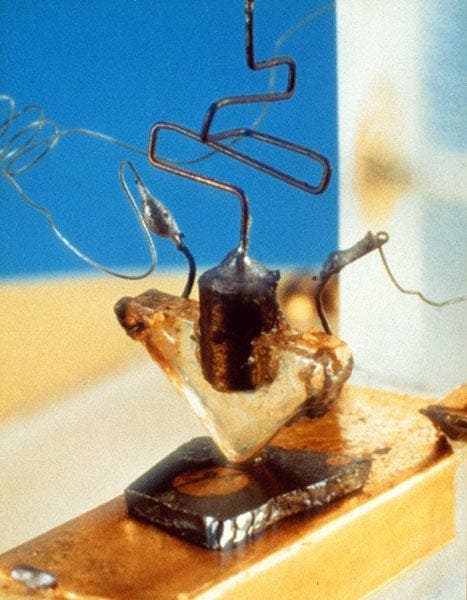
The first transistor of 1947; the silver-gray slab on the bottom is pure germanium, the element discovered by Clemens Winkler in 1886 (Computer History Museum)
The discoveries of three new elements, with properties nearly identical to those predicted by Mendeleev, played a huge role in the acceptance of Mendeleev's periodic table. Winkler had the most difficult task of all, and was successful where most chemists would have given up. Germanium would just hang around the lab for 60 years, but when the time came to find semi-conductors for the first transistors, there it was. In the famous photo of the first transistor (see our post, and also here, last image), that slab of silver-gray on the bottom is germanium.
William B. Ashworth, Jr., Consultant for the History of Science, Linda Hall Library and Associate Professor emeritus, Department of History, University of Missouri-Kansas City. Comments or corrections are welcome; please direct to ashworthw@umkc.edu.