Scientist of the Day - Peter Medawar

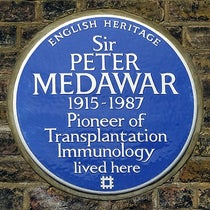
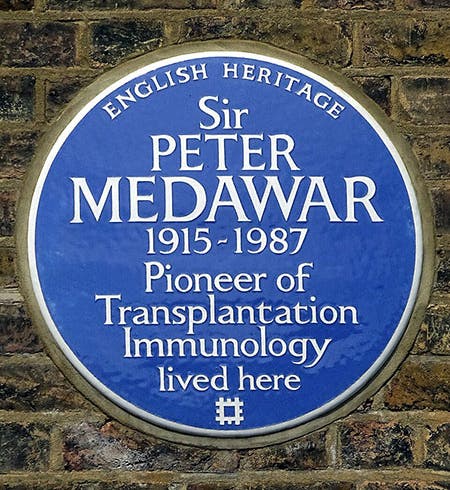
Blue Plaque honoring Peter Medawar, 25 Downshire Hill, Hampstead, London Borough of Camden (Wikimedia commons)
Peter Brian Medawar, a biologist and writer, died on Oct. 2, 1987, at the age of 72, in London. He had been born in Brazil in 1915, the offspring of a Lebanese father and an English mother. He returned to England to study, survived his public-school education, with the help of an able biology teacher, and made it to Magdalene College, Oxford, where he was able to study with John Zachary Young, better known as JZ, who no doubt planted the sceptical and philosophical seeds that flourished during Medawar's later intellectual development.

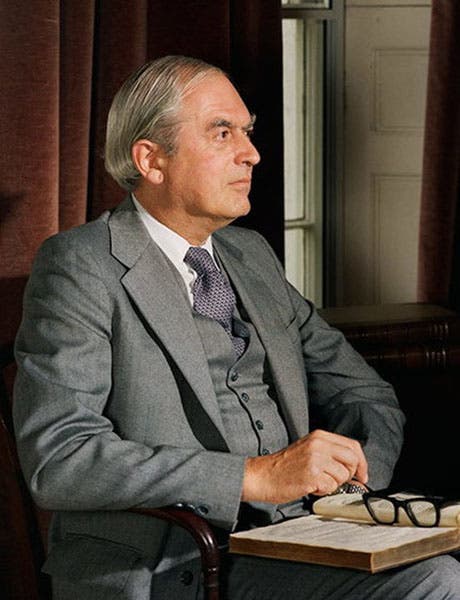
Portrait of Peter Medawar, on the occasion of his Nobel Prize, 1960 (nobelprize.org)
Medawar did his doctoral research at Oxford under Howard Florey, who would soon be wooing the Americans into making penicillin on a large scale, and who would turn Medawar toward immunology. Medawar taught at Birmingham, and then at University College, London. It was at Birmingham that he discovered that tissues could be "taught" not to reject foreign tissue, what was soon called "acquired immunological tolerance," which led directly to the possibility of successful organ transplant surgery. For this discovery, Medawar would share the Noble prize in Medicine/Physiology in 1960, a pretty good trick for someone who was neither a physician nor a physiologist.

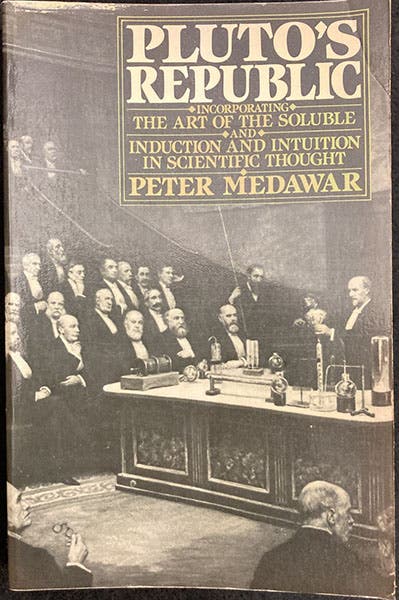
Front cover, Pluto’s Republic, by Peter Medawar, paperback edition of 1984 (author’s copy)
In the 1960s, Medawar took on important administrative roles, such as directing the Medical Research Council and similar agencies. During this period, he took to writing for the general public, in the form of book reviews, essays , addresses, and book-format collections of such occasional writings. And this was the Medawar I came to know and appreciate. I have five of his books on my shelves, but the one I would single out to recommend to others is called Pluto's Republic, published in 1982. It is quite a mish-mash of a book, incorporating two earlier books and some unpublished essays, and with a new title, using his expression for the world inhabited by pseudo-scientists, writers and theologians trying to be scientists, psychoanalysts, and any others who can't tell Plato from Pluto. I only have a paperback copy, which is odd for me (third image), but if you can find a copy at your local library, go through it and read just the book reviews. They are so wonderfully insightful, as well as occasionally devastating. Sometimes he reviews books he likes, such as D’Arcy Thompson's On Growth and Form. But the real treasures are the reviews that tear authors to shreds. Teilhard du Chardin's The Phenomenon of Man (1955) had millions of fervid acolytes by the time Medawar got to it. He jumped right in: " the greater part of it, I shall show, is nonsense, tricked out with a variety of metaphysical conceits, and its author can be excused of dishonesty only on the grounds that before deceiving others, he has taken great pains to deceive himself." The hammer keeps falling: "Teilhard is for ever shouting at us: things are, in alphabetical order, astounding, colossal, endless, enormous, fantastic [the list goes on for a paragraph]." Medawar ridiculed all the meaningless neologisms Teilhard foisted upon us, such as noosphere, and radial energy. And he reproves the public for believing that a man who is unintelligible must be profound.
Medawar also had little use and respect for Arthur Koestler's The Act of Creation (1964; Koestler's response is included), and in other reviews he took aim at defenders of IQ, and at psychoanalysts, especially those that attempted to cure physical diseases by psychiatric means. In all cases, he was trying to show the public what scientists really do, and why they do it that way, and how a misunderstanding of the aims and methods of science leads to fundamentally erroneous pseudo-philosophies, such as those of Koestler and Teilhard.
I was surprised that Medawar liked James Watson's Double-Helix (1968), when so many of his colleagues panned it as a caricature of what biologists do. Medawar noted that Watson was honest, if naive, and completely outward-looking, and what is wrong with honesty without introspection? Besides, he made the greatest discovery of the 20th century, so he deserves a little slack.
Medawar had a stroke in 1969, which left him both physically and mentally impaired to some degree, so most of his books of the 1980s were prepared with the help of his wife Jean, whose name (or rather initials, J.S.) appear on a few of the titles.
The field of biology has produced some excellent essayists on science, such as Lewis Thomas, David Quammen, Stephen Jay Gould, and Loren Eiseley. If you have such a shelf (I do, although, thanks to Gould, it requires two shelves), then Peter Medawar belongs on it.
William B. Ashworth, Jr., Consultant for the History of Science, Linda Hall Library and Associate Professor emeritus, Department of History, University of Missouri-Kansas City. Comments or corrections are welcome; please direct to ashworthw@umkc.edu.