Scientist of the Day - Edwin Landseer

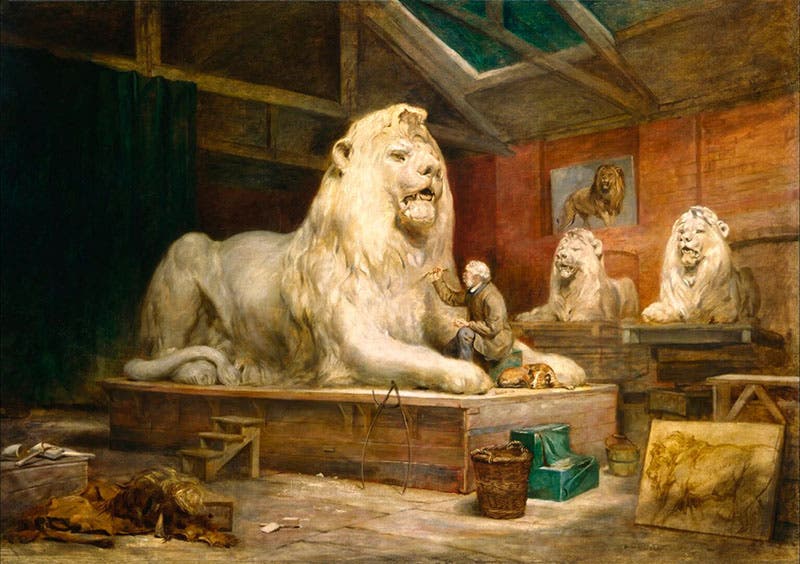
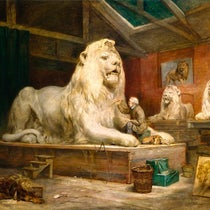
Sir Edwin Landseer, showing Landseer at work on one of his colossal lion sculptures, by John Ballantyne, oil on canvas, ca 1865, National Portrait Gallery, London (npg.org.uk)
Edwin Henry Landseer, a painter, sculptor, and animalier, died on Oct. 1, 1873, in London, at the age of 71. The son of an etcher, he was a child prodigy as an artist, and was already submitting paintings to the Royal Academy of Arts in London in his early teens. The Academy had its own school system and Landseer was educated almost entirely within it. It certainly worked in his case, as he became one of the most popular of Victorian painters, and was a special favorite of Queen Victoria and Prince Albert.

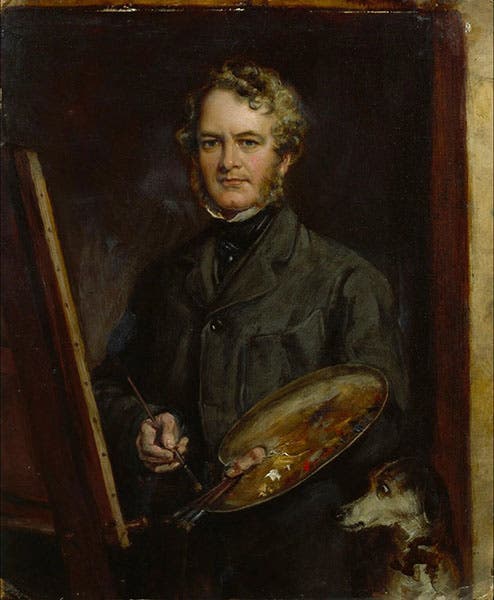
Portrait of Edwin Landseer, by Sir Francis Grant, oil on board, ca 1852, National Portrait Gallery, London (npg.org.uk)
Landseer liked to paint animals, especially dogs, horses, and deer, making him an animalier, which is one of the reasons why we include him in our Scientists of the Day series. His most familiar painting is probably The Monarch of the Glen, supposedly inspired by a trip to the Scottish Highlands in the 1820s, but not painted until 1851 (second image). For people who like majestic animals, this is just the ticket. It is now in the National Galleries of Scotland.

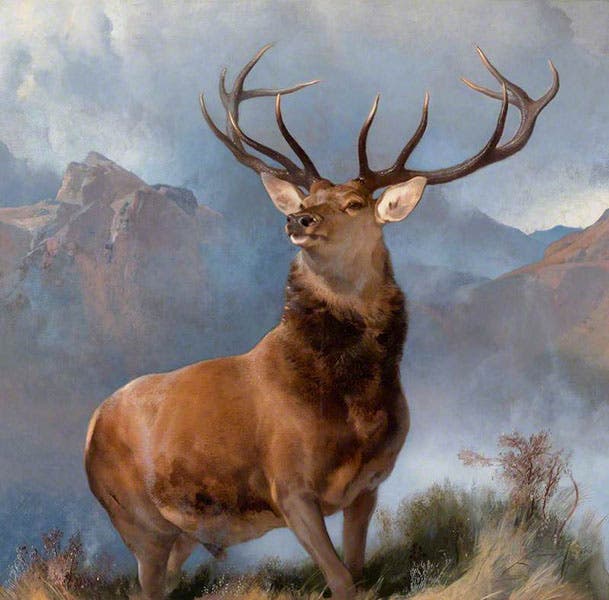
Monarch of the Glen, by Edwin Landseer, oil on canvas, 1851, National Galleries of Scotland (artuk.org)
Landseer, like most dog-lovers, was partial to scenes of dogs saving humans. One of the dogs often depicted in these visual dramas is a black-and-white Newfoundland, as in the somewhat maudlin Saved of 1856 (which you can see at this link, if you must). Here we show the more noble Distinguished Member of the Humane Society (1838, Tate Britain, fourth image). This breed almost disappeared in favor of the all-black Newfoundland, but it was reconstituted in the early 20th century and is now called a Landseer.

A Distinguished Member of the Humane Society, by Edwin Landseer, oil on canvas, 1838, Tate Britain (Wikimedia commons)
Landseer's most widely viewed work of art is undoubtedly the set of four bronze lions on Trafalgar Square, facing the four winds and protecting Lord Nelson atop his column. Landseer received the commission in 1858, and it was an odd award, since Landseer had never sculpted anything before, and never would again. It took him nine years, working in a borrowed London studio, where he was captured en flagrante in a marvelous painting by John Ballantyne (1865, National Portrait Gallery, first image). The sculptures were unveiled in January of 1867 and have been popular since Day One. They are quite convincing as sentinels, and inviting as foothills to be climbed.

Two of the Landseer lions in Trafalgar Square, London, recent photograph (Wikimedia commons)
We thought we would include one other Landseer composition that he painted while working on the lions; it is totally unlike his other cheery or sentimental animal paintings, although it does portray two polar bears. It is called Man Proposes, God Disposes, was exhibited in 1864, and is now in the Royal Holloway collection at the University of London. It supposedly depicts the final fate of the Franklin expedition of 1845 in search of a Northwest passage. The expedition had come back into the news in 1859, when evidence of the demise of Franklin and his crew was finally discovered (see our post on Francis McClintock). Landseer was then entering a bleak period, with mental health problems, and he apparently stewed over the death of Franklin for several years before producing this stark scene (last image). Lady Jane Franklin was invited to the preview at the Royal Academy in 1864, and, not surprisingly, declined to attend.

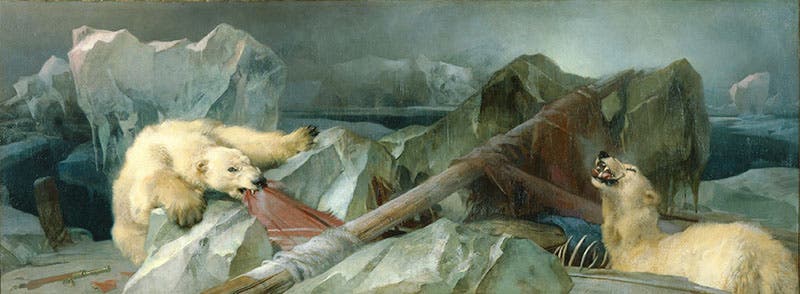
Man Proposes, God Disposes, by Edwin Landseer, oil on canvas, Royal Holloway Collection, University of London (royalholloway.ac.uk)
Landseer was in a decent mental state when his lions were unveiled in 1867, but he went downhill from there, and was declared insane in 1871. However, after his death in 1873, the final years were forgotten, his funeral drew thousands, and he has been honored as one of the great British artists ever since. He was buried at St. Paul’s Cathedral.
There are two versions of his portrait by Francis Grant in the National Portrait Gallery. The other one is usually shown. We like this one (second image).
William B. Ashworth, Jr., Consultant for the History of Science, Linda Hall Library and Associate Professor emeritus, Department of History, University of Missouri-Kansas City. Comments or corrections are welcome; please direct to ashworthw@umkc.edu.