Scientist of the Day - Edwin Colbert

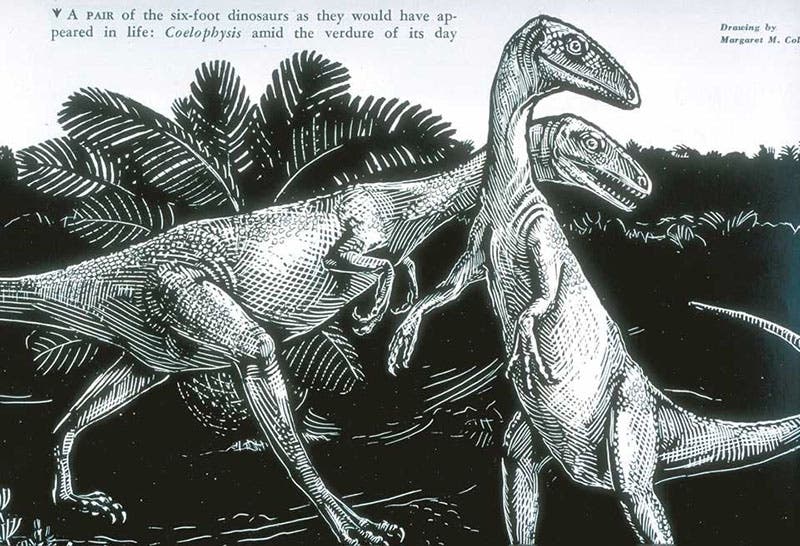
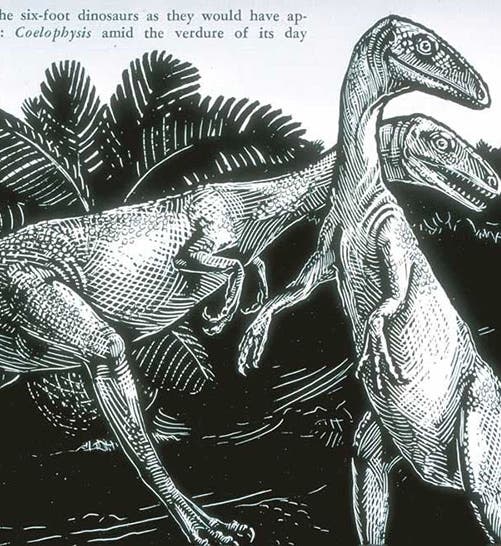
Pair of Coelophysis as they might have appeared in life, woodcut after drawing by Margaret Colbert, "Little Dinosaurs of Ghost Ranch," by Edwin H. Colbert, Natural History, vol. 56, p. 392, 1947 (Linda Hall Library)
Edwin H. Colbert, an American vertebrate paleontologist, was born Sep. 28, 1905, in Clarinda, Iowa. He grew up in Maryville, Missouri, and attended the University of Nebraska. He then departed the Midwest to study paleontology at Columbia University, where the eminent dinosaur expert Henry Fairfield Osborn was in the twilight of his career. Colbert received his PhD in 1935, and in that same year was awarded the Daniel Giraud Elliot medal by the National Academy of Sciences. This is a bit of a mystery to me, since Osborn himself only received the mdal in 1929, after a lifetime of work, and Richard Swann Lull in 1933. That must have been a heck of a thesis that Colbert submitted in 1935.

Portrait of Edwin Colbert, photograph, 1960s, American Museum of Natural History archives (Wikimedia commons)
Most of the paleontology faculty at Columbia, and some of the students, also had positions at the American Museum of Natural History, where Osborn, for example was Curator of Vertebrate Paleontology and then President, and Colbert followed Osborn’s lead, eventually succeeding him as Curator.

Two Coelophysis skeletons from Ghost Ranch, New Mexico, still embedded in their matrix, American Museum of Natural History (Wikimedia commons)
Colbert’s most notable fossil discovery came in 1947, when he and his team, working at Ghost Ranch, New Mexico, about 50 miles northwest of Santa Fe, uncovered a dense concentration of the fossilized bones of a small theropod dinosaur, Coelophysis. The initial find yielded about a dozen complete skeletons of a Triassic dinosaur that, until 1947, was little known. Over 1000 skeletons have since been recovered from Ghost
Ranch, making Coelophysis now one of the best-known of all dinosaurs (third image).

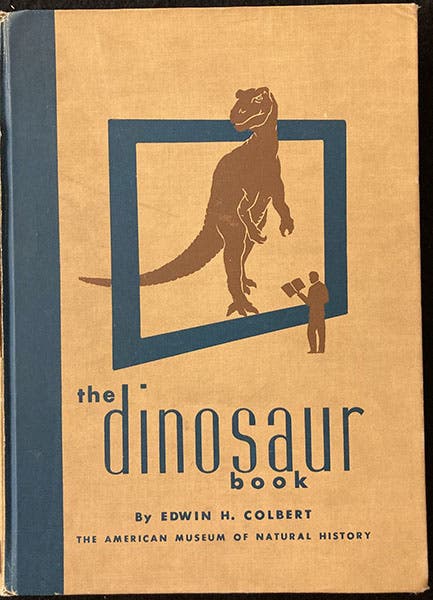
Printed front cover, The Dinosaur Book, by Edwin H. Colbert, 1945 (Linda Hall Library)
In addition to writing professional articles on Coelophysis, Colbert also published a popular article in Natural History magazine in 1947, called “Little dinosaurs of Ghost Ranch.” It was illustrated by his wife Margaret, who was an excellent paleo-artist, as her lively version of Coelophysis demonstrates (first image). Margaret was the daughter of the noted paleontologist, William Diller Matthew. Colbert would later write a biography about his father-in-law, the dust jacket of which we showed in our post on Matthew.

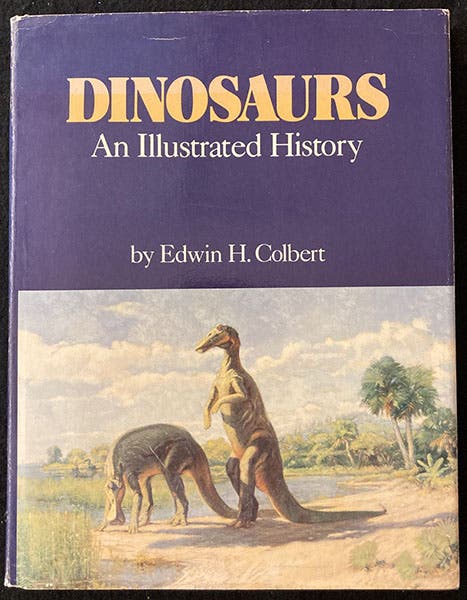
Dust jacket, Dinosaurs: An Illustrated History, by Edwin H. Colbert, 1983 (author’s copy)
Except for the sensational find at Ghost Ranch, a place that Georgia O’Keefe would make even more famous when she moved there in 1949, Colbert is best known as a writer of popular books on dinosaurs. Indeed, in the decades from 1940 to 1980, he was the best, and our library has a half-dozen of his books (fourth and fifth images). Most of them are no longer read, since dinosaur studies have come a long way in the past 60 years, but one of Colbert’s books is more valuable now than it was when published in 1968. It is called Men and Dinosaurs: The Search in Field and Laboratory (sixth image), and it is a history of dinosaur discovery from the time of Gideon Mantell and William Buckland to the 1960s, and it is just excellent. Unlike many other popularizers, Colbert was both a field man and a scholar, and he knew how to present a popular account backed up by just the right amount of scholarship so that the reader could follow up on any topic of interest. When we put together our exhibition, Paper Dinosaurs, 1824-1969 (1996), I relied on Colbert’s Men and Dinosaurs more than any other work to ferret out primary sources appropriate for display. There is a good reason why it is still in print (as a Dover paperback titled The Great Dinosaur Hunters and their Discoveries).

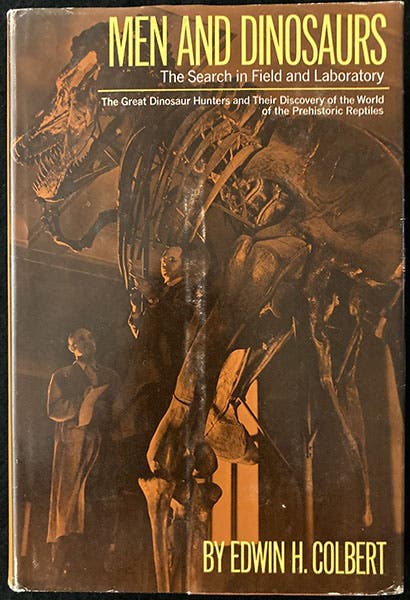
Dust jacket, Men and Dinosaurs: The Search in Field and Laboratory, by Edwin H. Colbert, 1968 (author’s copy)
In 1967, Colbert made further headlines when he led an expedition that found the first remains of a proto-dinosaur, Lystrosaurus, in Antarctica, which was viewed as further evidence for continental drift. After his (presumed required) retirement from the American Museum in New York at age 65, Colbert moved to Flagstaff and became Curator at the Museum of Northern Arizona. His autobiography, Digging into the Past was published in 1989 and is, not surprisingly, very readable, insightful, and honest. I especially enjoyed his descriptions of his contentious relationship with his boss, the bombastic Henry Fairfield Osborn, whom he refers to as HFO, and about whom he pulls few punches. Colbert continued to curate and write until his death on Nov. 5, 2001, at the age of 96.
William B. Ashworth, Jr., Consultant for the History of Science, Linda Hall Library and Associate Professor emeritus, Department of History, University of Missouri-Kansas City. Comments or corrections are welcome; please direct to ashworthw@umkc.edu.

![“And I do mean YOU,” drawing of an Anopheles mosquito, by Theodor Seuss Geisel, This is Ann, [by Theodor Seuss Geisel and Munro Leaf], p. 32, 1943 (The Linda Hall)](https://preview-assets-us-01.kc-usercontent.com:443/9dd25524-761a-000d-d79f-86a5086d4774/5aeabdb9-b9f5-40d6-8cf7-f7fff782da1d/seuss1.jpg?w=210&h=210&auto=format&fit=crop)