Scientist of the Day - Alfred Vail

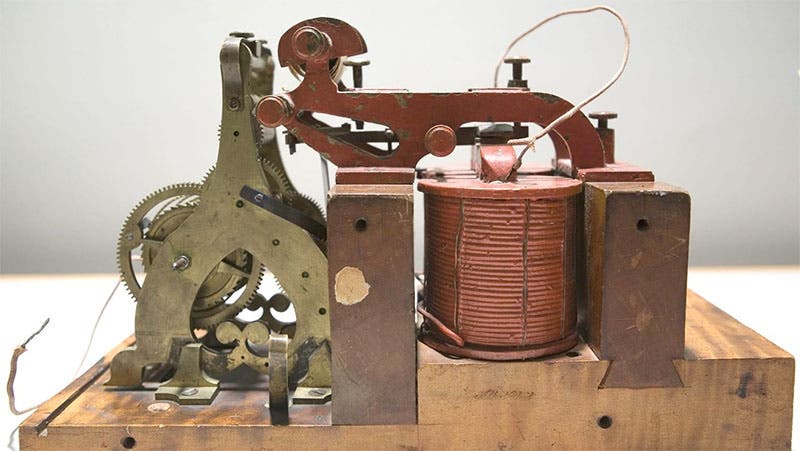
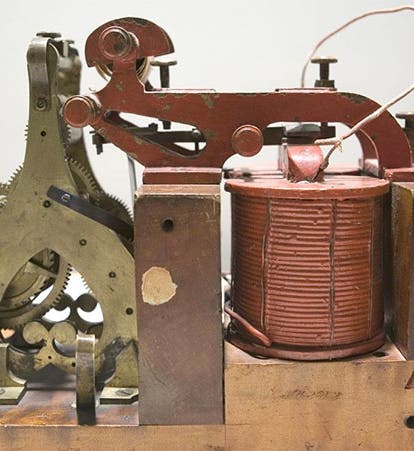
The original telegraph register, built by Alfred Vail, that received the first long-distance telegraph message in 1844, Cornell University (ithacajournal.com)
Alfred Vail, an American inventor and machinist, was born Sep. 25, 1807, in Morristown, New Jersey. His father was a manufacturer who established the Speedwell Iron Works, where Alfred grew up and trained as a machinist. He then went on to graduate from NYU in 1836, so he was now an educated machinist, and well able to understand the potential of Samuel F.B. Morse's primitive telegraph when he demonstrated it at NYU in 1837. Soon Morse and Vail had teamed up, with Vail as the engineer and lead technician, a fortunate union for Morse, who knew little about electromagnetism.

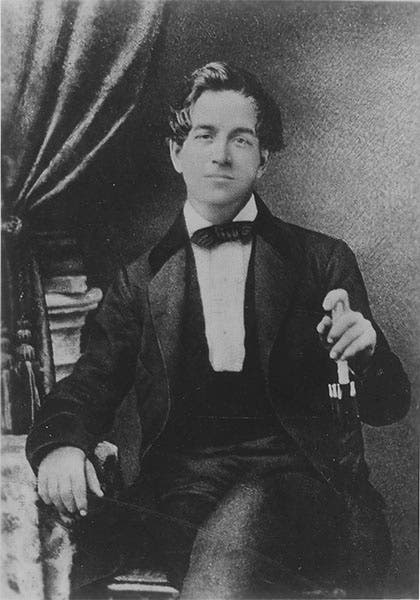
Portrait of Alfred Vail, photograph, National Museum of American History, Smithsonian Institution (americanhistory.si.edu)
Vail would design many of the key elements of the first successful telegraph system, including the transmission key and the register, which recorded the dots and dashes on a paper tape. Indeed, the first successful demonstration of Morse's telegraph was at Speedwell Iron Works in 1838. For his contributions, Vail received 1/4 of the patent rights income, which he split with his brother. This was later reduced to 1/8 share when Morse brought in a Congressional partner to seek financial support from the government, which he eventually obtained.

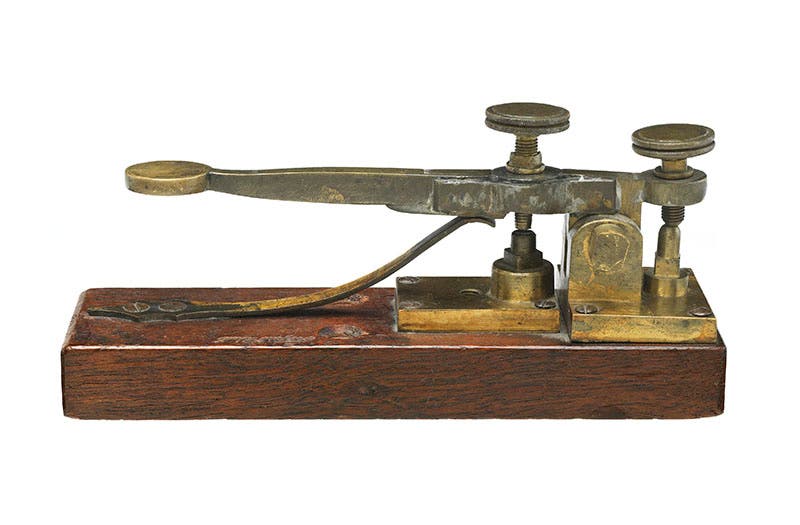
Transmitting key, invented and built by Alfred Vail, 1844, National Museum of American History, Smithsonian Institution (collections.si.edu)
The story of the development of the telegraph between 1838 and 1844 is a long and messy one, and not especially inspiring; we passed over most of it in our post on Morse, and we will do so here as well. Morse was beset on all sides by rivals and opponents of his patents, and even by his supposed allies, like the Congressman who was supposed to be helping him. Morse reacted by claiming more credit for successes than he was due, which usually meant ignoring in public the contributions of Vail. Vail did have his moment in the limelight on May 24, 1844, when he, in Baltimore, was on the receiving end of Morse's coded message, "What hath God wrought?", which travelled over 18 miles of wire from Washington, and which Vail then re-transmitted to Morse. The tape that recorded that first message is preserved in the Smithsonian Institution, and we showed a piece of it in our post on Morse. The Smithsonian also has an original sending key built by Vail (third image), and several of his registers. The original register that recorded the tape of May 24 ended up at Cornell (first image).

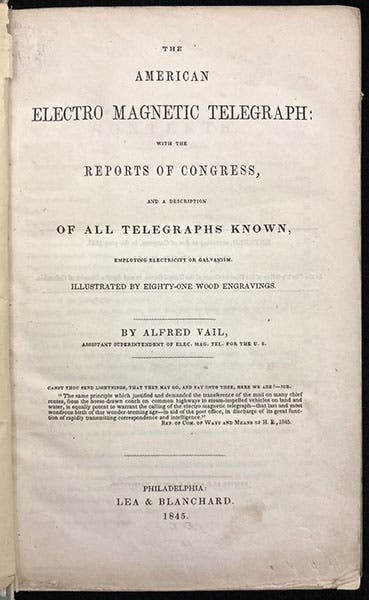
Title page, The American Electro Magnetic Telegraph, by Alfred Vail, 1845 (The Linda Hall)
But by this time, Vail had had enough of being ignored as a pioneer of telegraphy. He paused to write a book describing his own contributions, The American Electro Magnetic Telegraph (1845), which we have in our collections. It contains many wood engravings of his various inventions, including a fine full-page diagram of his register (fifth image). But no one seems to have revised their accounts of the invention of telegraphy because of it. One of the few people who read the book was Joseph Henry, who noticed immediately that he was nowhere mentioned, even though he invented the electromagnetic relay, and assuming that Morse had authorized Vail's book, turned against Morse and remained sour on the man for the rest of his life.

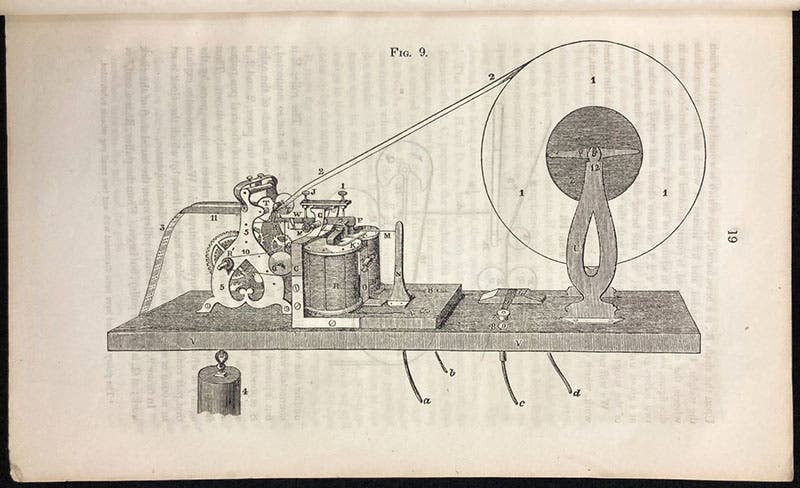
Register for recording Morse code messages on paper tape, invented and built by Alfred Vail, diagram in his The American Electro Magnetic Telegraph, p. 19, 1845 (The Linda Hall)
Since Morse's original transmission keys and receivers were so poorly thought out, and had to be improved by Vail, some have assumed that the same was true of the Morse code, which was a brilliant conception, because it could be sent over a single wire, and was a vast improvement over Morse's original numerical code, which required a huge code book to translate. So a few historians have claimed that Vail and not Morse invented the famous Morse code. But there is really no evidence for this, and Vail never claims to have done so, even in his book. So probably the Morse code is properly named.

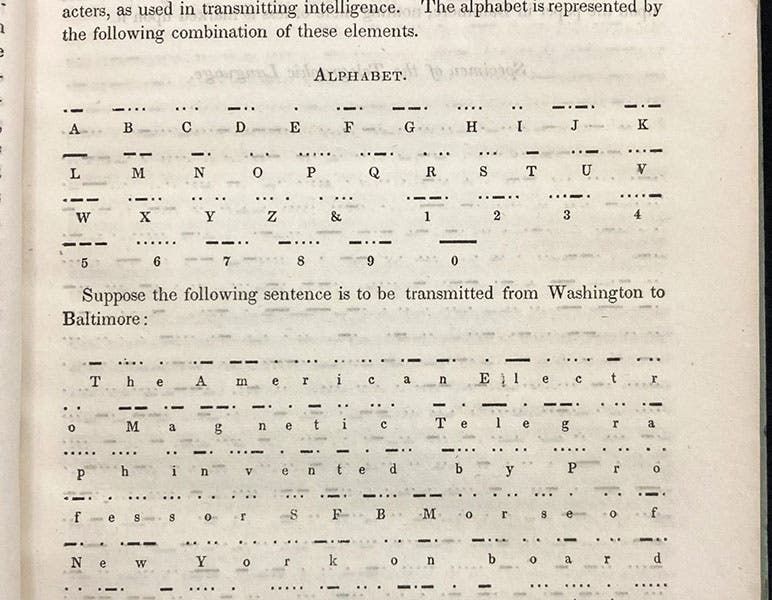
The Morse code alphabet, here called the telegraphic alphabet, and a sample dot-dash message, The American Electro Magnetic Telegraph, by Alfred Vail, p. 27, 1845 (The Linda Hall)
Interestingly, Vail reproduced the dot-dash code in his book. He didn’t call it Morse code, but neither did he call it Vail code. Instead, it was the telegraphic code. The message he used as a sample relates the story about Morse’s original brainstorm onboard ship in 1832 (sixth image).

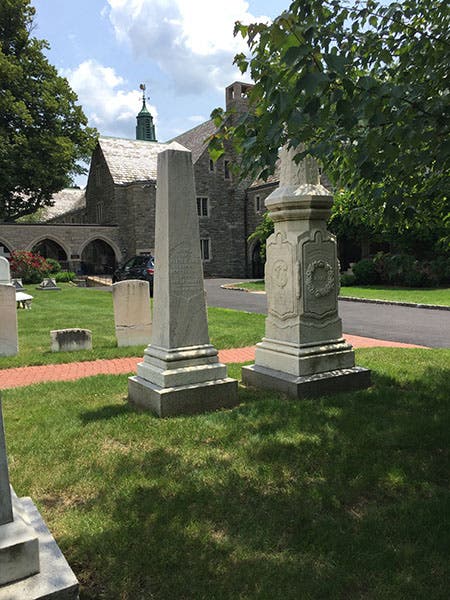
Memorial stone for Alfred Vail (on the left) at his grave in Saint Peter's Episcopal Churchyard, Morristown, New Jesey (findagrave.com)
After writing his book, Vail cut his ties with Morse and retired to Morristown and had nothing further to do with telegraphy. He worked on a family genealogy for the rest of his life. He died on Jan. 18, 1859, at the age of 51, and was buried in St. Peter's Episcopal Churchyard in Morristown. On his gravestone, which you cannot read here (but can here), there is a carved claim: “Inventor of the telegraphic dot and dash alphabet.” This was an assertion by Vail’s heirs, not Vail.
William B. Ashworth, Jr., Consultant for the History of Science, Linda Hall Library and Associate Professor emeritus, Department of History, University of Missouri-Kansas City. Comments or corrections are welcome; please direct to ashworthw@umkc.edu.