Scientist of the Day - Ibn al-Haytham

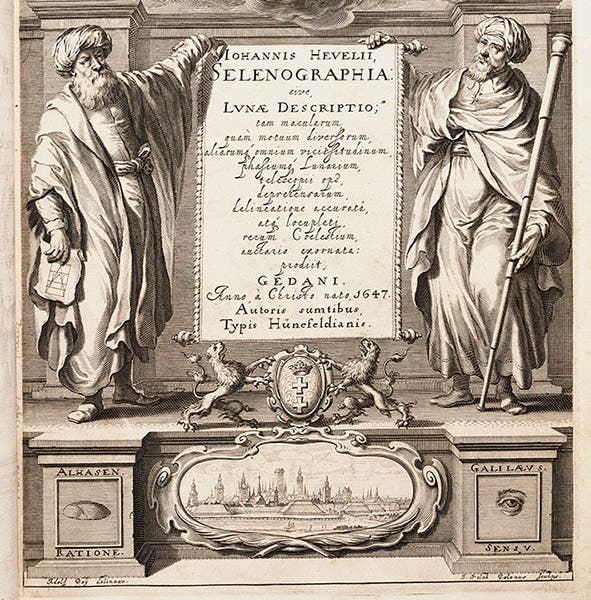
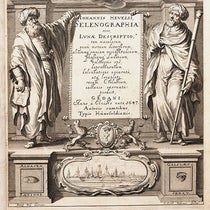
Ibn al-Haytham (left), representing Reason, and Galileo (right), representing Sense, detail of engraved title page, Selenographia, by Johannes Hevelius, 1647 (The Linda Hall)
Ibn al-Haytham, an Arabic mathematical scientist, was born in Basra about 965 CE and died in Cairo about 1040 CE. He was known as Alhazen or Alhacen in medieval and early modern times. Al-Haytham was a Muslim, so his work falls under the rubric of Islamic science, and he was probably the most adept and original of them all, which is saying a lot, since the Golden Age of Islamic Science includes the work of al-Khwarizmi, Avicenna, al-Tusi, Jabir Ibn Hayyan, and al-Birundi.

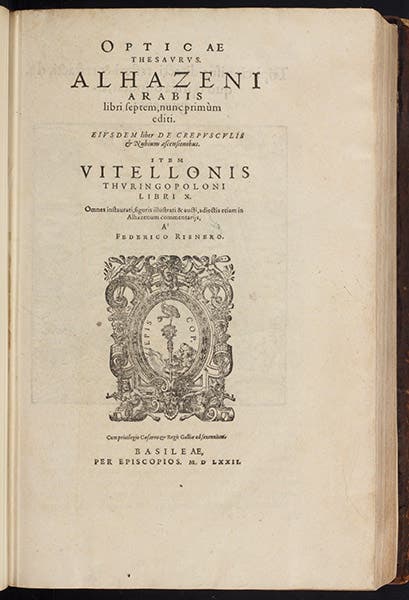
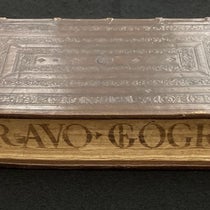
Title page,Thesaurus, by Ibn al-Haytham, 1572 (The Linda Hall)
Al-Haytham's most influential work was in optics. He wrote a treatise called Kitab al- Manazir (the Book of Optics), which has survived (in Latin only - the original didn't make it). Here al-Haytham tried to figure out how vision works. He concluded that light comes into the eye from outside (intromission theory), unlike most of his Greek predecessors, who thought that the eye emits rays which perceive objects at a distance (extromission theory). He thought the lens was the sensitive organ in vision (understanding the function of the retina came centuries later). Al-Haytham discovered the law of reflection in optics, and understood some of the basic principles of refraction, the bending of light by glass and water. He seems to have invented the camera obscura. Perhaps most importantly, he understood that the principles of optics had to be determined by experiment, not by theory.

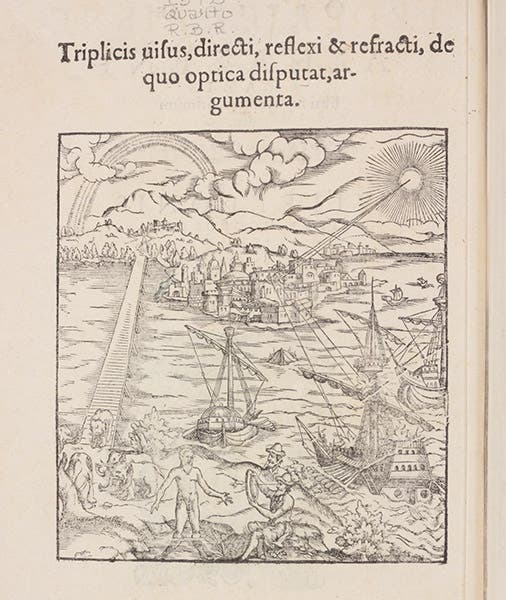
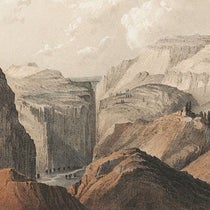
Detail of frontispiece, Opticae Thesaurus, by Ibn al-Haytham, 1572 (The Linda Hall)
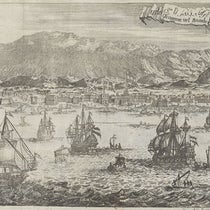
Al-Haytham’s first disciple in the West was Vitello, who wrote his own optical treatise following al-Haytham, followed in turn by Robert Grossetteste and Roger Bacon. Several centuries later, al-Haytham was embraced by Johannes Kepler. His work was known to Kepler because his book was published, in Latin translation, by Friedrich Risner in 1572, as Opticae Thesaurus. The same volume also contained Vitello's book, so Kepler had his most important predecessors right at hand, in one volume, when he wrote his own optics in 1611. The frontispiece, which in this case follows the title page, is indeed full of optical imagery (third image), but it is not particularly identifiable with al-Haytham. The elephant at left, backing across the bridge because the view is otherwise too terrifying, came straight out of Pliny’s Natural History. But the diagram of the eye a chapter later is specific to al-Haytham (fourth image).

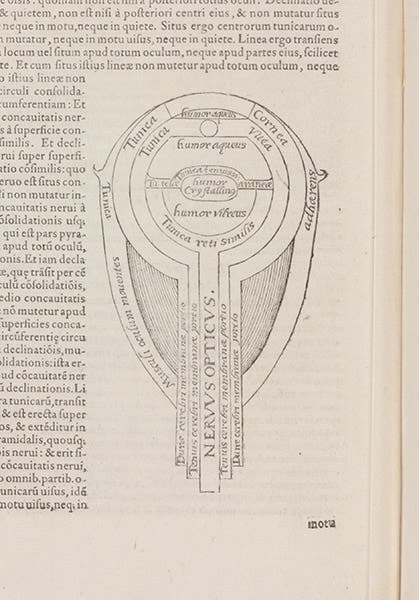
Diagram of the eye, detail of p.6 of text, Opticae Thesaurus, by Ibn al-Haytham, 1572 (The Linda Hall)
There is no known contemporary portrait of Ibn al-Haytham, and only one later imagined portrait, which is the one everyone uses. It was first included by Johannes Hevelius on the engraved title page of his Selenographia (1647), which presented his observations and maps of the Moon as viewed through his telescopes. In his engraving, Hevelius chose one historical astronomer, Galileo, on the right, to represent Sense, and another on the left to represent Reason, which was al-Haytham, whom he calls Alhazen. Most portraits pulled from this, zoom in on al-Haytham's face and omit the identifying legend beneath and Galileo across the aisle. We decided to enlarge the view (first image).
Our modern understanding of al-Haytham's contribution to modern theories of vision is primarily due to Mark Smith, professor of medieval history of science at the University of Missouri at Columbia and a former classmate of mine in the PhD program at the University of Wisconsin-Madison. In a half-dozen books over 30 years, Prof. Smith has provided insightful commentary on every aspect of al-Haytham's work. We have most of those here in our Library.
William B. Ashworth, Jr., Consultant for the History of Science, Linda Hall Library and Associate Professor emeritus, Department of History, University of Missouri-Kansas City. Comments or corrections are welcome; please direct to ashworthw@umkc.edu