Scientist of the Day - Strabo

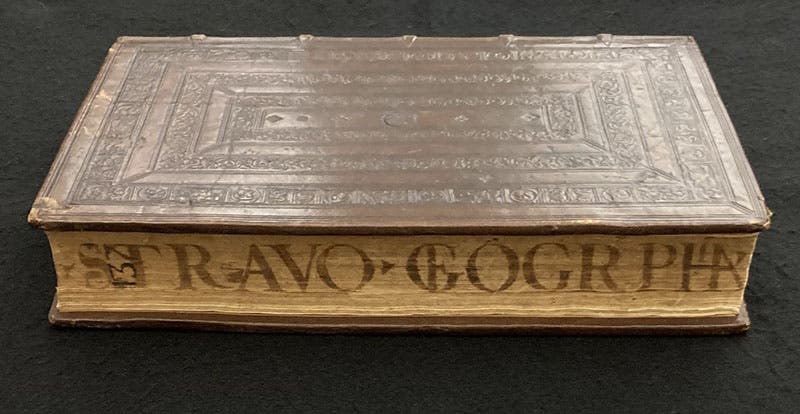
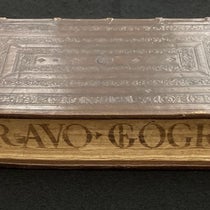
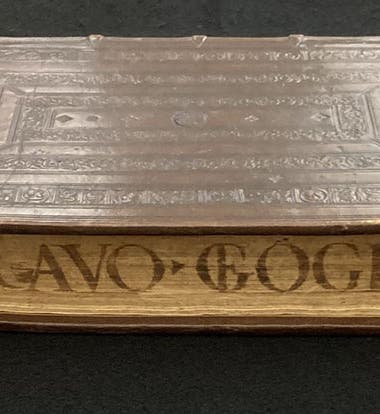
Binding and fore-edge label, Strabonis geographicorum, 1523 (The Linda Hall)
Strabo, a Greek geographer, was born around 63 BCE in Amaseia in Pontus, a kingdom on the Black Sea in what is now northern Turkey. He lived during the late Roman Republic and into the ascendancy of Augustus as the first Roman Emperor, and he died about 24 CE.

Portrait of Strabo, engraving, cropped from page in Les vrais pourtrait & vies des hommes illustres, by André Thevet, vol 1, p 76, 1584 (Wikimedia commons)
We know almost nothing about Strabo's life. We know he wrote two books, a historical work that does not survive, and a book called Geographia, which does. The Geographia usually carries a Latin title – our copy does – but it was written in Greek and was regularly translated into Latin for publication.

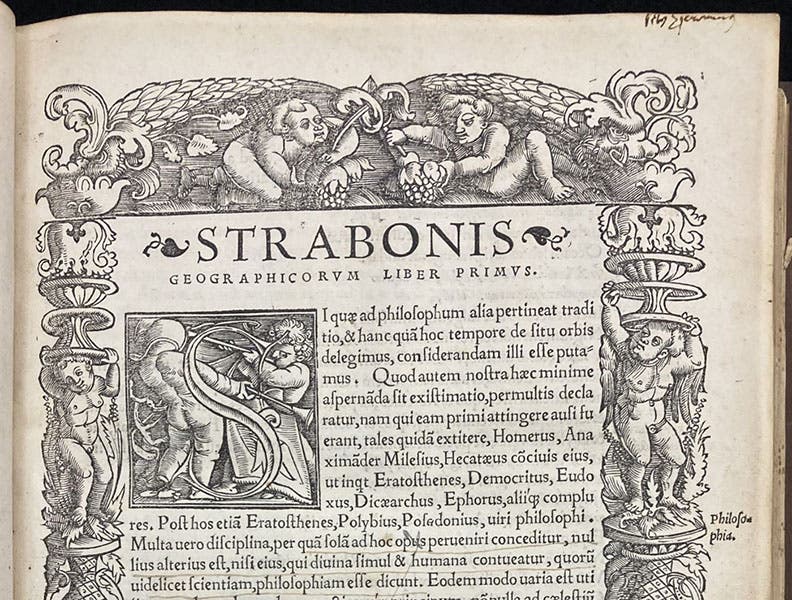
Opening paragraph of Strabo’s Geographia, Strabonis geographicorum, p. 1, 1523 (The Linda Hall)
We wrote a post not long ago about another Geographia, that of Ptolemy of Alexandria, and completed about 115 years after Strabo's. The two Geographias could not be more different. Ptolemy's is filled with maps and tables of longitude and latitude, and the text describes physical features of the land. Strabo's has no maps – indeed, it has no pictures at all. Strabo was more oriented toward cultural and political geography. Although he discussed many of the same topics as Ptolemy, such as the size of the oecumene (the inhabited world), his geographical information was not intended to provide the basis for regional maps, or for a map of the world.

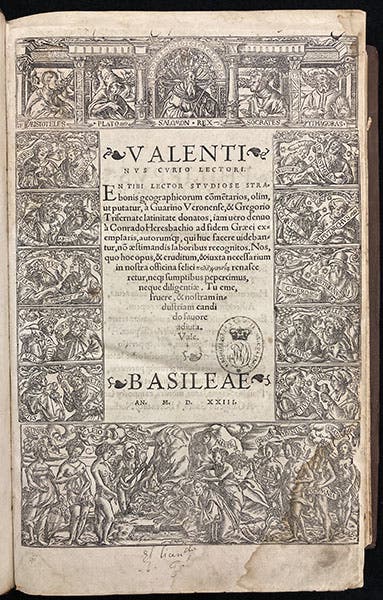
Title page of Strabonis geographicorum, with the name of the printer, Valentinus Curio of Basel, overshadowing that of Strabo, 1523; woodcut border by Hans Holbein (The Linda Hall)
Our edition of Ptolemy's Geographia was published in 1525 and is a splendid large quarto, bound in full dark calf. Our copy of Strabo's Geographia was printed 2 years earlier, in 1523 and is even more splendid, in a blind-tooled calf binding, with the fore-edge boldly labeled so it could be found on the shelf (first image). The first page of the text (third image) displays Strabo's name prominently, but surprisingly, the title page (fourth image) does not; instead, the printer, Valentinus Curio, has pride of place. The woodcut border of the title page was designed, and perhaps cut, by Hans Holbein, who also designed the initial letters throughout the book (fifth image), and the printer’s mark that occupies the last page in the book (sixth image).

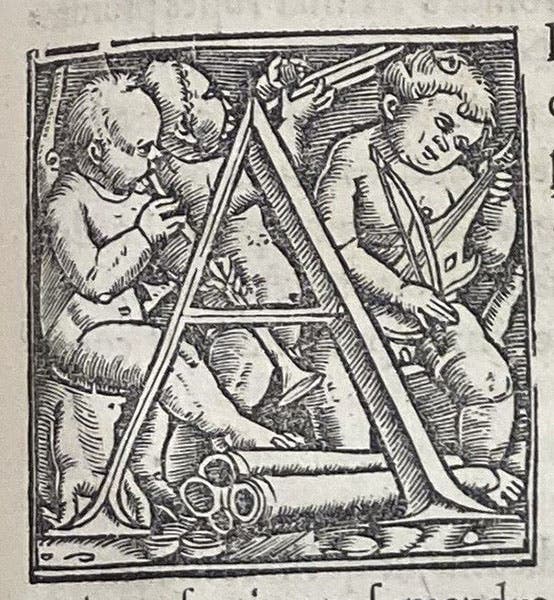
Initial letter “A”, by Hans Holbein, Strabonis geographicorum, p. 271, 1523 (The Linda Hall)

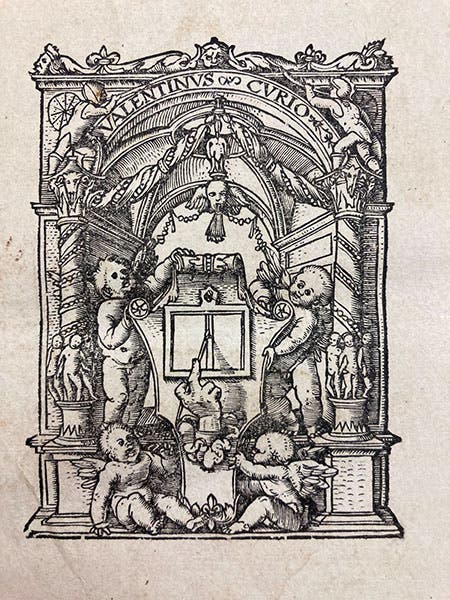
Printer’s device for Valentinus Curio of Basel, by Hans Holbein, Strabonis geographicorum, last page, 1523 (The Linda Hall)
Should you ever need a vintage image of the nine muses, might I suggest the bottom panel of Holbein's title-page border? It has nothing to do with Strabo or geography, but it would be a shame to pass it by in silence (last image, below).

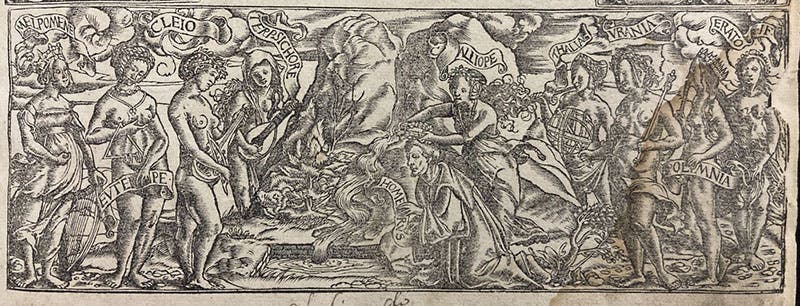
The Nine Muses, bottom panel of woodcut title-page border, by Hans Holbein, Strabonis geographicorum, 1523 (The Linda Hall)
The portrait most often used in modern discussions of Strabo is an engraving found in Les vrais pourtrait & vies des hommes illustres, by André Thevet (1584), which is a totally imaginary likeness, but a fine engraving. This is one of the few scientific portrait books we do not own, so we had to borrow it from Wikimedia commons (second image).
William B. Ashworth, Jr., Consultant for the History of Science, Linda Hall Library and Associate Professor emeritus, Department of History, University of Missouri-Kansas City. Comments or corrections are welcome; please direct to ashworthw@umkc.edu.