Scientist of the Day - Engelbert Kaempfer

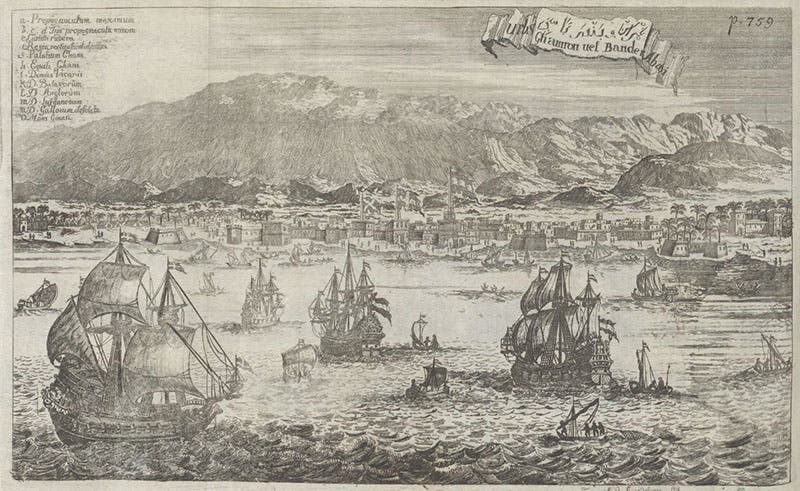
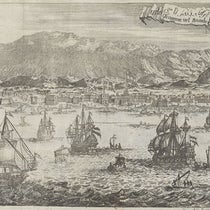
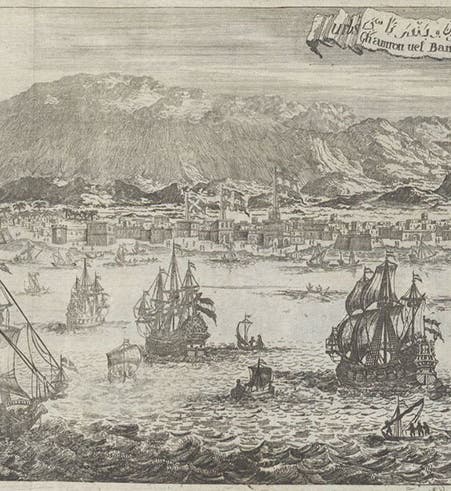
Bandar Abbas, port city, Strait of Hormuz, Persian Gulf, folding etching in Amoenitatem exoticarum, by Engelbert Kaempfer, p. 759, 1712 (The Linda Hall)
Engelbert Kaempfer, a German naturalist and traveler, was born on Sep. 16, 1651, in Lemgo, Lippe, in what is now central Germany. He studied at a variety of Prussian universities, including Gdansk and Königsberg, where he was drawn to medicine and botany. In 1691, he found himslf in Uppsala, where he decided what he really wanted to do was travel. He managed to get himself attached to the entourage of the Swedish ambassador to Persia, and proceeded to become one of the greatest travelers since Marco Polo.

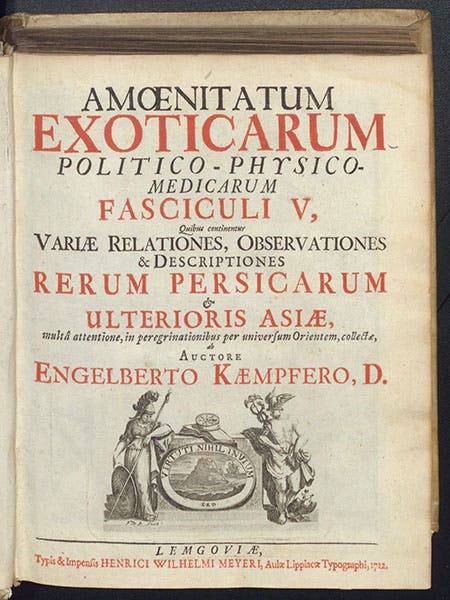
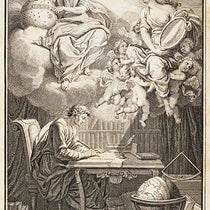
Title page in red and black, Amoenitatem exoticarum, by Engelbert Kaempfer, p. 759, 1712 (The Linda Hall)
They journeyed to Moscow, then down through central Asia to Isfahan, their destination. Kaempfer took notes all the way, on plants, and local customs, and languages. When the embassy was ready to head back to Sweden, Kaempfer bid everyone good speed and joined the Dutch East India Company. He traveled with their ships to Arabia, India, and eventually (1689) to Batavia in the East Indies, and thence to Siam and Japan, where he spent several years. He finally returned to Holland in 1693, after 10 years on the move, taking notes all the while.

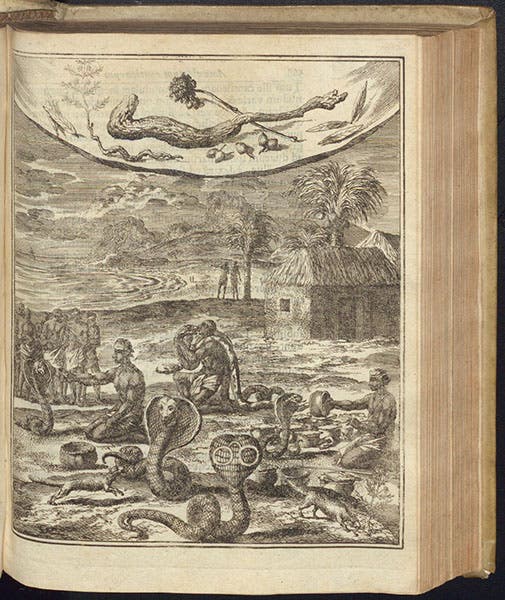
Snake charmers and cobras, etching, Amoenitatem exoticarum, by Engelbert Kaempfer, p. 759, 1712 (The Linda Hall)
Kaempfer submitted part of the book he was writing as a thesis for a medical degree in 1694, and he could have had a university position anywhere, but he returned to Lemgo to become physician to the Count of Lippe, and stumbled into an unhappy marriage at the same time; his book on his travels did not see the light of day until 1712, 19 years after he returned. It was called Amoenitatem exoticarum (Exotic pleasures). It was not a traditional natural history like those of Aldrovandi, or even Georg Markgraf's Natural History of Brazil. Instead (except for the last book, book 5), it was a series of observations on various cultural practices involving animals, plants, or medicines, such as how snake-charmers make cobras dance (third image), or how locals collect asafetida, a resin that oozes from the root of a plant that grows only in northeast Persia and Afghanistan (fourth image).

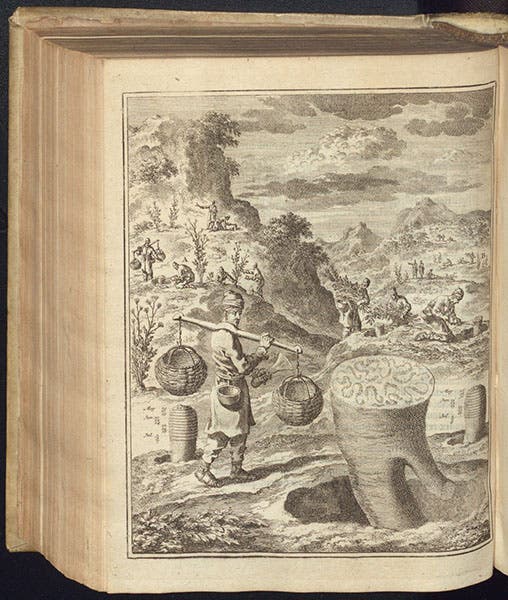
Harvest of resin from Asafetida root, Persia, etching, Amoenitatem exoticarum, by Engelbert Kaempfer, p. 548, 1712 (The Linda Hall)
The most interesting “Observation” (as he called his chapters) to modern eyes is the “History of Japanese Tea,” where we encounter one of the first discussions in the West of the cultivation, harvesting, and preparation of tea. Kaempfer provided not only an engraving of the plant, which the Japanese call Tsjaa, but another showing all the implements one needs to conduct a traditional Japanese tea ceremony (fifth and sixth images).
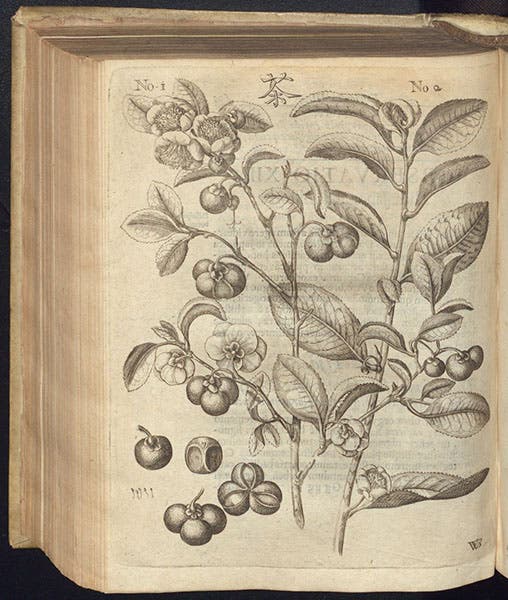
Tsjaa, tea plant, Japan, etching, Amoenitatem exoticarum, by Engelbert Kaempfer, p. 606, 1712 (The Linda Hall)

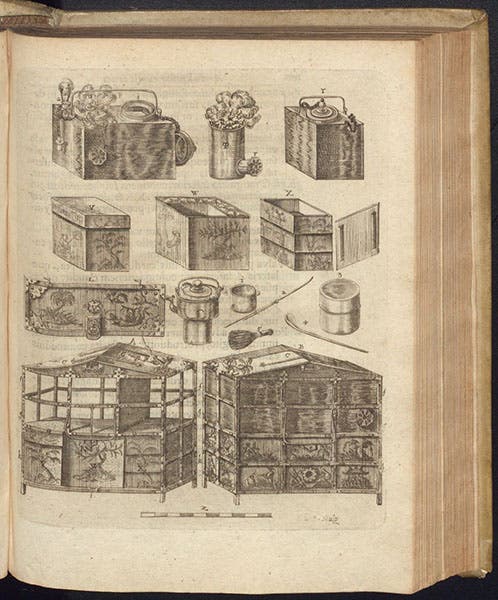
Paraphernalia and utensils for a tea ceremony, etching, Amoenitatem exoticarum, by Engelbert Kaempfer, p. 629, 1712 (The Linda Hall)
Kaempfer also provided the first description of acupuncture, and of moxibustion, an Eastern medical treatment where tiny cones of moxa, a variety of flax, are placed on certain parts of the body and burned, thereby drawing out injurious vapors that cause sickness. The plate (seventh image, below) is a map of proper moxa-burning points, labeled In Japanese.

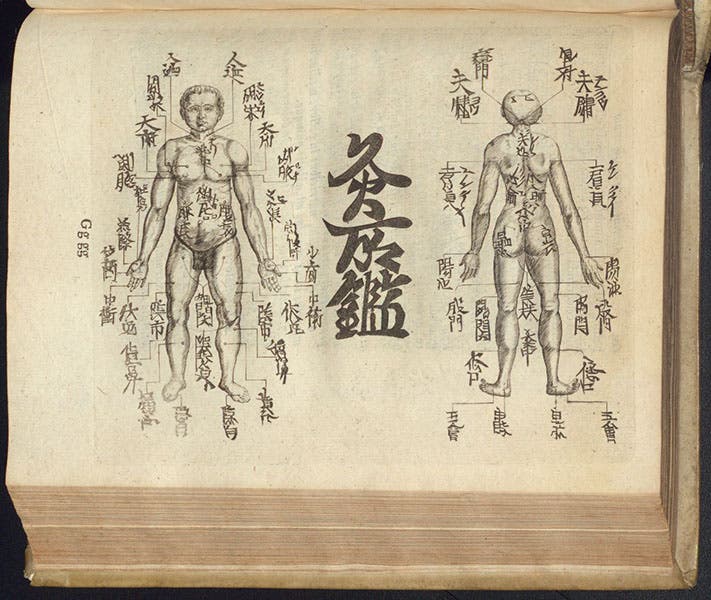
Application points for burning moxa, etching, Amoenitatem exoticarum, by Engelbert Kaempfer, p. 601, 1712 (The Linda Hall)
The last section of Exotic Pleasures is a glossary of plants native to Japan, providing both the Japanese and Latin names. One of the most interesting of these appears at the very bottom of the page shown in our eighth image, with the curious name, Ginkgo. This is the first mention in the West of a tree that has now been planted around the world (including a handsome one on our Library grounds, near the front gate). Kaempfer also included an engraving of the characteristic fan-shaped leaves of this distinctive tree (ninth image).

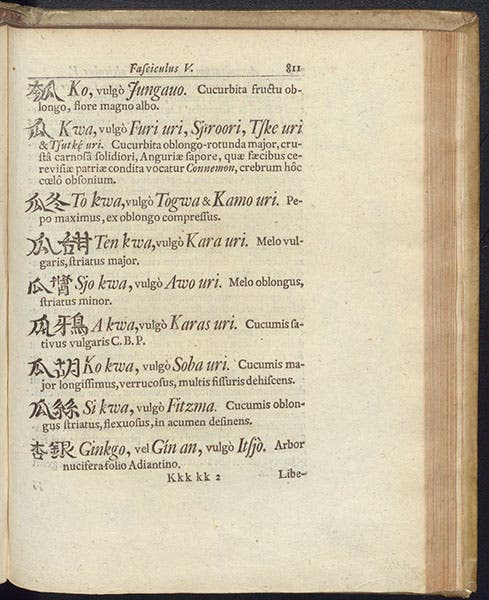
Page from listing of Japanse flora, wtih Ginkgo at the bottom, Amoenitatem exoticarum, by Engelbert Kaempfer, p. 811, 1712 (The Linda Hall)
We have not written about Kaempfer before, because we did not have his book. But this past spring, rare-books librarian Bruce Bradley managed to acquire a copy, a really fine specimen of a book, with sharp creases on all the folding plates and not a tear anywhere. I am so pleased it has now joined our special collections. All our images today, except for the last one, were taken from our recent acquisition.

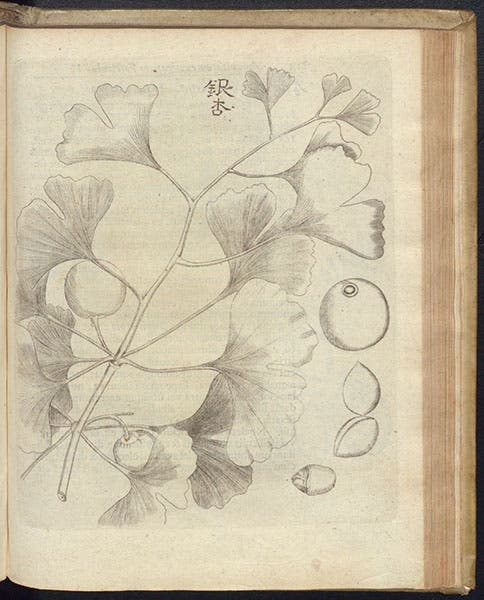
Ginkgo leaves, etching, Amoenitatem exoticarum, by Engelbert Kaempfer, p. 813, 1712 (The Linda Hall)
Kaempfer wrote one other book, a History of Japan, but it was still in manuscript when he died in 1716. Hans Sloane in London heard that Kaempfer's papers were in Lippe, so he stepped in and bought them all. He had the History of Japan translated into English and published in 1727. Since Japan shut itself off from the West until 1854, Kaempfer’s History of Japan was one of the only sources available, for a century and a quarter, written by one of the few scholars to have gone there.


Wall plaque honoring Engelbert Kaempfer, Nicolaikirche, Lemgo, Lippe, Westphalia (findagrave.com)
There are 2 monuments to Kaempfer in a square in Temgo, with the taller one perhaps overly baroque (but you can see them here), and a more elegant and restrained plaque inside the Nicolaikirche in Temgo where he is buried, which appropriately includes images of a cobra, a ginkgo leaf, and a tea leaf (last image).
William B. Ashworth, Jr., Consultant for the History of Science, Linda Hall Library and Associate Professor emeritus, Department of History, University of Missouri-Kansas City. Comments or corrections are welcome; please direct to ashworthw@umkc.edu.