Scientist of the Day - Émilie du Châtelet

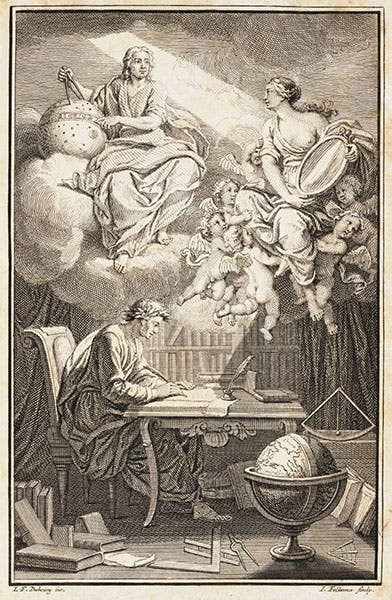
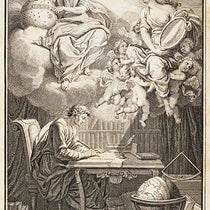
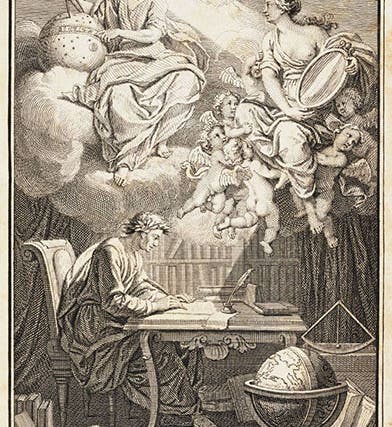
Frontispiece, Élémens de la philosophie de Neuton: mis à la portée de tout le monde, by Voltaire, 1738; Émilie du Châtelet is possibly represented by the woman holding the mirror (The Linda Hall)
Émilie du Châtelet, a French noblewoman and mathematician, died Sep. 10, 1749, at the age of 42. Madame du Châtelet was exceptional for her time in being trained in advanced mathematics, including the new calculus of Newton and Leibniz. She was also partial to the physics of Newton, at a time when most of her countrymen still preferred the mechanical philosophy of René Descartes, and she would spend many years engaged in the difficult task of translating Newton's Principia mathematica into French, a project that is not for the faint of heart (or intellect).

Portrait of Émilie du Châtelet, oil on canvas, by Marianne Loir, Museum of Fine Arts, Bordeaux (Wikimedia commons)
Before the Newton project, Émilie had become involved in what we now call the vis viva controversy. Descartes had proposed that the force exerted by a body is determined by the body's mass times its velocity, or mv. The German philosopher Gottfried Leibniz later proposed a different measure, mv2, which he called vis viva, or living force. In one sense, both philosophers were correct, since we now recognize mv as a measure of momentum, and mv2 as a measure of kinetic energy. But none of this was understood in the 18th century, and it was thought that force had to be one or the other.

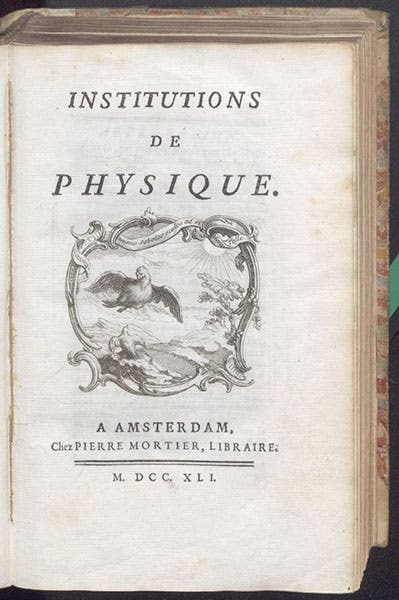
Title page, Institutions de physique, by Émilie du Châtelet, 1741 (The Linda Hall)
A respected French mathematician, Jean-Jacques d'Ortous de Mairan, had published a paper in 1728, "Dissertation on the motive force of bodies," in which he defended mv as a measure of force. But in 1740, Mme du Chātelet announced her presence to the masculine world of French mathematics by publishing her first major book, Institutions de physique (third and sixth images), and in the last part of the work, she attacked Mairan's 1728 paper and came down on the side of Leibniz and vis viva.

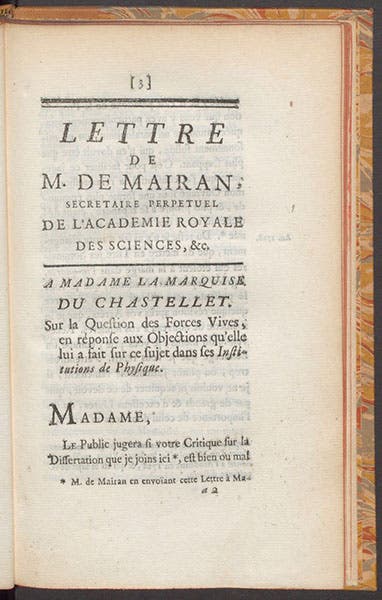
First page, Lettre de M. de Mairan ... A Madame la Marquise du Chastellet. Sur la question des forces vives, by Dortous de Mairan, 1741 (The Linda Hall)
Mairan's friends told him to let things be – the woman was unknown and would go away if ignored – but Mairan would not be silent, and in 1741 he published a brief letter in his own defense, attempting to put this upstart marquise in her place (fourth image). That was not such a good idea, as it turned out. First of all, since Mairan was a highly respected scientist, he immediately legitimized Mme du Châtelet and gave her a status in intellectual circles that she had not previously possessed. What is worse, she immediately wrote a letter of her own in reply, refuting every one of Mairan's points and maintaining the superiority of Leibniz's vis viva (fifth image). When the dust had settled, and contemporaries had read pamphlet and counter-pamphlet, it was generally agreed that Mme du Châtelet had thoroughly bested the old man, and her career was off and running. Mairan’s career was over.
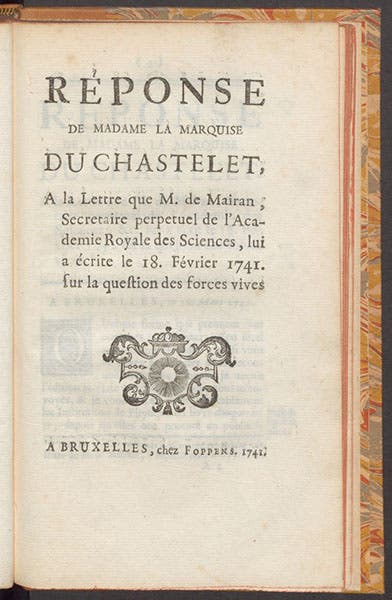
Title page, Réponse de Madame la Marquise du Chastelet, a la lettre que M. de Mairan, by Émilie du Châtelet, 1741 (The Linda Hall)
Émilie du Châtelet also possessed a considerable amount of personal vis viva, known in France as joie de vivre, and she cut quite a swath through French social circles. Although married at a young age (which is how she acquired her title of marquise and her last name of du Châtelet), and the mother of three children, she re-entered Parisian society in 1733 and embarked on a series of love affairs, the most notable being an extended alliance with Voltaire, who shared her passion for Newtonian physics, and a few other passions as well. They met in 1733; in 1734, Voltaire moved into the du Châtelet estate home of Château de Cirey in Haute-Marne, in Champagne country in northeastern France, many, many hours from Paris. That same year, Madame du Châtelet moved there as well. They shared the chateau for seven years, until 1741, with the full knowledge and apparently approval, or lack of disapproval, of her husband.
Émilie helped Voltaire write his Élémens de la philosophie de Neuton (Introduction to Newtonian Philosophy, 1738), since she was a much better mathematician than he was. The frontispiece of Voltaire’s work shows the divine Newton at the top, and Voltaire writing his book below (first image). The intermediary, reflecting the light of Newton down to Voltaire, is usually thought to be Madame du Châtelet.

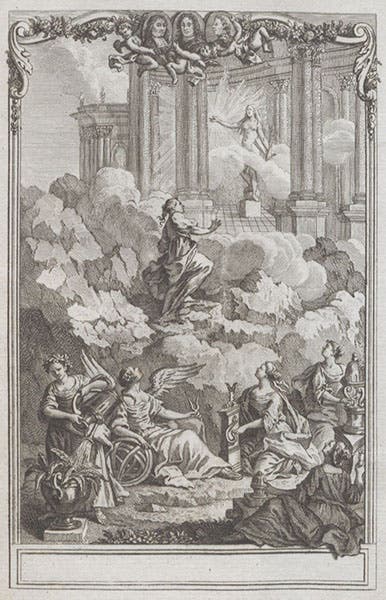
Frontispiece, Institutions de physique, by Émilie du Châtelet, 1741 (The Linda Hall)
Émilie undertook to translate Newton’s Principia into French in the mid-1740s, finishing about 1747. By this time, she and Voltaire were living apart but still apparently in love. Unfortunately, another affair of 1748 left her pregnant, and her expressed fears of the perils of childbirth at her age proved all too well-founded, as she died after giving birth in 1749, only 42 years old.

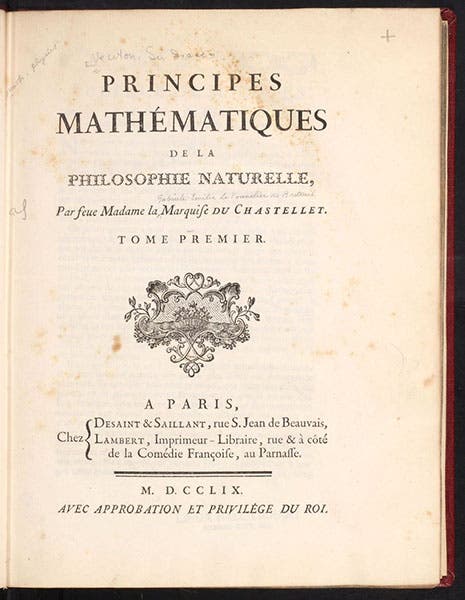
Principes mathématiques de la philosophie naturelle, by Isaac Newon, transl. by Émilie du Châtelet,1749 (The Linda Hall)
Voltaire made sure that Du Châtelet’s translation of Newton was published, in partial form in 1756, and then in its entirety in 1759. It is still regarded as one of the finest translations of Newton that we have (seventh image). Several charming portraits of Émilie du Châtelet were painted during her lifetime, all capturing the inner spark of a beautiful and extremely intelligent woman. We have used one painted by Marianne Loir around 1748, now in the Musée des Beaux-Arts, Bordeaux (second image).
We have mentioned six works in this post--three by Émilie du Châtelet, two by Mairan, and one by Voltaire. We have all six in our History of Science Collection, including the two scarce vis viva pamphlets of 1741. That is a happy state of affairs.
Since Emilie du Châtelet is a good candidate for being one of the most brilliant women in science ever, there has been no shortage of biographies, most of them worth reading. I like La Dame d'Esprit: A Biography of the Marquise Du Châtelet, by Judith P. Zinsser (Viking, 2006).
William B. Ashworth, Jr., Consultant for the History of Science, Linda Hall Library and Associate Professor emeritus, Department of History, University of Missouri-Kansas City. Comments or corrections are welcome; please direct to ashworthw@umkc.edu.