Scientist of the Day - Royal Earl House

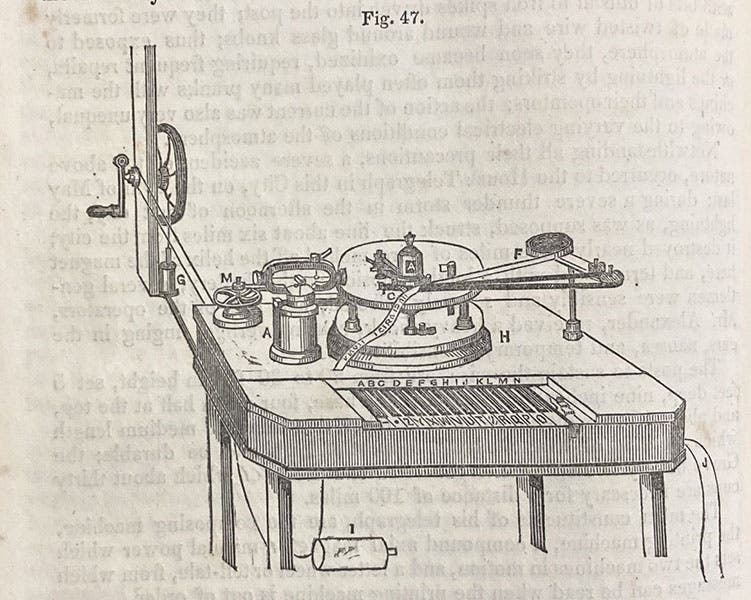
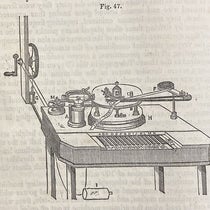
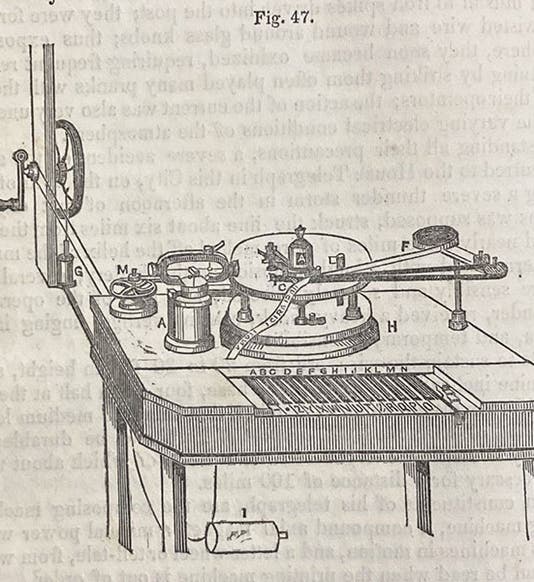
House’s printing telegraph, detail of fig. 47, Lectures on the Electro-Magnetic Telegraph, by Laurence Turnbull, p. 98, 1852 (The Linda Hall)
Royal Earl House, an American inventor, was born Sep. 9, 1814, somewhere in Vermont. Nothing is known about his life until 1845, when he turned up in New York City after Samuel F. B. Morse had sent the first telegraph message from Washington to Baltimore in 1844. The Morse system, as everyone seems to know, used a pattern of dits and dahs to encode the letters of the alphabet, which had to be translated by the key operators – there was no way in the original Morse system to print a message directly.

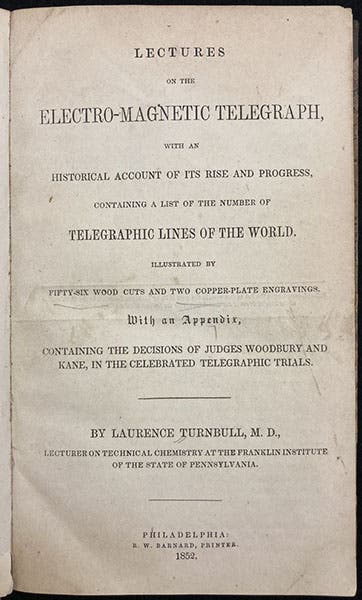
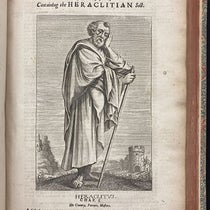
Title page, Lectures on the Electro-Magnetic Telegraph, by Laurence Turnbull, 1852 (The Linda Hall)
This is where House came in. We don't know how he acquired his electro-magnetic skill, but by 1846, he had developed and patented a printing telegraph that had no key or key operators at all. Instead, it sported a piano keyboard with 28 keys plus a shift key, which was able to transmit letters directly and, using a synchronized print wheel, print them out on the receiving end. The Morse people sued immediately, arguing patent infringement, but the House system did not use the Morse code or the key system, and Morse lost the suit

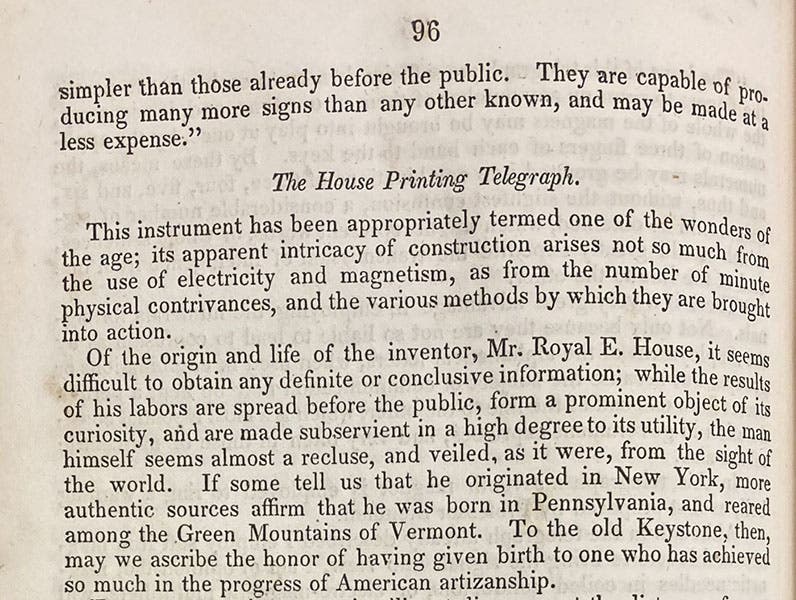
Opening paragraph, discussion of House printing telegraph, Lectures on the Electro-Magnetic Telegraph, by Laurence Turnbull, p. 96, 1852 (The Linda Hall)
The House printing telegraph was put into use in several locations, on lines from Boston to New York, and from Springfield, Mass. to Albany, and thence to Buffalo, and seemed to work well, when it worked. The problem with House's system is that the synchronized machinery was intricate and prone to breaking down. But customers seem to have been happy with it in the 1850s.

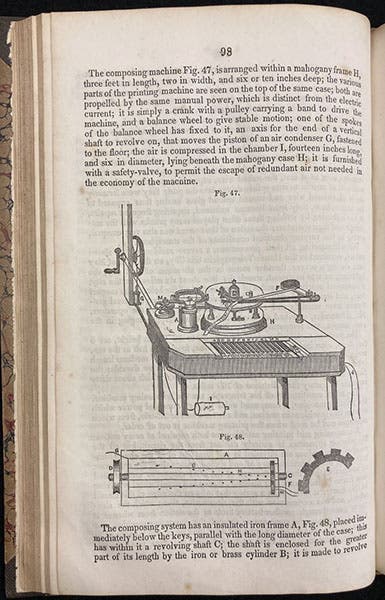
House’s printing telegraph, diagrams of the entire composing and printing apparatus (fig. 47), and the revolving drum under the keyboard (fig. 48), Lectures on the Electro-Magnetic Telegraph, by Laurence Turnbull, p. 98, 1852 (The Linda Hall)
It is hard (for me) to figure out how the House printing telegraph worked. We have in our collections a book that made a laudable attempt at explication: Lectures on the Electro-Magnetic Telegraph, by Laurence Turnbull, published in 1852. It has seven pages devoted to House’s printing telegraph, including 6 figures with many elements identified by letters referred to in the text; we reproduce some of the figures in our first, fourth, and fifth images here. But I could not follow the details. Certainly some of you can. I will try to get this book scanned and available online in the near future, for the curious among you.

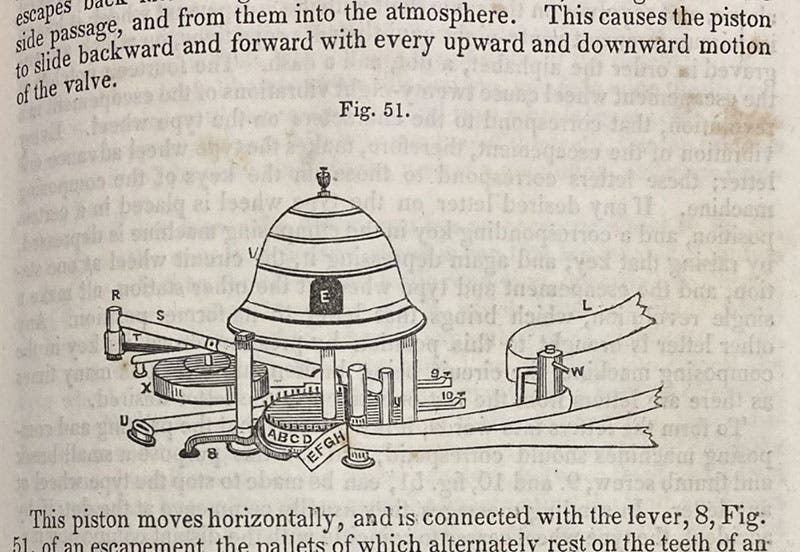
The printing apparatus of House’s printing telegraph, fig. 51, Lectures on the Electro-Magnetic Telegraph, by Laurence Turnbull, p. 101, 1852 (The Linda Hall)
House’s patent application of 1846 is available on Google Patents; we show the diagrams page here; there were 8 more pages of printed text. I was interesting to me that the diagrams showed only a few of the elements of his invention, like the drum that rotated beneath the keyboard, and the printing wheel.

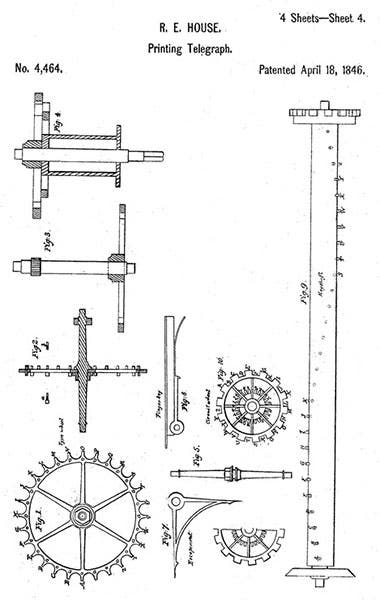
Patent diagrams, House printing telegraph, showing the print wheel and the drum under the keyboard and a few other specs, patent no. 4464, granted to R. E. House, Apr. 18, 1846, Google Patents (patents.google.com)
It is frequently said that an original House printing telegraph is in the Smithsonian Institution, and a vintage photo is in circulation that supposedly shows House’s patent model (seventh image), but no House instrument is in evidence on any of the Smithsonian websites. Here is yet another House mystery to be solved.

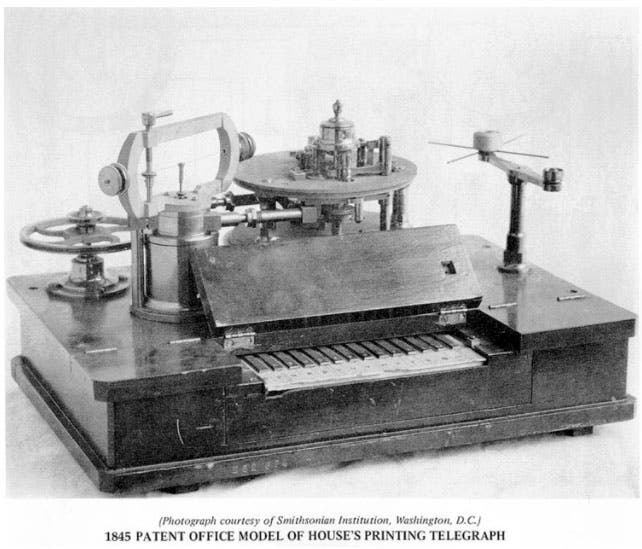
Vintage photo of the patent model for House’s printing telegraph, supposedly in the Smithsonian Institution (historyofinformation.com)
It is also said that House's company flourished into the 1870s, and that it ultimately merged with that of Morse. But I do not know how much of House's invention was present in later printing telegraphs. David Hughes invented a printing telegraph in England that looks very much like House's, with a similar piano keyboard (see the third image at our post on Hughes). Which of the two was more influential? I have not found that answer.
I would very much like to find a portrait of Royal House, but I am not hopeful. Finding the patent model, or an actual House printer, has, I think, better odds. Please stay tuned.
William B. Ashworth, Jr., Consultant for the History of Science, Linda Hall Library and Associate Professor emeritus, Department of History, University of Missouri-Kansas City. Comments or corrections are welcome; please direct to ashworthw@umkc.edu.