Scientist of the Day - Thomas Stanley

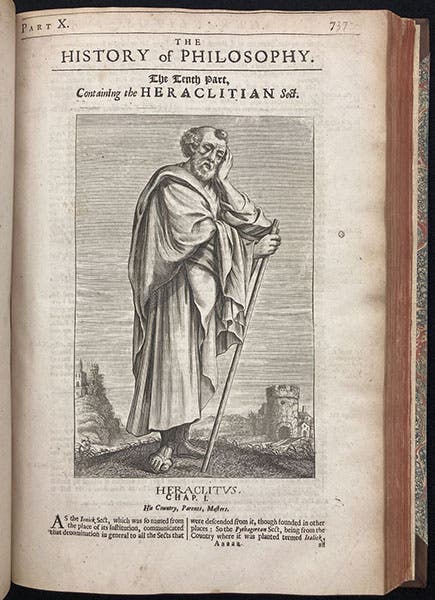
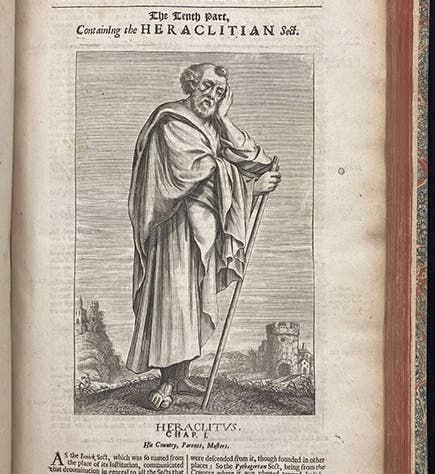
Heraclitus, imagined portrait, engraving by William Faithorne, A History of Philosophy, by Thomas Stanley, 2nd ed., p 737, 1687 (The Linda Hall)
Thomas Stanley, an English poet and writer of considerable wealth and privilege, was born Sep. 3, 1625, in Clothall, Hertfordshire. He seems to have lived most of his life in the family manor house there, Cumberlow Manor, which has not survived.

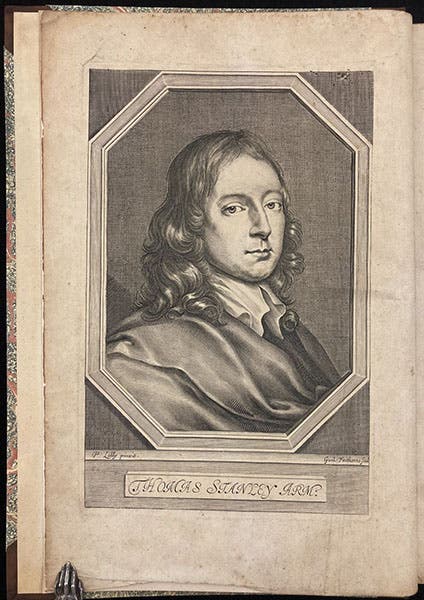
Portrati of Thomas Stanley, engraved frontispiece by William Faithorne, A History of Philosophy, by Thomas Stanley, 2nd ed., 1687 (The Linda Hall)
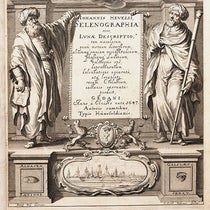
Stanley attended Cambridge, then Oxford, then Middle Temple in London, to study law. Unexpectedly, in the middle of all this ordinary upper-class pussy-footing about, Stanley published a four-volume History of Philosophy (1655-62), and in English to boot. It is a learned and sometimes amusing collection of biographies of ancient philosophers (a fact not mentioned in the title), compiled from a variety of ancient Greek and Roman authors. We do not have the four-volume first edition in our collections, but after Stanley's death, the work was reissued in one tall quarto volume in 1687, and we have a nice copy of this second edition, bound in unusual marbled-paper boards. It will take you about 30 seconds with this volume to discover why it is such a desirable resource. It is illustrated with full-body portraits of philosophers gracing the countryside, beginning with Thales the Milesian and continuing through the Greek Stoics and Epicureans. It says as much in the continuation of the title: … illustrated with the effigies of divers of them (third image).

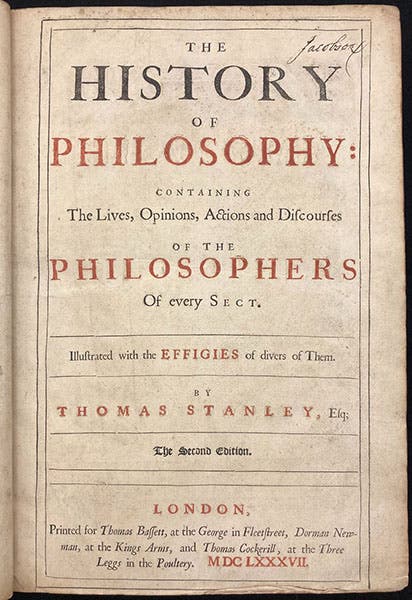
Title page, A History of Philosophy, by Thomas Stanley, 2nd ed., 1687 (The Linda Hall)
If you teach ancient philosophy or ancient science, especially in general surveys, you know how hard it is to illustrate such discussions, using perhaps a map of Ephesus and a tourist photo of the ruins of the Temple of Artemis to provide background for Heraclitus. Contemporary portraits and busts are rarely found. But that did not stop Stanley, or his artist, William Faithorne. There is an engraving of Thales on page 1, and you can find similar portraits of Socrates, Aristotle, Parmenides, and Zeno of Elea in the appropriate chapters. It doesn't really matter that the portraits are made-up, provided you explain that at the outset. Even imaginary portraits give you and the students something plausible to look at while they learn about nous and humors and atoms in the void.
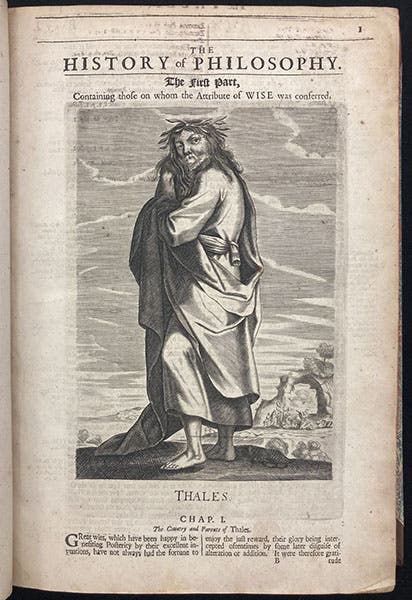
Thales, imagined portrait, engraving by William Faithorne, A History of Philosophy, by Thomas Stanley, 2nd ed., p. 1, 1687 (The Linda Hall)
So I used Stanley frequently in my classes, and in this series of scientific anniversaries, where you can see Stanley/Faithorne portraits in the posts on Democritus, Empedocles, and Pythagoras. I could have used a Stanley engraving for the post on Zeno the Stoic (Zeno of Citium) just a month ago, but in that case, I had an attractive portrait bust, so I show Stanley's Zeno here instead (fifth image).

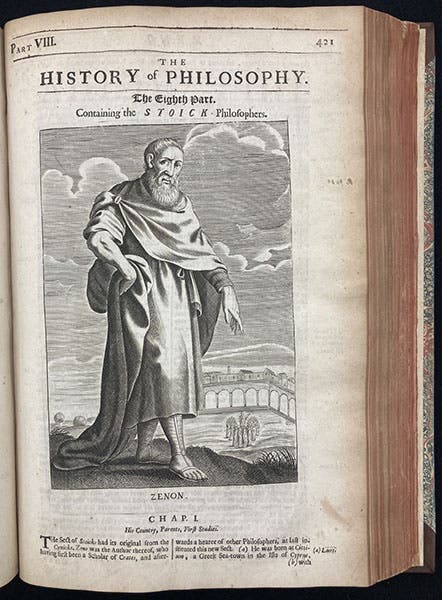
Zeno the Stoic (Zeno of Citium), imagined portrait, engraving by William Faithorne, A History of Philosophy, by Thomas Stanley, 2nd ed., p. 421, 1687 (The Linda Hall)
One of the most interesting portraits in Stanley's book is that of Aristotle. It is initially somewhat off-putting, because of the way the body is hunched over, but there is something unusual about the face – it is not imagined. Instead, it was copied from an ancient cameo in the collection of Fulvio Orsini, which was published in 1606 by Theodor Galle and quickly became everyone's favorite Aristotle likeness. You can learn more about it in our post on Galle.

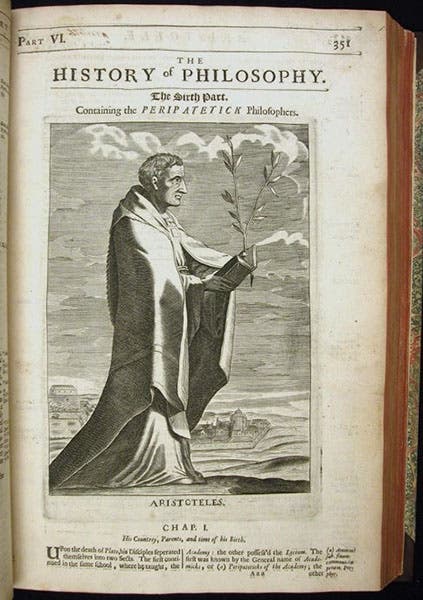
Aristotle, portrait after a cameo, engraving by William Faithorne, A History of Philosophy, by Thomas Stanley, 2nd ed., p. 351, 1687 (The Linda Hall)
Not every philosopher discussed by Stanley was accompanied by a portrait – most were not. For those unfortunate ones, you had to read the text, which, happily for modern readers, is in English, not Latin. We show you the complete entry for Philolaus, a later Pythagorean who proposed that the Earth moves through the heavens, circling a central Fire (seventh image).

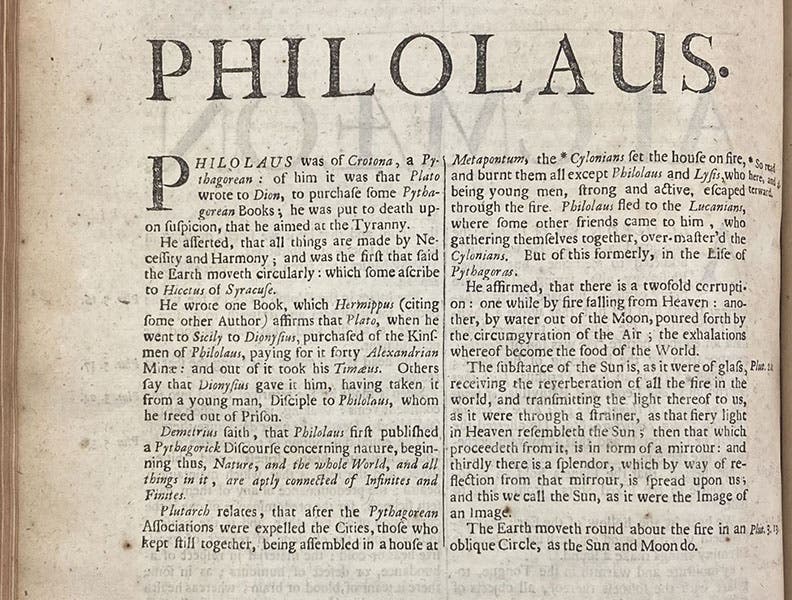
Complete text on Philolaus, a Pythagorean, A History of Philosophy, by Thomas Stanley, 2nd ed., p. 586, 1687 (The Linda Hall)
Stanley may have liked portraits of his subjects, but he had little use for diagrams. Any Renaissance discussion of Aristotle would have included a diagram of the four elements and the four qualities, but not Stanley. I found only one diagram in the entire volume, but it is an interesting one, showing the harmony of the spheres as propounded by Pythagoras (last image). It was taken, however, not from Pythagoras, but from Robert Fludd.

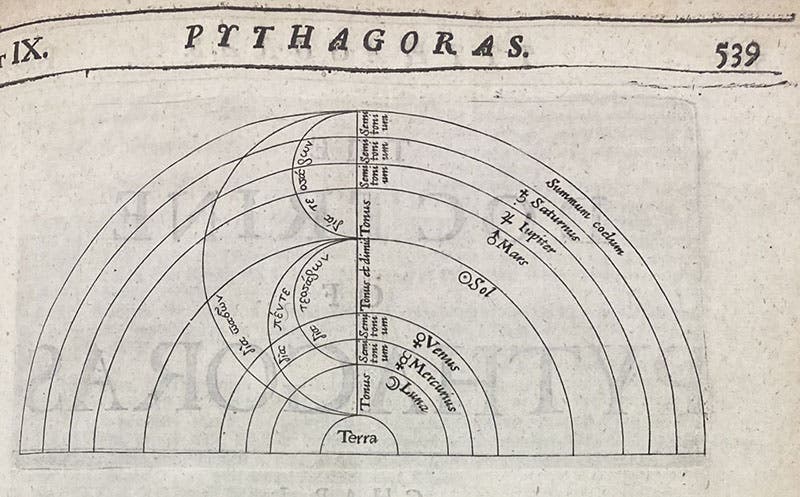
Diagram of the harmony of the spheres, in the section on Pythagoras, A History of Philosophy, by Thomas Stanley, 2nd ed., p. 539, 1687 (The Linda Hall)
Faithorne was a well-known and prolific engraver in Restoration England. He also did real portraits, often of scientists, and we have included some of those in our posts on John Aubrey, John Ray, and Robert Boyle.
Our portrait of Thomas Stanley (second image), the original Flat Stanley, was engraved by Faithorne and included as the frontispiece to our posthumous edition of A History of Philosophy. If you prefer oil portraits in color (and ordinarily I do), there is a nice one in the National Portrait Gallery in London.
William B. Ashworth, Jr., Consultant for the History of Science, Linda Hall Library and Associate Professor emeritus, Department of History, University of Missouri-Kansas City. Comments or corrections are welcome; please direct to ashworthw@umkc.edu.