Scientist of the Day - Romeyn Beck Hough

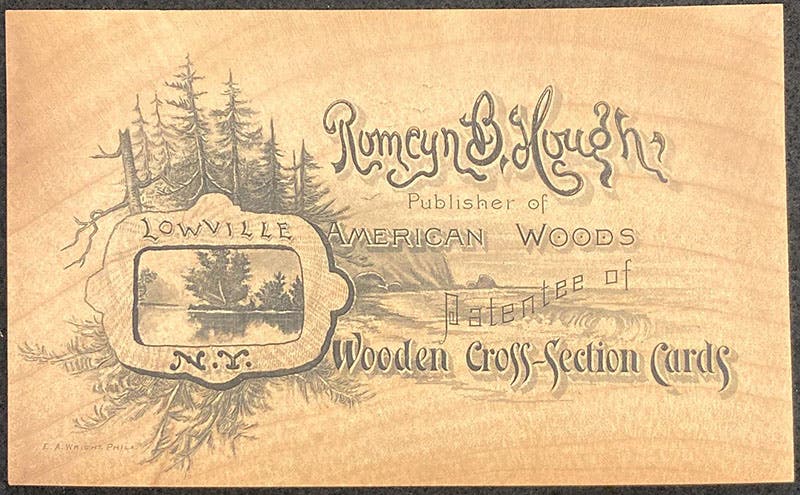
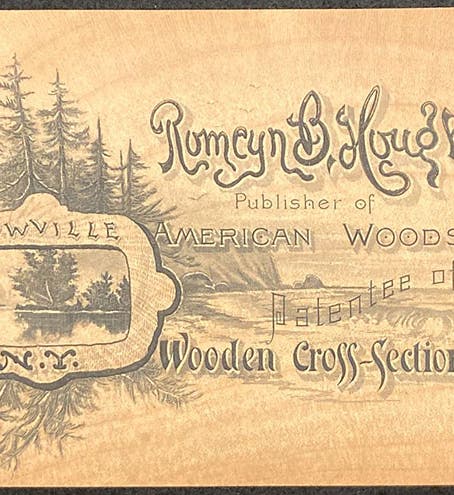
Business card of Romeyn Beck Hough, printed on a thin slice of hardwood, originally loosely laid in vol. 1 of The American Woods, Exhibited by Actual Specimens and with Copious Explanatory Text, by Romeyn Beck Hough, 1888, now shelved in a separate envelope (The Linda Hall)
Romeyn Beck Hough, an American physician, botanist, and inventor, died on Sep. 2, 1924, at the age of 67. Although formally trained in medicine at Cornell, he much preferred botany, and he decided while in his late 20s to market a xylotheque, a set of books about trees (in this case American trees), illustrated with actual wood samples instead of prints or photographs. The problem was that standard veneer cutters made slices that were much too thick to use in a book. So Hough invented a new kind of cutter that could produce slices less than a thousandth of an inch thick. So enamored was he of his slicer that he detoured from the tree project to market business cards printed on wood. He said of these, no one will ever throw such a business card away, and he was probably right. We show one of his own business cards above, which came loosely inserted with several others in the first volume of the work described below (hence the stains on the title page (third image).

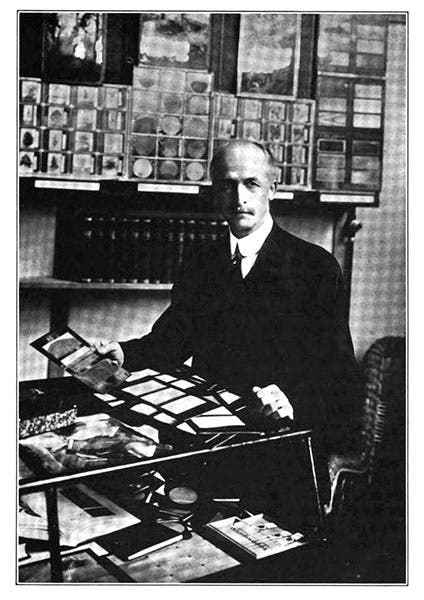
Romeyn Beck Hough in a publicity photograph, with cards from American Woods, various business cards made of wood, as well as lantern slides, and microscope slides, California’s Magazine, 1916 (microscopist.net)
Hough began to a accumulate wood slices from a variety of trees, starting with those in his native New York, and to publish American Woods. The first volume, really a book-shaped box, was published in 1888, and it contained a short text volume, and then 25 pieces of black Bristol board, each one cut out to hold three slices of wood – a tranverse section, a radial section, and a tangential section. The name was printed in five languages on both sides of the card. You could put the card on the table and view the 3 slices by reflected light, or hold them up to the light and look right through them. We show the contents of volume 2 in our last image.

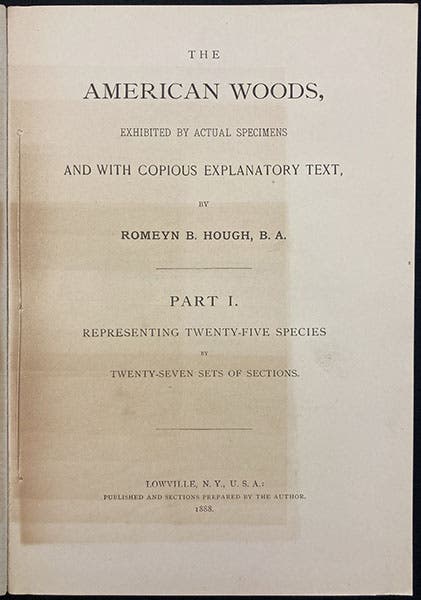
Title page, The American Woods, Exhibited by Actual Specimens and with Copious Explanatory Text, by Romeyn Beck Hough, vol. 1, 1888 (The Linda Hall)

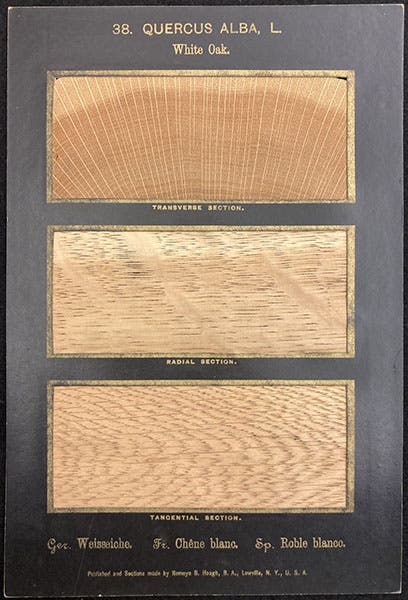
Card containing slices of Quercus alba, White Oak, The American Woods, Exhibited by Actual Specimens and with Copious Explanatory Text, by Romeyn Beck Hough, vol. 2, card 38, 1891 (The Linda Hall)
The first 3 volumes were an instant success, and Hough won all sorts of awards at various world’s fairs, such as in Paris. He continued to publish further volumes, one every few years, with a goal of 15 volumes, describing and illustrating some 375 trees. As it turned out, Hough managed only 13 volumes before he died unexpectedly in 1924. He had the materials ready for a 14th volume before he died; this was finished and published by his daughter Marjorie in 1928. A first edition of Hough's American Woods contains 14 text volumes and 14 boxes of tree slices, 25 cards or 75 slices per box. We have just such a set in our rare book vault. I have been unable to discover how many sets he published in that first edition of 1888-1928. I would like to know that.

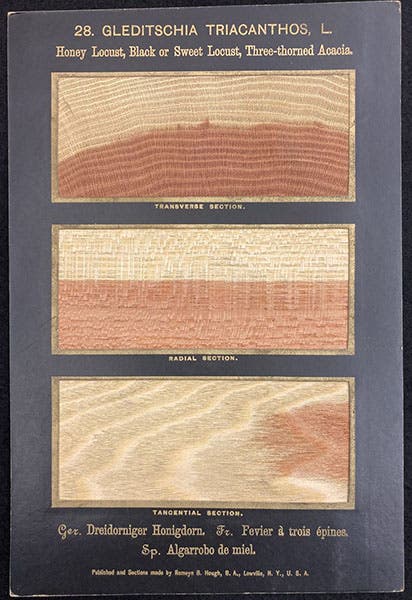
Card containing slices of Gleditschia tricanthos, Honey Locust, The American Woods, Exhibited by Actual Specimens and with Copious Explanatory Text, by Romeyn Beck Hough, vol. 2, card 28, 1891 (The Linda Hall)

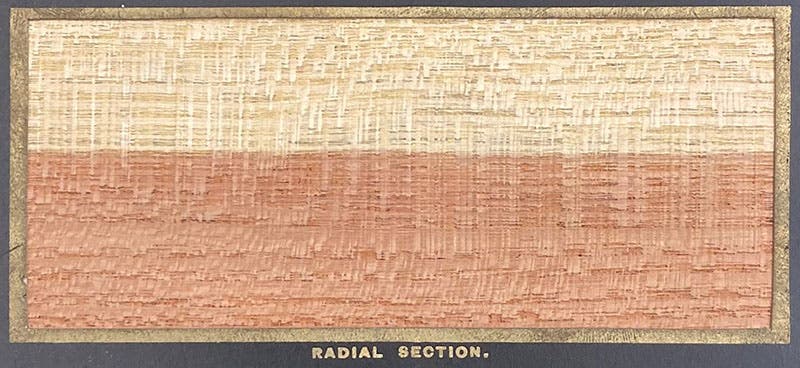
Detail of the radial section of Gleditschia tricanthos, Honey Locust, The American Woods, Exhibited by Actual Specimens and with Copious Explanatory Text, by Romeyn Beck Hough, vol. 2, card 28, 1891 (The Linda Hall)
Hough had hundreds of thousands of leftover wood slices that daughter Marjorie inherited upon his death. In 1957, she collaborated with a forester, Elwood Harrar, to begin to issue a new edition of American Woods, this one in 15 volumes, and called Hough's Encyclopaedia of American Woods. We have a set of the 1957-2004 edition as well.
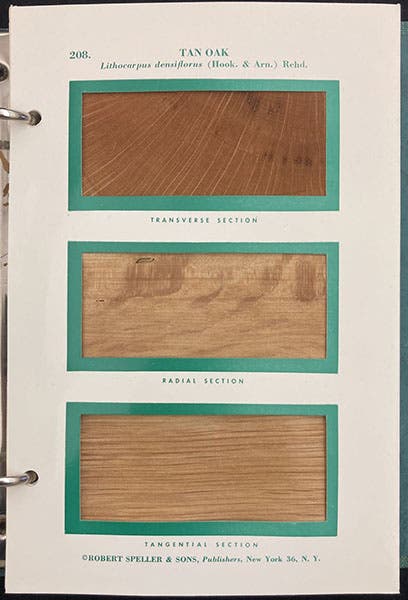
Card containing slices of Tan Oak, Hough's Encyclopaedia of American Woods, by Elwood S. Harrar, vol. 9, card 208, 1957-2004 (The Linda Hall)
For this new edition, the cardboard mounts were punched and loaded into ring binders, which are easier to leaf through than the boxed cards of the first edition (seventh image). But there is one serious drawback – the veneer samples are loosely inserted in the cardboard sleeves and are prone to falling out. Pull a volume off the shelf, and you are sure to find a thin strip of wood on the floor before you put it back; it is not easy to find where it belongs. So I leave the 1957 edition on the shelf now and use only the original, which holds on to its veneers with tenacity.

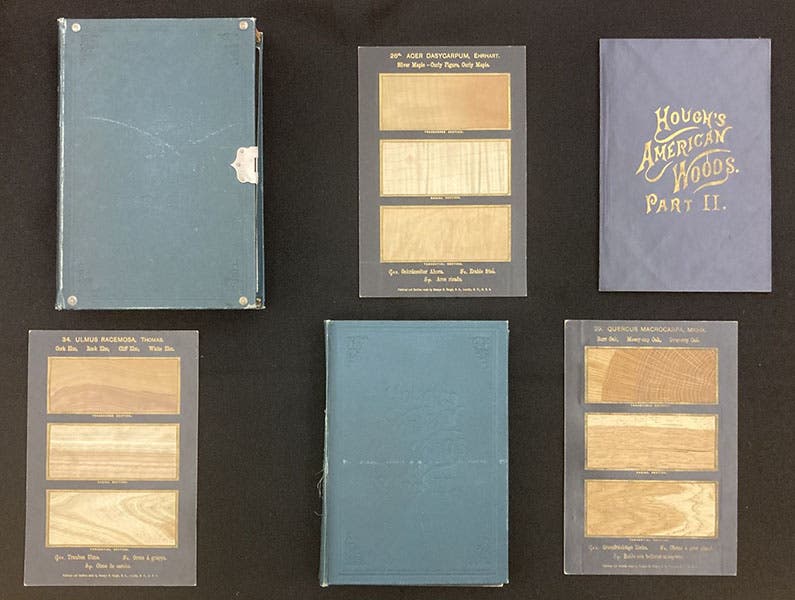
Volume 2 of The American Woods, Exhibited by Actual Specimens and with Copious Explanatory Text, by Romeyn Beck Hough, showing outer case and inner slipcase, text volume, and three of the cards with wood slices (The Linda Hall)
Sets of the first edition of American Woods sell now and then at auction, for tens of thousands of dollars, much more if the sets are complete, which they usually are not. It is usually the most prized work in any forestry library, coming in just ahead of John Evelyn's Sylva, both editions of which (1664 and 1786) we have in our collections.
There is an excellent webpage that shows lots of Hough memorabilia, including details of his microscope slides; it was the source for our portrait (second image). You can access it here.
William B. Ashworth, Jr., Consultant for the History of Science, Linda Hall Library and Associate Professor emeritus, Department of History, University of Missouri-Kansas City. Comments or corrections are welcome; please direct to ashworthw@umkc.edu.