Scientist of the Day - Martha the Pigeon

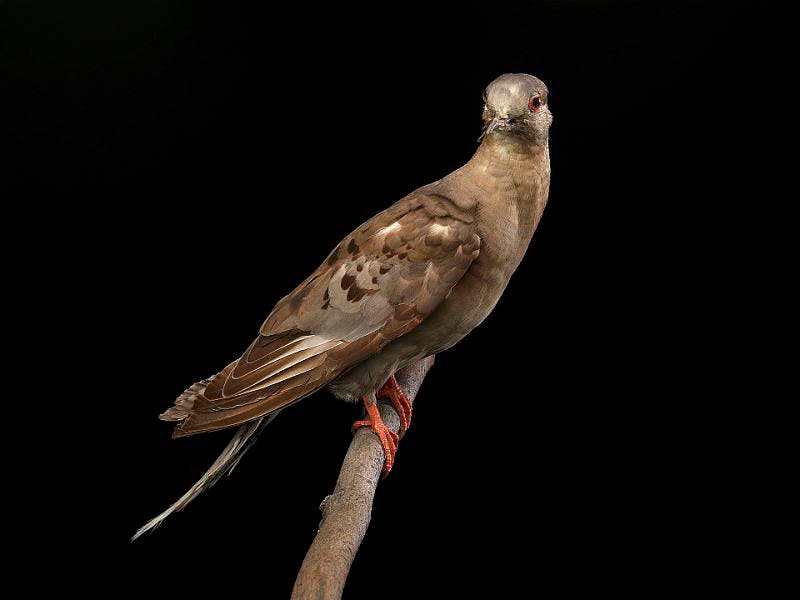
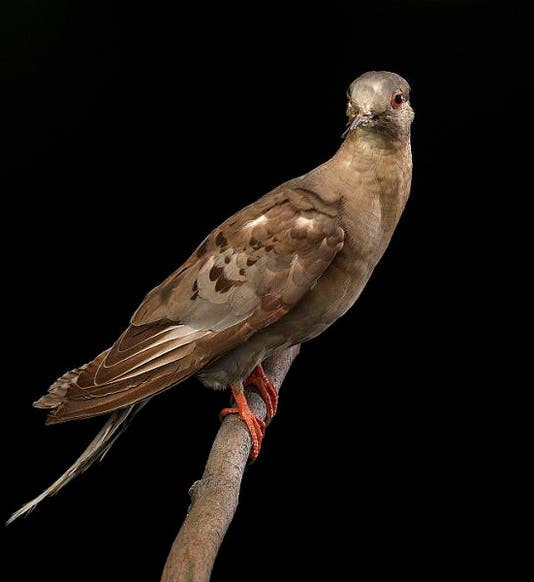
Martha, the last Passenger Pigeon, mounted and on display in the National Museum of Natural History, Smithsonian Institution, 1916 (si.edu/object)
Martha, the last passenger pigeon on earth, died on Sep. 1, 1914, in her cage at the Cincinnati Zoo. A specimen of Ectopistes migratorius, she was hatched around 1885 in the same zoo, where she lived every one of her 29 years. At the time of Martha's birth, passenger pigeons were already in trouble, which was why Martha was in a zoo in the first place. Not long before, her kind had numbered in the billions and had darkened considerable portions of the American skies. It seemed unthinkable that the predations of hunters and the deforestation of the landscape could make a dent in the passenger pigeon population, but by the 1870s, the number was down to the low millions, and by 1906, there were seven pigeons left alive, four in the Milwaukee Zoo and three in Cincinnati. When the four in Milwaukee died in 1907, Martha and her two male friends were all that remained, and after the two males passed away in 1910, Martha was an "endling," the last surviving member of her species. When Martha passed away, the passenger pigeon line was extinct.

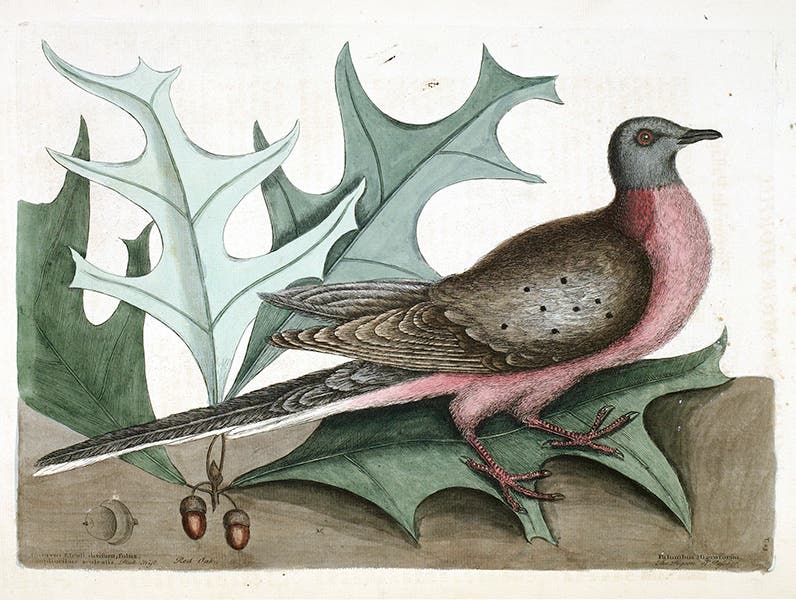
Palumbus migratorius, the Pigeon of Passage, hand-colored engraving in The Natural History of Carolina, Florida, and the Bahama Islands, by Mark Catesby, second edition, vol. 1, 1754 (The Linda Hall)
Upon her demise, Martha was frozen in ice and shipped to the Smithsonian Institution, where she was stuffed and put on display, as a reminder of the perils of unchecked plundering of our natural resources. After a half-century of display, Martha was removed to some shelf in the bowels of the Washington mall, but as the centennial of her death approached, the National Museum of Natural History refurbished Martha and placed her once again on view. In fact, the museum created a new exhibition around her: Once There were Billions, which opened in June of 2014 and ran until January of 2016. Our first photo (first image) was taken on his occasion. In fact, many photos were taken, so that the museum could provide us with a rotating three-dimensional view of Martha. Scroll down one screen at this link.

Martha on display in the “Objects of Wonder” exhibit at the Smithsonian Institution, 2017 (Wikimedia commons)
After that exhibit closed, the Smithsonian Institution in 2017 mounted a semi-permanent exhibition of their most special items, called “Objects of Wonder,” which included Martha, and was up until 2025, I believe. That was when our third image was taken. But as far as I can tell, Martha is no longer on display. I hope she is returned to view. We humans need ever-present reminders – lots of them – that the ecological web of nature is a fragile fabric that does not take kindly to rough handling. And that, not incidentally, we are well woven into that fabric.

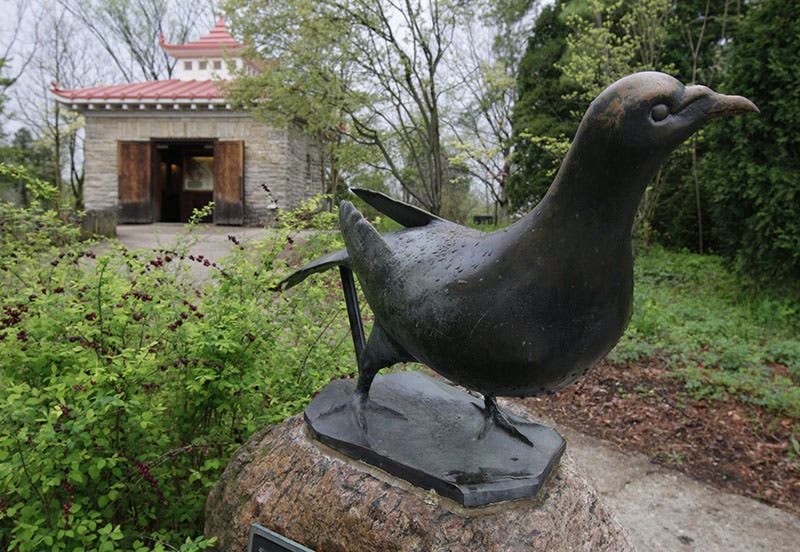
Bronze sculpture of Martha, Cincinnati Zoo, with pagoda in the background dedicated to Martha and Incas, the last Carolina Parakeet, who also died here, photo by Cincinnati Enquirer, 2019 (cincinnati.com)
The Cincinnati Zoo has not forgotten its most famous long-term resident. They built a pagoda-shaped memorial aviary in the 1970s, and there is a bronze statue of Martha on permanent display out front; you can see both in our fourth image. Another famous endling, Incas the Carolina Parakeet, passed away in the same zoo in 1918. I believe the pagoda is a monument to both birds.

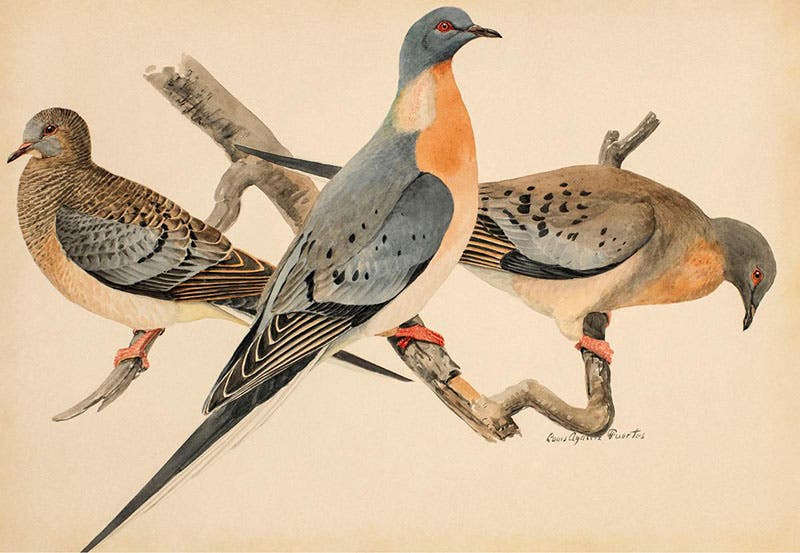
Passenger pigeons, by Louis Agassiz Fuertes, for Birds of New York, 1910-14, plate 42, New York State Museum, Albany (nysm.nysed.gov)
However, perhaps the finest memorials to Martha are those images that were made while the passenger pigeon was still a viable species, such as a painting by Louis Agassiz Fuertes for his Birds of New York (1910-14; last image), or a plate of the “Pigeon of Passage” from Mark Catesby’s Natural History of Carolina (1754; second image). Catesby described their vast numbers: “In Virginia I have seen them fly in such continued trains three days successively, that there was not the least interval in loosing sight of them.” Who would have imagined that human action (and lack of oversight) could have cut that passage so short.
William B. Ashworth, Jr., Consultant for the History of Science, Linda Hall Library and Associate Professor emeritus, Department of History, University of Missouri-Kansas City. Comments or corrections are welcome; please direct to ashworthw@umkc.edu.