

Scientist of the Day - Michael Maestlin

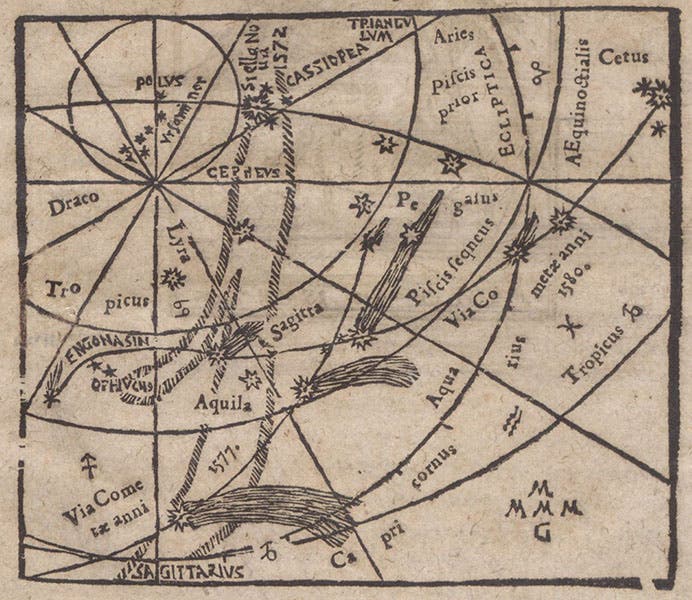
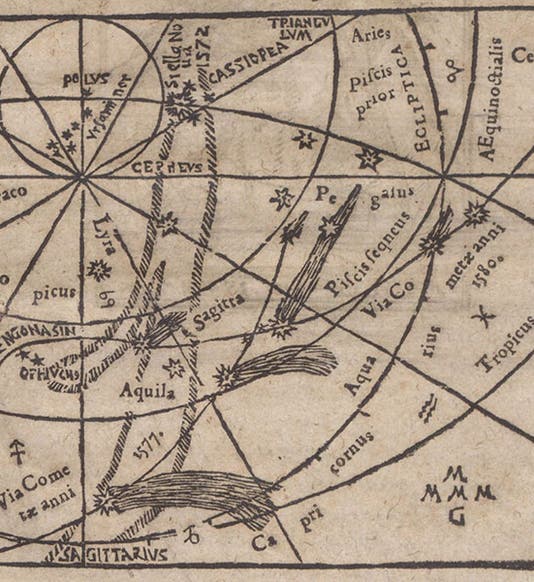
Woodcut comet map, showing the paths of the comets of 1580 and 1577, and the location of the new star of 1572 in Cassiopeia, title page, Consideratio & obseruatio cometae aetherei astronomica, qvui anno M D LXXX … in alto Aethere apparuit, by Michael Maestlin, 1581 (The Linda Hall)
Michael Maestlin, a German astronomer, was born on Sep. 30, 1550, in Göppingen, near Stuttgart, in southern Germany. He studied with Philipp Apian, son of Peter Apian, at Tübingen, and would eventually succeed Philipp as professor of mathematics at Tübingen. In that role, beginning in 1589, he taught young Johannes Kepler, not only astronomy, but Copernican astronomy. Maestlin and Kepler were two of the first practicing Copernican astronomers in Europe. We discussed Maestlin's impact on Kepler in our first post on Maestlin.

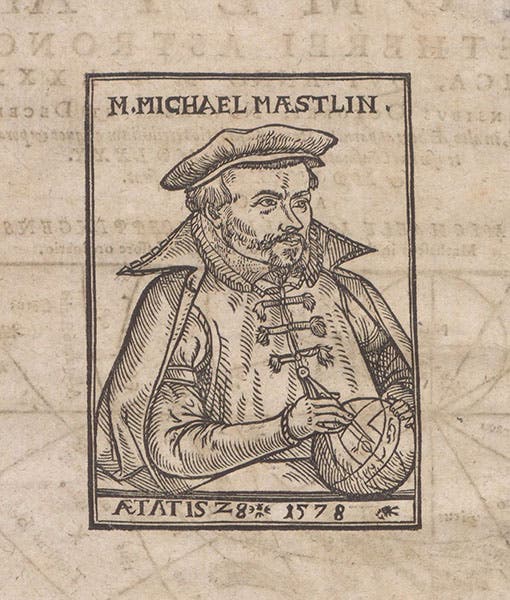
Portrait of Michael Maestlin, age 28, 1578, woodcut frontispiece, Consideratio & obseruatio cometae aetherei astronomica, qvui anno M D LXXX … in alto Aethere apparuit, by Michael Maestlin, 1581 (The Linda Hall)
The reason we follow up with a second post is that last year, we acquired a rare treatise by Maestlin on the comet of 1580. To call it rare is a bit of an understatement, as our recent acquisition is the only copy in North America. And it is a beautiful copy, a 44-page treatise in paper wrappers, acquired from New York City rare-book dealer Jonathan Hill. It is called: Consideratio & obseruatio cometae aetherei astronomica, qvui anno M D LXXX … in alto Aethere apparuit (Considerations and observations on the ethereal comet which appeared in 1580 in the high heavens), Heidelberg, 1581.

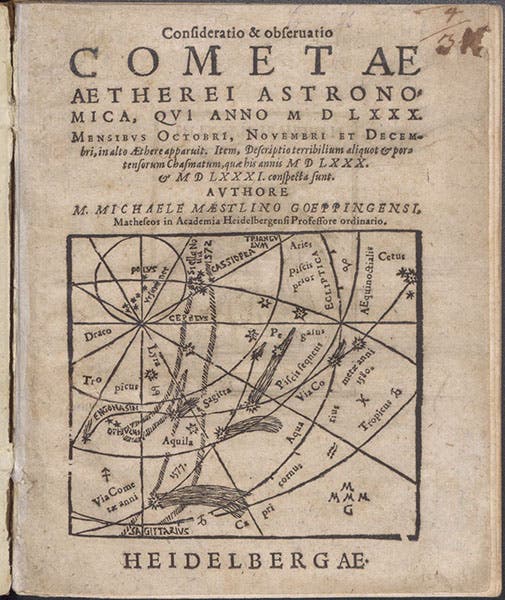
Title page with woodcut comet map, Consideratio & obseruatio cometae aetherei astronomica, qvui anno M D LXXX … in alto Aethere apparuit, by Michael Maestlin, 1581 (The Linda Hall)
The comet of 1580 is not famous, not like the comet of 1577, which attracted the attention of Tycho Brahe, who determined, by measuring its parallax, that it was far beyond the moon, and thus a heavenly body, contrary to the opinion of Aristotle. Maestlin was 27 when the comet of 1577 appeared, and he too, independently of Tycho, measured its parallax, and came to the same conclusion as Tycho. To accommodate a universe with comets, they both abandoned the traditional Aristotelian cosmology of the universities, and began to look favorably on the Copernican system (although Tycho, who was fine with planets and comets orbiting the Sun, could not abide the thought of a moving Earth, and had to devise his own system).

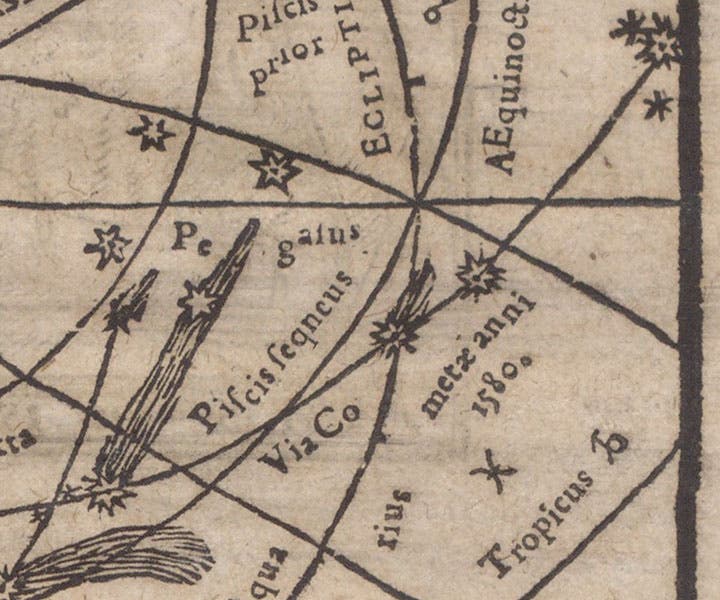
“Via cometae anni 1580,” path of the Comet of 1580, moving from upper right to lower left, detail of woodcut comet map, title page, Consideratio & obseruatio cometae aetherei astronomica, qvui anno M D LXXX … in alto Aethere apparuit, by Michael Maestlin, 1581 (The Linda Hall)
The comet of 1580 was not nearly as dramatic as the comet of 1577, but its parallax could be measured, and it too had a parallax less than the Moon's, meaning it was further away than the Moon, and thus a celestial object. The comet of 1580 seems to have confirmed Maestlin’s new-found Copernicanism.

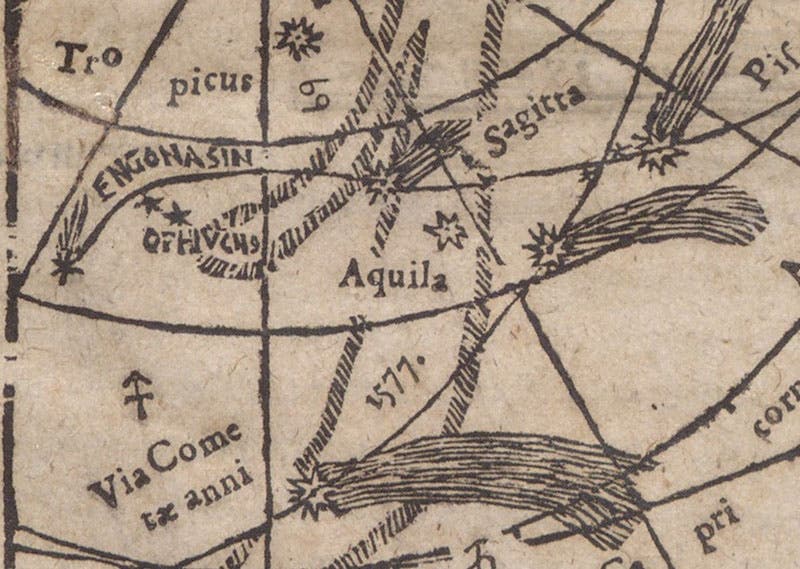
“Via cometae anni 1577,” path of the Comet of 1577, moving from bottom to top, detail of woodcut comet map, title page, Consideratio & obseruatio cometae aetherei astronomica, qvui anno M D LXXX … in alto Aethere apparuit, by Michael Maestlin, 1581 (The Linda Hall)
The title page has a comet map taking up much of the space (first and third images). Comet maps were very rare in 1581; if comets are not thought to be celestial, there is nothing to map. Maestlin’s may be our oldest comet map. It shows the paths of both the comet of 1577 and 1581, and they are labeled. Also shown on the map is the nova of 1572 in Cassiopeia, at the top (see details, fourth, fifth, and sixth images). Maestlin was 22 when this new star showed up, and it probably made a big impression on him. It certainly did on Tycho, prompting his break with Aristotelian cosmology, which had no place for new stars.

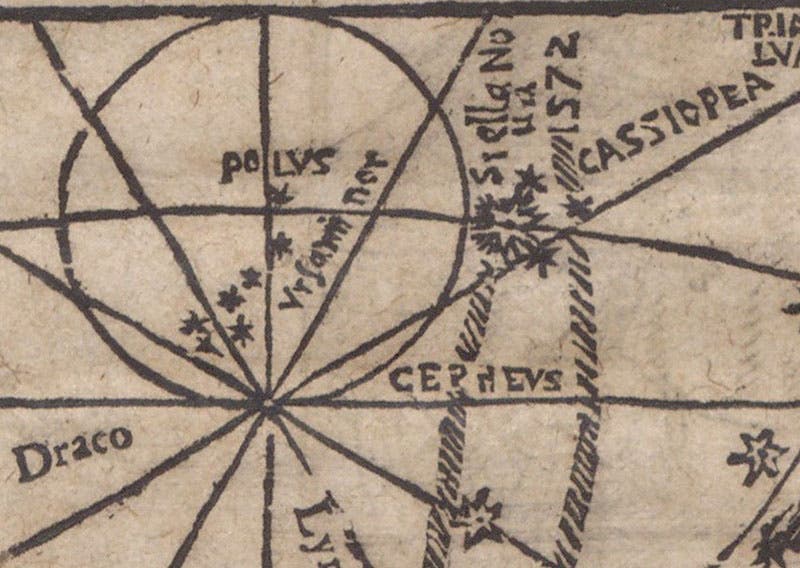
“Stella nova 1572 Cassiopea,” new star of 1572 in Cassiopeia, detail of woodcut comet map, title page, Consideratio & obseruatio cometae aetherei astronomica, qvui anno M D LXXX … in alto Aethere apparuit, by Michael Maestlin, 1581 (The Linda Hall)
The other attractive feature of our new acquisition is a woodcut portrait of Maestlin as a frontispiece (second image). Until we acquired this book, I had thought there was only one portrait of a younger Maestlin, and it was the one I reproduced in our first post, although we do not own it. The woodcut here shows him at age 28, and it was unusual for a young astronomer to have his features rendered in wood. If you look for portraits of Maestlin today on Google Image, you will not find ours. In a week or so, the bots will find our post, and then it should turn up.

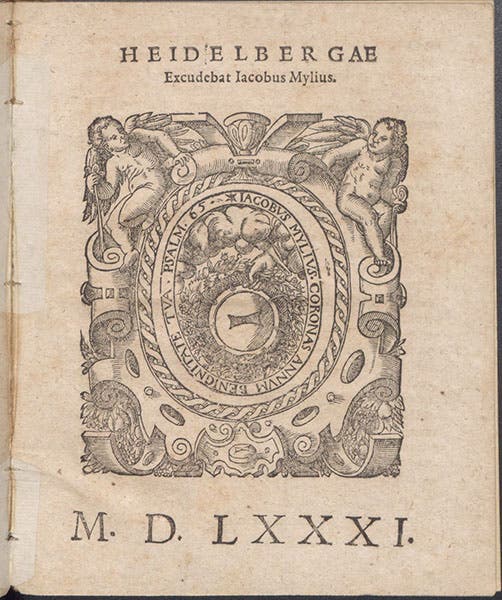
Printer’s mark of Jacob Mylius of Heidelberg, woodcut, colophon, Consideratio & obseruatio cometae aetherei astronomica, qvui anno M D LXXX … in alto Aethere apparuit, by Michael Maestlin, 1581 (The Linda Hall)
Since yesterday we showed the printer's mark of the Henripetris of Basel in our post on Walther Ryff, I thought I would include the mark of Maestlin's printer, Jacob Mylius of Heidelberg, which takes up the entire final page of our new Maestlin book. Some of these early printers were not shy about advertising themselves.
Maestlin lived a long time for a sixteenth-century German. He died on Oct. 26, 1631, at age 81. Presumably he was buried in Tübingen, but I have been unable to find the location of his grave.
William B. Ashworth, Jr., Consultant for the History of Science, Linda Hall Library and Associate Professor emeritus, Department of History, University of Missouri-Kansas City. Comments or corrections are welcome; please direct to ashworthw@umkc.edu.

![“And I do mean YOU,” drawing of an Anopheles mosquito, by Theodor Seuss Geisel, This is Ann, [by Theodor Seuss Geisel and Munro Leaf], p. 32, 1943 (The Linda Hall)](https://preview-assets-us-01.kc-usercontent.com:443/9dd25524-761a-000d-d79f-86a5086d4774/5aeabdb9-b9f5-40d6-8cf7-f7fff782da1d/seuss1.jpg?w=210&h=210&auto=format&fit=crop)
