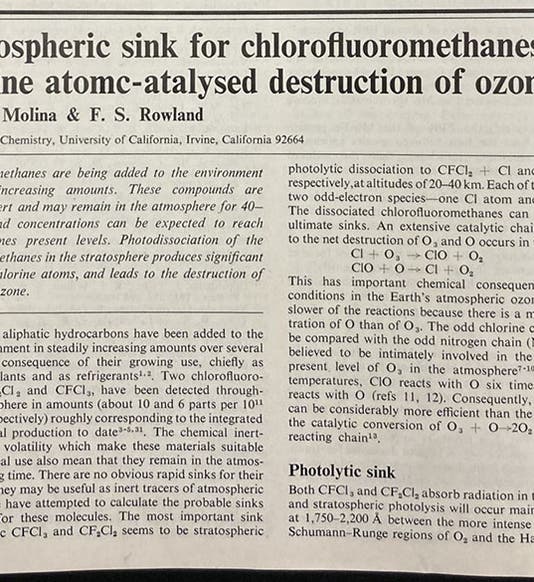
Scientist of the Day - Mario Molina

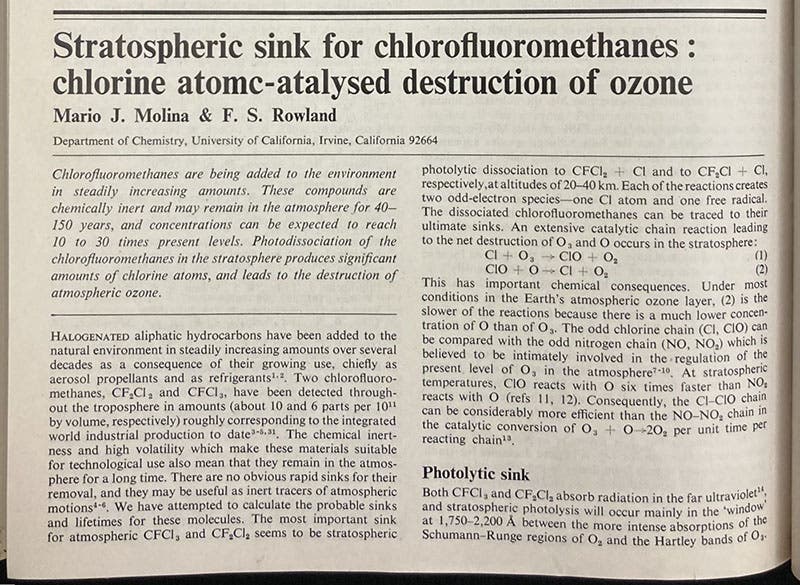
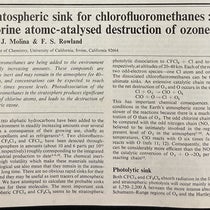
First paragraph, “Stratospheric sink for chlorofluoromethanes: Chlorine atomc-atalysed destruction of ozone,” by Mario J. Molina and F.S. Rowland, Nature, vol. 249, p. 810, June 28, 1974 (The Linda Hall)
Mario Molina, a Mexican physical and atmospheric chemist, died on Oct. 7, 2020, in Mexico City, where he has been born 77 years earlier, on Mar. 19, 1943. He received his preliminary education in Mexico, Switzerland, and Freiberg in Germany, but once he decided he wanted to be a professional chemist, he headed for the United States, to UC-Berkeley in particular, where he earned his PhD in 1973. For his postdoc, he decided to spend a year or two working with Sherwood Rowland at UC-Irvine. Rowland was studying chlorofluorocarbons (CFCs), compounds of hydrogen, carbon, chorine, and fluorine, which were widely used as refrigerants and aerosol propellants. Freon is a CFC. Rowland and Molina wondered, what happens to CFCs when they are released into the environment? They are chemically inert, it turns out, at least at ground level, which means nothing breaks them down. So if you dump some in a swamp, most of them will still be there 50 years later, unchanged.

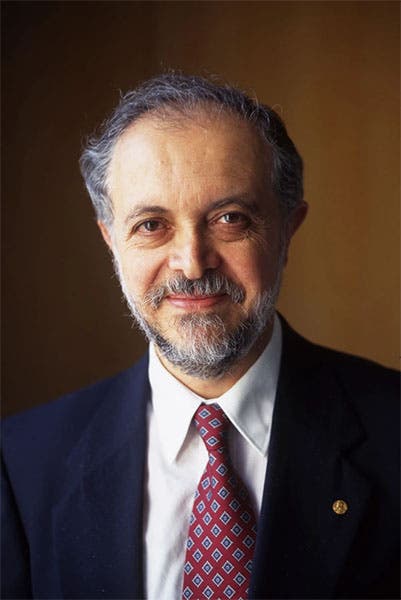
Portrait of Mario Molina, photograph, Nature, Nov. 6, 2020 (obituary) (nature.com)
Buy what about the molecules that drift up into the upper atmosphere. Molina and Rowland discovered that there, ultraviolet light from the Sun, radiation that never makes it to the Earth’s surface, can and will break down the CFCs, producing chlorine gas. And chlorine gas has an affinity for ozone, the triple molecule of oxygen, O3, that protects the Earth’s surface from harsh ultraviolet light. The chlorine snags an oxygen atom and leaves behind O2, which is a fine molecule for breathing, but not for protection from ultraviolet light. What is worse, the chlorine is a catalyst, meaning it is later released and free to prey on another O3 molecule, and another. The CFCs, it seemed to Molina and Rowland, threaten to erode the ozone layer and our ultraviolet shield.
The two chemists announced their discovery in a paper in Nature on June 28, 1974 (you can see the first paragraph in our first image), and the abstract pulled no punches: "Photodissociation of the chlorofluoromethanes in the stratosphere produces significant amounts of chlorine atoms, and leads to the destruction of atmospheric ozone" (third image).

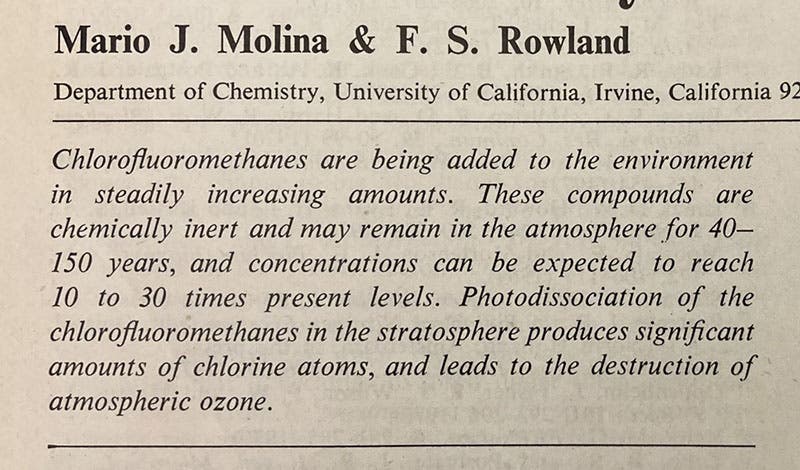
Abstract, ”Stratospheric sink for chlorofluoromethanes: Chlorine atomc-atalysed destruction of ozone,” by Mario J. Molina and F.S. Rowland, Nature, vol. 249, p. 810, June 28, 1974 (The Linda Hall)
Surprisingly, the Molina/Rowland discovery led rather quickly to a complete ban on CFCs in the United States in 1978, as well as in Canada and Mexico, despite howls from the refrigerant industry. But nothing much changed in the stratosphere, as Europe and Asia continued to release CFCs into the environment. It would take another jolt to bring the rest of the world on board, and that happened in 1985, with the discovery of a large hole in the ozone layer over Antarctica. That was alarming to everyone, and by 1990, most of the countries of the world had signed onto the Montreal Protocol of 1987, which completely banned the production or release of CFCs into the atmosphere. For their pioneering discovery of 1974, Molina and Rowland shared the 1995 Nobel Prize in Chemistry.

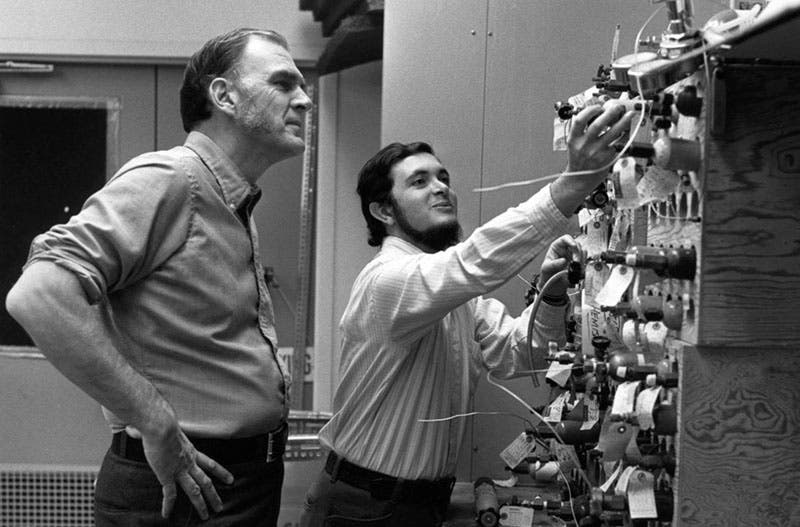
Mario Molina (right) and Sherwood Rowland in their lab at UC-Irvine, 1975 (nobelprize.org)
Molina went on to teach at MIT and UC-San Diego. He lived to see the ozone layer begin to recover in 2006, when the reforms he helped initiate in 1974 finally began to show measurable reduction in upper atmosphere CFCs and repair in the ozone hole.
Molina is quite a hero in his native Mexico, as the first native Mexican to win a Noble Prize in the sciences, and only the third Nobelist overall. He deserves a statue or a bust, neither of which I could find.

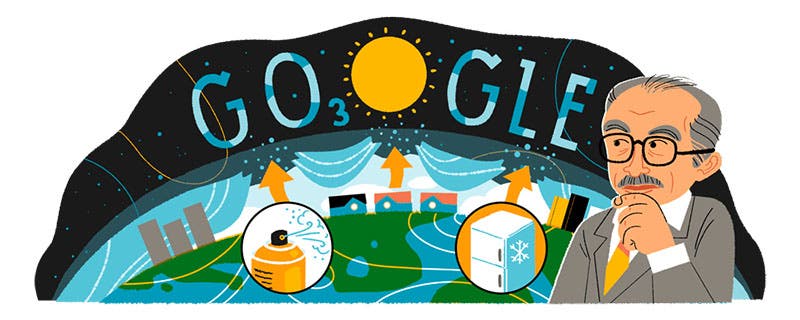
Google Doodle for Mar. 19, 2023, honoring Mario Molina’s 80th birthday; notice how the first “O” of Google has acquired a subscript “3” so that it now represents an ozone molecule (doodles.google)
On Mar. 19, 2023, on what would have been Molina’s 80th birthday, Google ran a Doodle honoring Molina (fifth image). Notice how the first “O” in Google has acquired a subscript “3”, so that it now represents an ozone molecule, ready to be broken down by ultraviolet light (from the second “O,” now the Sun) and the CFCs from below. That was a clever Doodle.
William B. Ashworth, Jr., Consultant for the History of Science, Linda Hall Library and Associate Professor emeritus, Department of History, University of Missouri-Kansas City. Comments or corrections are welcome; please direct to ashworthw@umkc.edu.