Scientist of the Day - George Westinghouse

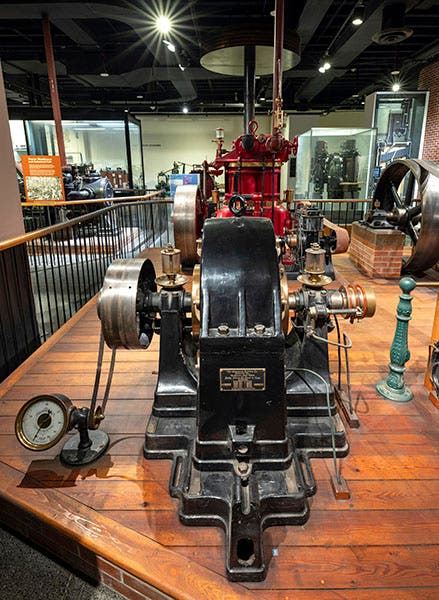
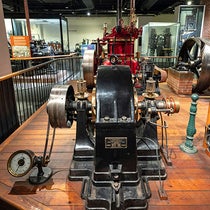
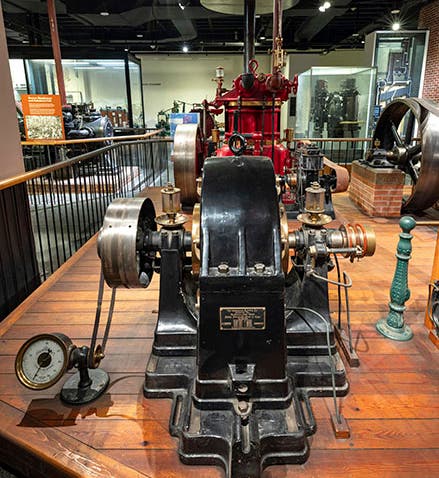
A Westinghouse single-phase AC generator, built in 1888, on display in the National Museum of American History, Smithsonian Institution (collections.si.edu)
George Westinghouse, an American machinist, inventor, entrepreneur, and manufacturer, was born Oct. 6, 1846, in Central Bridge, New York, whose single Notable Person on Wikipedia is Westinghouse. His father ran a machine shop, where George learned the art and craft of making things out of metal. After the Civil War, when he served in both the Union Army and Navy, he returned to Central Bridge to work on the first of his big ideas, this one for a single cast iron frog to allow two railroad tracks to cross at an angle. To be near cheaper sources of iron, he moved to Pittsburgh, along with his new wife. And there, he had perhaps his greatest idea of all, a railway air brake.

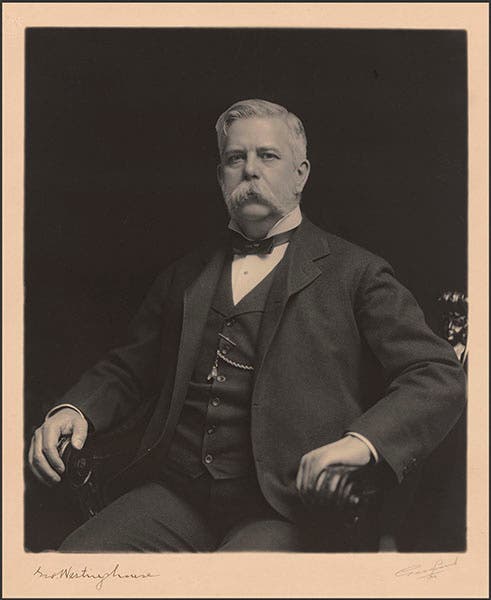
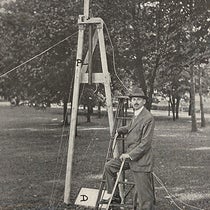
Portrait of George Westinghouse, photograph, 1906, National Portrait Gallery, Smithsonian (collections.si.edu)
There was no good way to stop a railroad train except by braking the locomotive, but the cars behind had considerable momentum, and they could only be slowed individually, by applying brakes manually, a cumbersome, time-consuming, and dangerous process. Westinghouse's idea was to have the locomotive supply compressed air via tubing for the entire length of the train, which would operate brakes on each car. The initial idea was to have the compressed air set the brakes, but Westinghouse soon realized that such a system would provide no braking if the air line were interrupted, and he switched to a fail-safe system where the compressed air would release the breaks; if the airflow were interrupted, the brakes were applied. Only when airflow was uninterrupted along the entire train would all brakes be released and the train free to move.

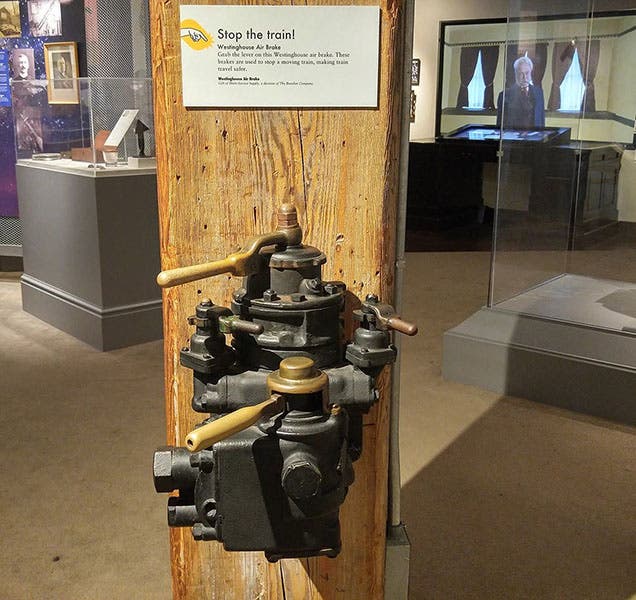
Westinghouse air brake control valve, undated but 1870s, on display in the Heinz History Center, Pittsburgh (facebook.com)
It was a brilliant solution to a considerable problem, and Westinghouse immediately formed a company to manufacture air brakes for any railroad that wanted them, and refused to license patents so that the rail companies could build their own. The Westinghouse Air Brake Company supplied brakes to railroads internationally from 1869 until 1999.

Ten 5,000 horsepower Westinghouse AC generators, Niagara Falls, 1895 (Wikimedia commons)
In the early 1880s, Westinghouse moved into lighting gas distribution systems, even discovering gas on the property of his Pittsburgh estate Solitude, which he was not reluctant to tap with several ugly derricks. But at that time, Thomas A. Edison was busy laying out power grids for numerous DC (direct current) electricity distribution systems in New York City. DC systems were simple but limited in range, because there was no way to increase the voltage for a DC system (and thus reduce the current and the heat loss), which meant that distribution lines could extend no more than a mile.
Westinghouse learned that two engineers, in England and France, had developed a transformer that could step down high-voltage AC (alternating current) for consumer use; a power company could transmit AC at high voltage (thus limiting heat loss) and then use transformers to provide low voltage (i.e. 100 volt) electricity to the public. Westinghouse bought the U.S. rights to the new transformers and turned his own young genius, William Stanley, loose to redesign everything. And thus Westinghouse entered what came to be called the "current wars," as Edison and Westinghouse battled, DC vs AC, to see what the first electrical grid systems were going to look like. Stanley moved to Great Barrington, Mass., built a power station outside of town (which you could not do with a DC system) and lit the place up.

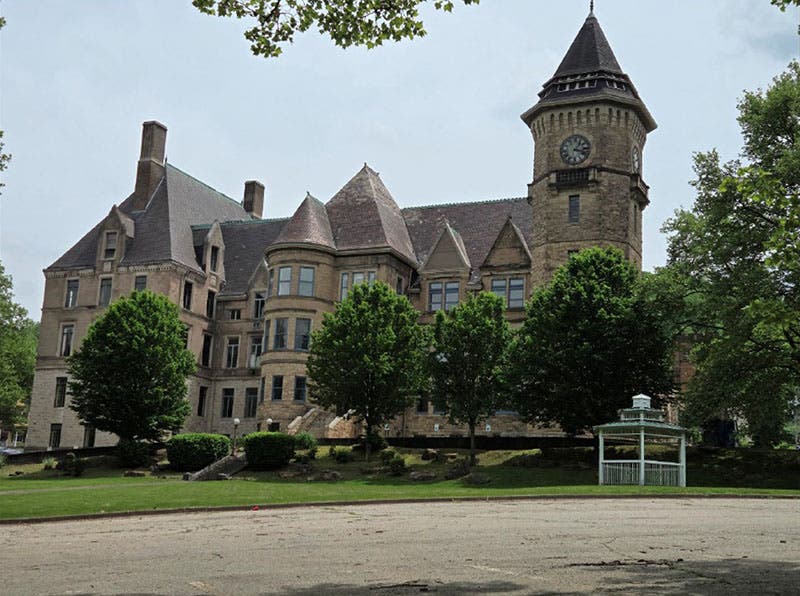
The former General Offices of the Westinghouse Air Brake Company, Wilmerding, Penn., now repurposed as an event space,
The big advantage of a DC system was in the motors. A DC motor was straightforward to build. In an AC system, the current reverses itself 60 times a second. Unless you wanted a motor that also reversed itself, you had to find a way to switch the direction of the current in the motor during the half cycle when it was going the other way. This was done with something called a commutator, a split contact on the rotating axis of the motor. Current was fed to the commutator by brushes, sticks of carbon that rubbed on the rotating commutator and made continuous electrical contact. As you can imagine, brushes and commutators were prone to wear and not a happy solution. Fortunately for Westinghouse, Nikola Tesla had just invented a brushless AC motor – a "polyphase induction" motor – that did away with moving electrical contacts. Westinghouse acquired those rights and all the pieces were in place. Edison countered with a campaign focused on the supposed dangers inherent in high-voltage AC. But eventually Westinghouse won the job of electrifying the World’s Columbian Exposition in Chicago in 1893, and everything went swimmingly. Westinghouse then was awarded the contract to build the first large-scale hydroelectric power plant at Niagara Falls, with massive AC generators (fourth image). The current wars were effectively over, as General Electric, Edison’s distribution company, switched to AC.

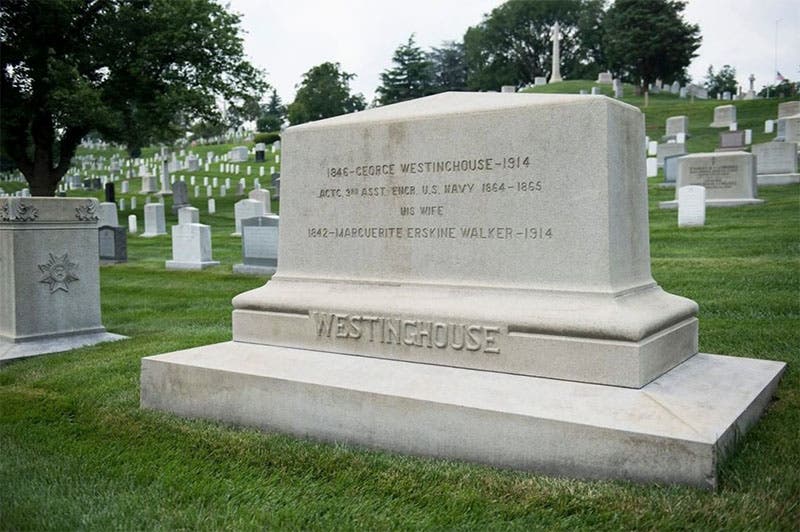
Grave of George Westinghouse and his wife Marguerite, Arlington National Cemetery, Arlington, Va. (findagrave.com)
George Westinghouse seems to have been a reasonably good fellow in an era of scoundrels. Sure, he was filthy rich, and built huge mansions in Pittsburgh, Massachusetts, and Washington, D.C., and hobnobbed with the likes of Andrew Carnegie, Henry Clay Frick, and Andrew Mellon. But he had just one wife, whom he married in 1867 when he was a nobody, and he treated his workers well. There is a Westinghouse Park in Pittsburgh, where his mansion used to be, and various of his inventions are on display in the National Museum of American History at the Smithsonian, and the Heinz History Center in Pittsburgh. And some of his corporate buildings, which were quite attractive and impressive, have been preserved and repurposed (fifth image). But I didn't find much else in the way of Westinghouse places to visit. Even his grave is simple, since he opted for Arlington National Cemetery as his final resting place (last image). He died on Mar. 12, 1914, in New York City, at age 67.
Not surprisingly, there are a number of books about Westinghouse, Edison, Tesla, and the current wars. I relied primarily on Empires of Light: Edison, Tesla, Westinghouse, and the Race to Electrify the World (2003), by Jill Jonnes.
William B. Ashworth, Jr., Consultant for the History of Science, Linda Hall Library and Associate Professor emeritus, Department of History, University of Missouri-Kansas City. Comments or corrections are welcome; please direct to ashworthw@umkc.edu.