Scientist of the Day - Robert Goddard

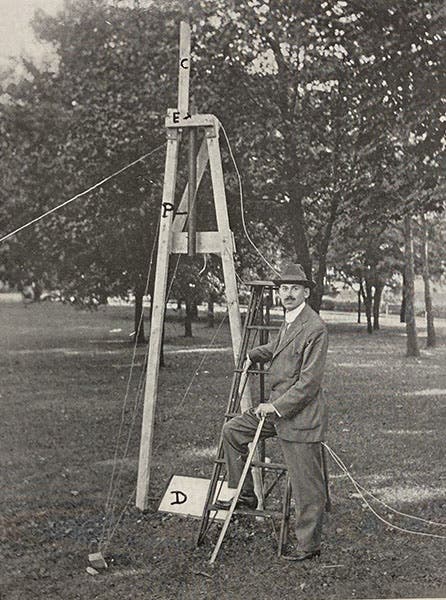
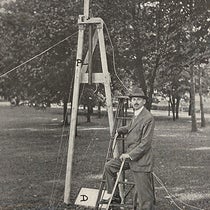
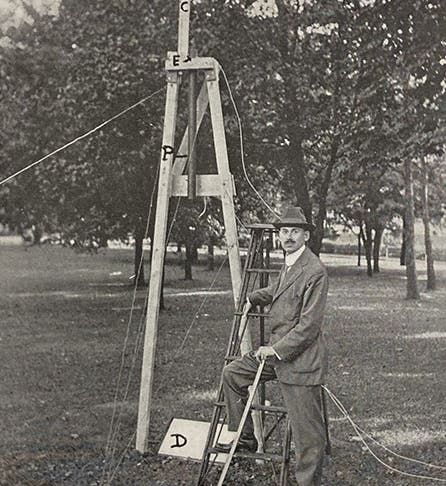
Robert Goddard with a rocket of his own design and construction, photograph, “A Method of Reaching Extreme Altitudes,” by Robert H. Goddard, Smithsonian Miscellaneous Collections, plate 6, fig. 1, vol. 71, no. 2, 1919 (The Linda Hall)
Robert Hutchings Goddard, an American physicist and rocket pioneer, was born Oct. 5, 1882, in Worcester, Mass. Goddard was the first American to design a high-altitude solid-fuel rocket and publish it, in 1919, and then follow it up with the first successful launch of a liquid-fuel (gasoline and liquid oxygen) rocket in 1926. We told this part of Goddard's story in an early post, which still reads well, although for some reason we did not include any images from our small Goddard collection, nor did we discuss his second publication of 1936. So today we revisit Professor Goddard, with some additional information and many more images.

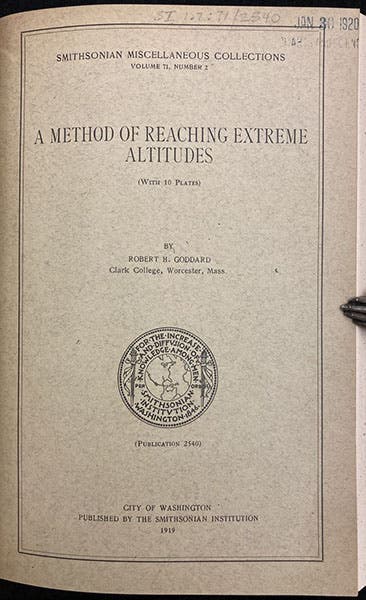
“A Method of Reaching Extreme Altitudes,” by Robert H. Goddard, Smithsonian Miscellaneous Collections, vol. 71, no. 2, 1919 (The Linda Hall)
In my first post, I did not sufficiently stress the novelty of Goddard's work. Rockets had been around as long as gunpowder, at least a millennium, but they were all the same, right up to 1900 – a tube packed with black powder cake that might have a range of a mile. The first person to imagine an entirely new kind of rocket was Konstantin Tsiolkovskii, a Russian schoolteacher. Tsiolkovskii completely rethought the rocket, imagining ones with liquid fuel and oxidizer in separate tanks, and a combustion chamber, and even multiple stages to help escape Earth’s gravitational pull. He published some articles, beginning around 1900, but he was not an engineer and never tried to build or launch a rocket. He was totally unknown, even in Russia, until the Bolsheviks made him a people's hero in 1920. But knowledge of his work did not make it to the West until the 1930s. We have written a post on Tsiolkovskii. Goddard knew nothing about him, so he started from ground level, and unlike Tsiolkovskii, he actually built and flew the rockets he designed.

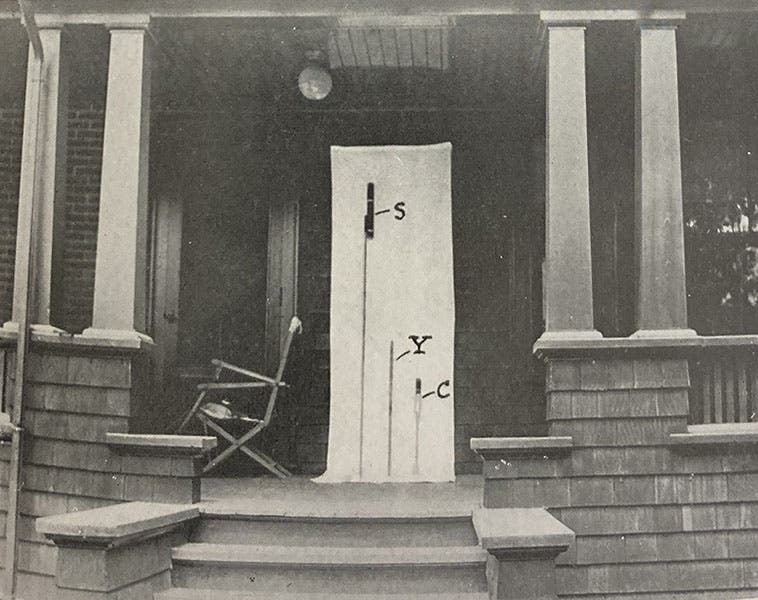
Various small rockets on Robert Goddard’s front porch, photograph, “A Method of Reaching Extreme Altitudes,” by Robert H. Goddard, Smithsonian Miscellaneous Collections, plate 1, fig. 2, vol. 71, no. 2, 1919 (The Linda Hall)
After his initial successful launch of 1926, Goddard continued to improve his rockets, and soon outgrew the farm in Auburn, Mass. that provided his initial launching area. So he bought some property near Roswell, New Mexico, and moved his operations there in 1930. When the government was not interested in supporting his research, he found financial backing from the Gugenheim Foundation. By 1935, he was launching rockets with gyroscope stabilizers and exhaust-directing vanes to altitudes of 7500 feet.

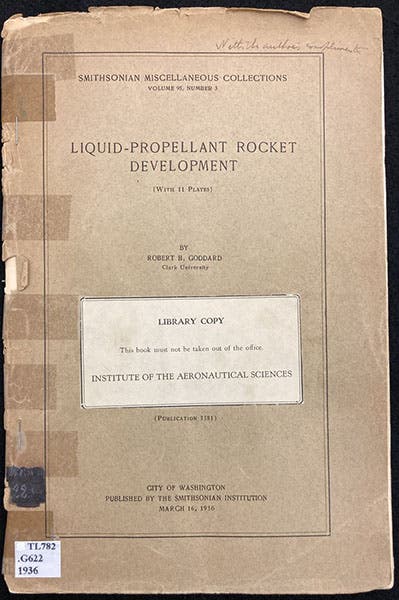
Front cover, “Liquid-Propellant Rocket Development,” by Robert H. Goddard, Smithsonian Miscellaneous Collections, vol. 95, no. 3, 1919 (The Linda Hall)

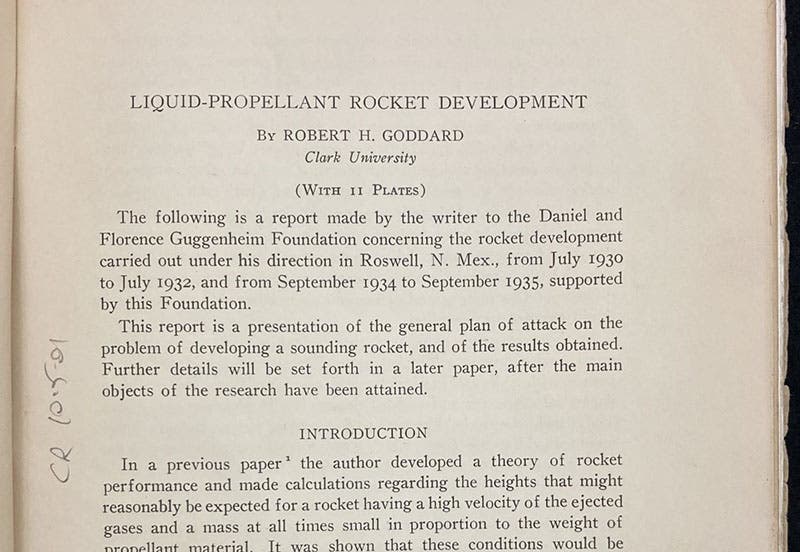
First paragraph, “Liquid-Propellant Rocket Development,” by Robert H. Goddard, Smithsonian Miscellaneous Collections, p. 1, vol. 95, no. 3, 1919 (The Linda Hall)
Goddard was a shy and secretive man and did not publish anything further about his rockets until 1936, when a long article appeared in the Miscellaneous Collections of the Smithsonian Institution, th same journal that had published his more famous paper of 1919. It was called “Liquid-propellant rocket development,” and it was his second and last publication on rockets. If you wanted to build a rocket of your own, the plans were all there. For the next 20 years, the only people interested in Goddard’s work were the Germans, inspired by the work of their own rocket pioneer, Hermann Oberth. The American military was totally blind to the potential of rocketry until World War II, when the German V-2 program suddenly made everything quite clear.

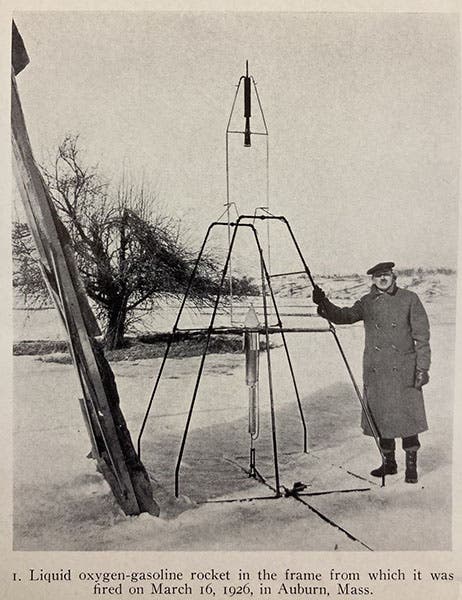
Famous photograph of Robert Goddadd with his first rocket, launched Mar. 16, 1926, “Liquid-Propellant Rocket Development,” by Robert H. Goddard, Smithsonian Miscellaneous Collections, plate 1, fig. 1, vol. 95, no. 3, 1919 (The Linda Hall)

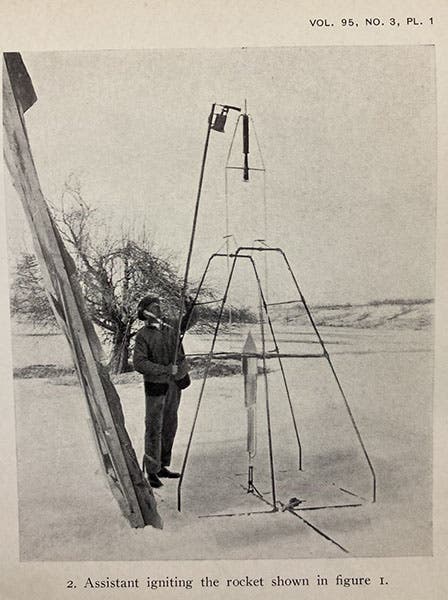
No-so-famous photograph of assistant lighting first rocket, launched Mar. 16, 1926, “Liquid-Propellant Rocket Development,” by Robert H. Goddard, Smithsonian Miscellaneous Collections, plate 1, fig. 2, vol. 95, no. 3, 1919 (The Linda Hall)
Both of Goddard’s papers are government documents, and are part of our vast Documents collection, but we keep these two in the tiny Documents section of our Special Collections (along with Dr. Seuss’s pamphlet on malaria). The most famous photograph of Goddard, showing him with the rocket that he would launch on Mar. 16, 1926, and which we showed from an outside source in our first post, was published in the second paper of 1936, and we show that printing here (sixth image), as well as the photo next to it, which is never reproduced, showing an assistant igniting that first rocket with a blow-torch (seventh image).

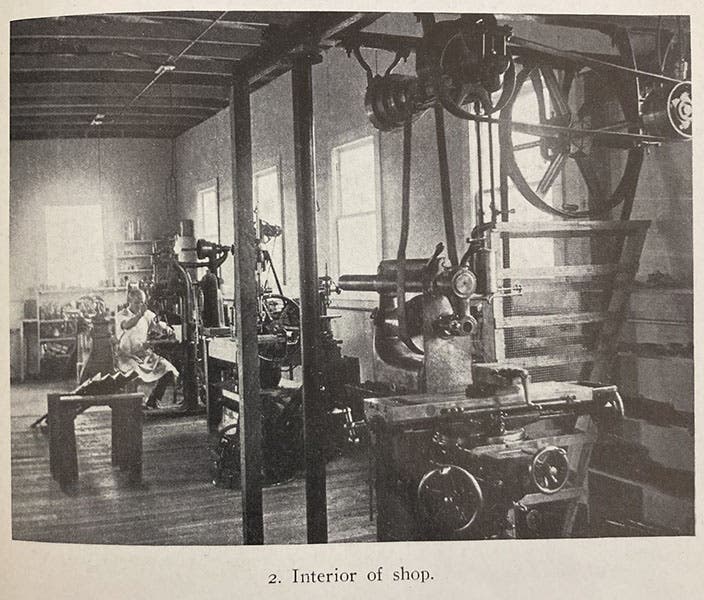
Goddard’s shop, Roswell, New Mexico, photograph, “Liquid-Propellant Rocket Development,” by Robert H. Goddard, Smithsonian Miscellaneous Collections, plate 3, fig. 2, vol. 95, no. 3, 1919 (The Linda Hall)
We also include here a photo of Goddard’s front porch before 1919, with three of his first rockets on display (third image), a photo of his rocket-building shop in Roswell, New Mexico, outfitted by the Gugenheim Foundation (eighth image), and a photo of his launch tower in Roswell (last image), all of these from one or the other of his two Smithsonian publications.

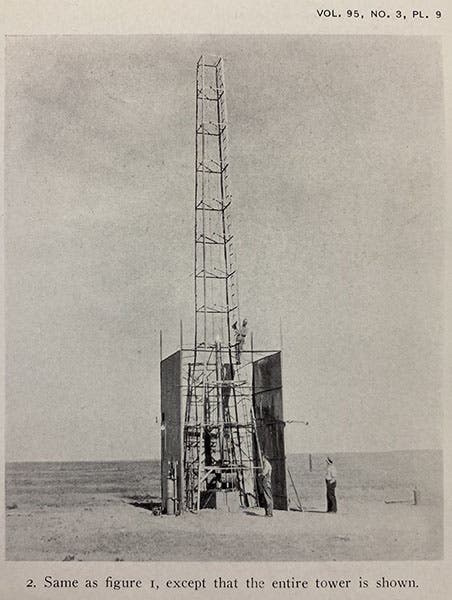
Rocket launch tower, Roswell, New Mexico, photograph, “Liquid-Propellant Rocket Development,” by Robert H. Goddard, Smithsonian Miscellaneous Collections, plate 9, fig. 2, vol. 95, no. 3, 1919 (The Linda Hall)
An excellent brief account of the work of Goddard and its relationship to that of Tsiolkovskii and Oberth may be found in Rockets and Missiles: The Life Story of a Technology (2004), by A. Bowdoin Van Riper, chapter 3: "The Birth of Modern Rocketry, 1900-1942."
William B. Ashworth, Jr., Consultant for the History of Science, Linda Hall Library and Associate Professor emeritus, Department of History, University of Missouri-Kansas City. Comments or corrections are welcome; please direct to ashworthw@umkc.edu.