Scientist of the Day - Gabriele Falloppio

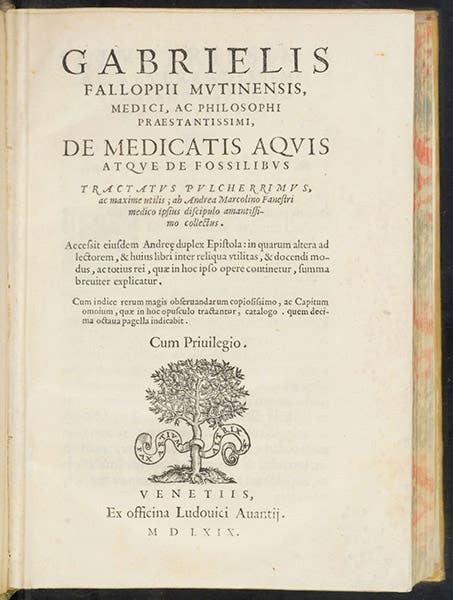
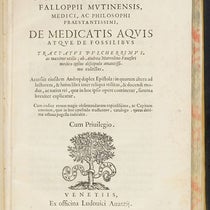
Title page, De medicatis aquis, atque de fossilibus, by Gabriele Falloppio, 1569 (The Linda Hall)
Gabriele Falloppio, an Italian anatomist, died Oct. 9, 1562, in Padua, where he was professor of anatomy, following in the footsteps of Andreas Vesalius and Realdo Columbo. And he was one of the teachers of the comparative anatomist Volcher Coiter. His name is recognizable to most people with a working knowledge of human anatomy as the eponym for the Fallopian tubes, which carry the ovum to the uterus, and which he actually did discover. He also discovered many canals, islets, ducts, fenestrae, and other structures of that ilk, in the skull, many related to the ear and the auditory network it feeds. Much of this is contained in the one book he published in his short life, called Anatomical Observations (1561), which we do not have, as it is out of scope.

Portrait of Gabriele Falloppio, engraving, 1688, Wellcome Collecion (Wikimedia commons)
Fortunately for us, and for this post, Falloppio gave a year's worth of lectures in 1556-57 on medicinal waters and thermal baths, which included a long discussion on petrifactions and figured stones, or fossils. It was first printed posthumously as De medicatis aquis atque de fossilibus (On medical waters and fossils) in 1564, and then again in 1569. Fossils are very much our kind of thing, and we are pleased to have a copy of the 1569 edition in our collections (first image). There is only one illustration in the book, which has nothing to do with fossils, showing a chemical furnace, but we include it anyway, since everyone likes images (third image). His other book, on anatomy, had no woodcuts at all – Falloppio was apparently a man of words, and not images.
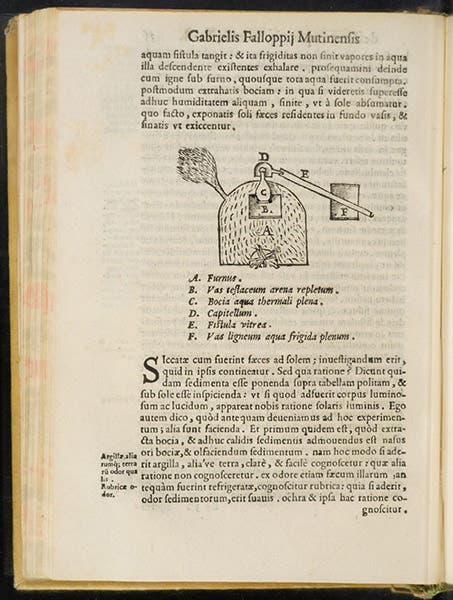
Chemical furnace, woodcut, De medicatis aquis, atque de fossilibus, by Gabiele Falloppio, p. 35 verso, 1569 (The Linda Hall)
Falloppio's discussion of fossils has seldom been looked at by historians of geology and paleontology. Charles Lyell mentioned Falloppio's book in the early pages of his Principles of Geology (1830-33), but as Falloppio denied the organic origin of fossils, Lyell did not linger. Martin J.S. Rudwick brought up Falloppio three times in his still exemplary book, The Meaning of Fossils (1972), the first book on the history of fossils I ever read, and was I ever lucky to start out with that one. Rudwick argued that Falloppio was justified in denying that marine fossils found on a mountain top far from the sea could be the remains of living things, given the current knowledge of the Earth’s surface in 1557.

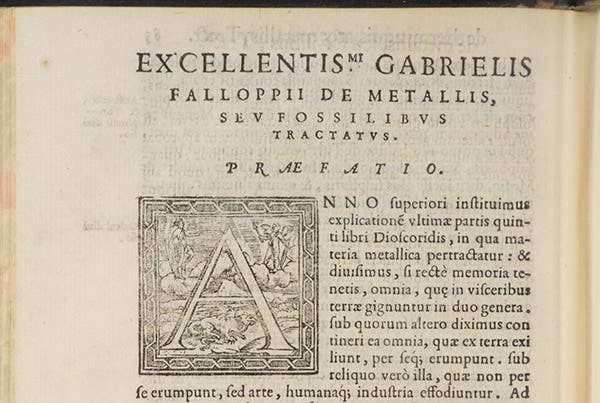
Beginning of second treatise, “On Metals and Fossils,” De medicatis aquis, atque de fossilibus, by Gabriele Falloppio, p. 85 verso, 1569 (The Linda Hall)
But hardly anyone else has looked at the 182 pages that Falloppio devoted to stones and fossils in his lectures and subsequent publication. There has been a recent book on Falloppio as anatomist (Gabrielle Falloppio: The Life and Work of a Renaissance Anatomist, by Michael Stolberg, 2022), but we do not own it, and I have not seen a copy. I hope the author spent some time with De medicatis aquis, but if not, I hope someone else accepts this challenge, to provide us with a full understanding of Falloppio's attitude toward metals, earths, and especially, figured stones.

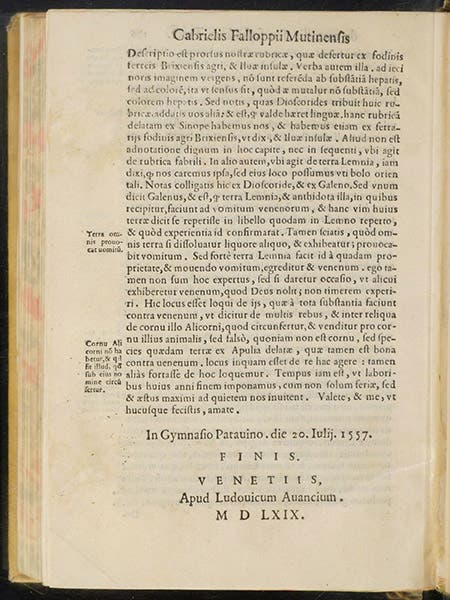
Colophon, showing that the lectures were given in 1556 and 1557, but were not published here until 1569, De medicatis aquis, atque de fossilibus, by Gabriele Falloppio, p. 176 verso, 1569 (The Linda Hall)
Falloppio died at the age of 38 or 39, of pneumonia. Who knows what a fuller life might have provided him, and us.
William B. Ashworth, Jr., Consultant for the History of Science, Linda Hall Library and Associate Professor emeritus, Department of History, University of Missouri-Kansas City. Comments or corrections are welcome; please direct to ashworthw@umkc.edu.