Scientist of the Day - Chuck Yeager

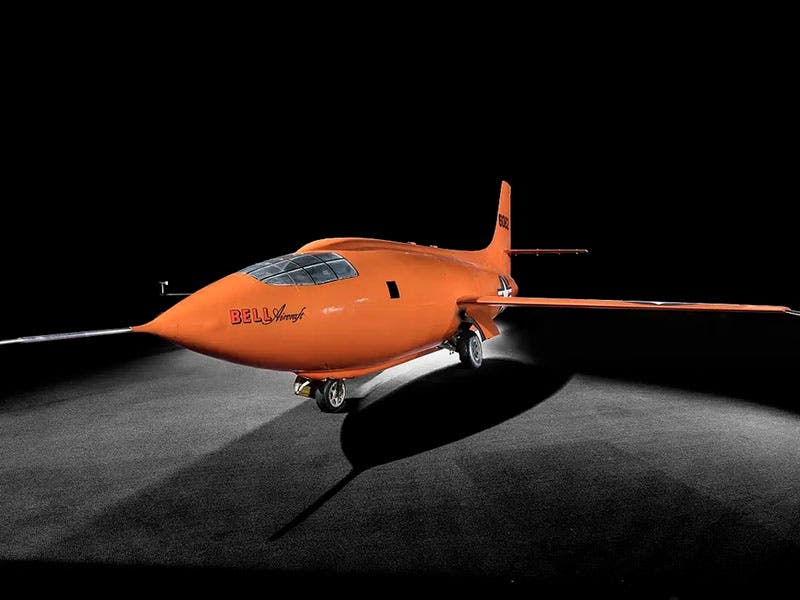
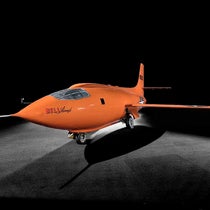
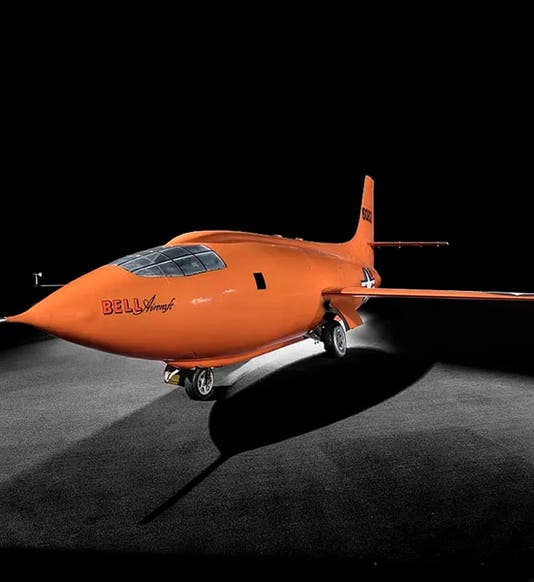
Bell X-1 that broke the sound barrier on Oct. 14, 1947, piloted by Chuck Yeager, on display at the National Air and Space Museum, Smithsonian Institution (airandspace.si.edu)
Chuck Yeager, an American test pilot, was born as Charles Elwood Yeager on Feb. 13, 1923, in Myra, West Virginia. He learned to fly in World War II and became an ace pilot in P-51 Mustangs. After the war, he remained in the U.S. Amy Air Corps (soon the U.S. Air Force) as a test pilot, working for the National Advisory Committee for Aeronautics (NACA).

Chuck Yeager at the tail end of a Lockheed F-104 Starfighter, photograph, 1963 (Wikimedia commons)
During Yeager's early tenure, NACA was concerned with producing and testing supersonic aircraft. They commissioned the XS-1, soon renamed the X-1, from Bell Aircraft in 1944, and by 1946 had 2 models ready to fly. The X-1 was rocket-powered, which was controversial, as jet aircraft had proven their worth during the War. Yeager was chosen as the lead test pilot, and he made a number of subsonic flights at what was then Muroc Army Air Base (now Edward's Air Force Base) in California in late 1946 and early 1947.

Bell X-1 (but not Glamorous Glennis) in the belly of a B-29 Superfortress, 1947 (Wikimedia commons)
But Oct. 14, 1947, was the big day. The X-1, with 6062 painted on its tail and Glamorous Glennis on its nose, was suspended within the belly of a modified B-29 Superfortress and flown to altitude. With Yeager at the controls, the X-1 was dropped and its rocket ignited, and Yeager proceeded to fly it on a level path at 45,000 feet through the sound barrier and achieve Mach 1.05 speed (about 660 mph at that altitude), the first indisputable instance of supersonic flight on a level path. Since no one was entirely sure that an aircraft and/ or its pilot could survive breaking through the sound barrier, that was a big deal, and soon many others would follow suit. Yeager, however, would always be the first.

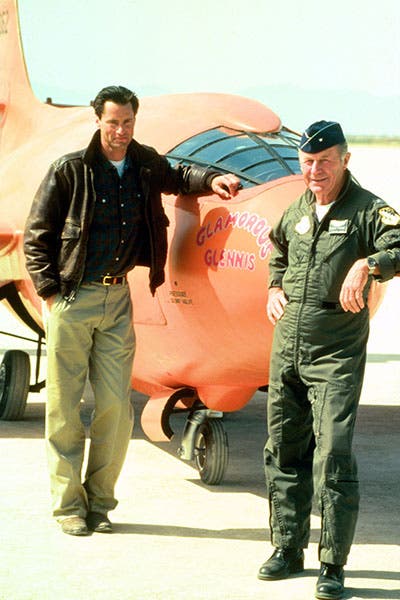
Chuck Yeager (right) and Sam Shepard, who played Yeager in the film, The Right Stuff, photograph, ca 1983 (bamfstyle.com)
The Bell X-1 that broke the sound barrier on that October day is now in the National Air and Space Museum in Washington, D.C. (first image). The orange paint job was a later addition. There is a 3 minute video, distilled down from a longer U.S. Air Force film, that captures Yeager’s breaking of the sound barrier; it is an excellent piece of footage.
Yeager would make many more supersonic flights, including one in 1953, during which, at a speed of Mach 2.44, he discovered a phenomenon called "inertial coupling", unknown until then to aeronautical engineers, in which the aircraft tries its best to tear itself apart by spinning on all three axes--pitch, roll, and yaw--at once. That Yeager managed to pull the plane out of its descent after a fall of 50,000 feet is just one more sign of his remarkable skill as a test pilot

Replica of Bell X-1 at the Cosmosphere, Hutchinson, Kansas (Wikimedia commons)
But in 1958, in the aftermath of Sputnik, NASA was founded, and NACA was disbanded, and Yeager remained outside the burgeoning space program. When they made the film The Right Stuff in 1983, about the Mercury astronaut program, director Philip Kaufman decided to begin the story with a long prelude about the test-pilot era of the late forties and fifties, with the focus on Yeager and the X-1 program. Kaufman did this because that is how Tom Wolfe started his book (1979) of the same name. Yeager was played by Sam Shepard (the real Chuck Yeager also had a cameo part, although it was poorly conceived). But the producers couldn't coax the original X-1 out of retirement, so they either built a replica, or acquired one that had already been built for some other purpose, and it is this X-1 that is seen in the film. Here is a short clip, showing the supersonic flight; it is not particularly accurate, since it had the X-1 going every which way, although in truth it probably didn’t take the real X-1 more than 120 seconds to use up all its rocket fuel and shoot through the sound barrier. But the end of the scene was well done, although cut short in the clip – this was indeed the first time anyone had heard a sonic boom, and no one knew that that sound, so much like an explosion, indicated success, not failure.

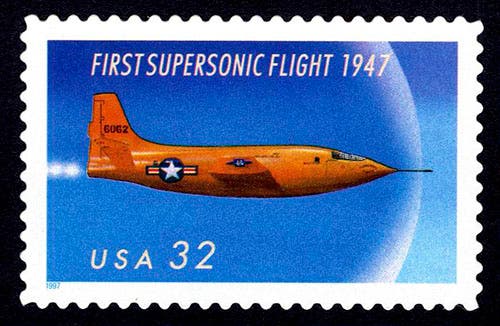
U.S. postage stamp honoring the Bell X-1, issued Oct. 14, 1997, on the 50th anniversary of the first supersonic flight, National Postal Museum, Smithsonian Institution (postalmuseum.si.edu)
Much later, the replica X-1 used in the film was acquired by the Cosmosphere in Hutchinson, Kansas, where you can see it on display. Since most of the Cosmosphere's artefacts are originals, not replicas, they are careful to point out that their X-1 is just a copy of the one in the Smithsonian.
William B. Ashworth, Jr., Consultant for the History of Science, Linda Hall Library and Associate Professor emeritus, Department of History, University of Missouri-Kansas City. Comments or corrections are welcome; please direct to ashworthw@umkc.edu.