Scientist of the Day - Robert Kerr

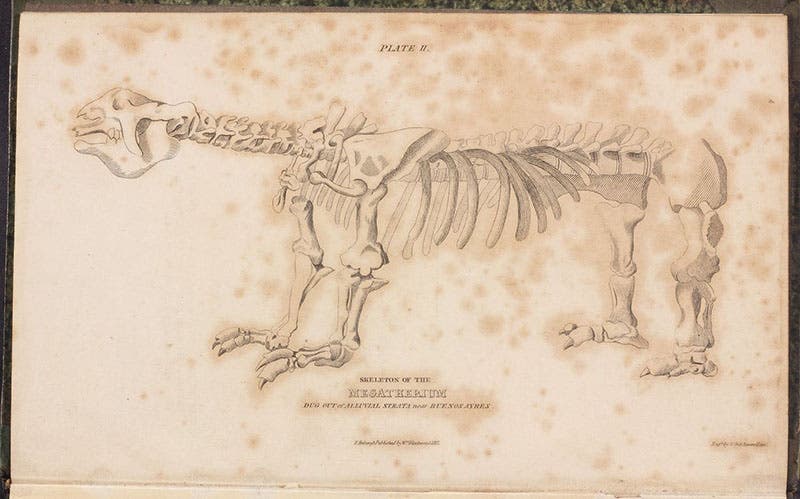
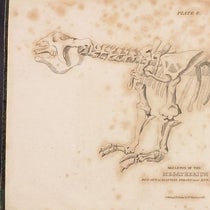
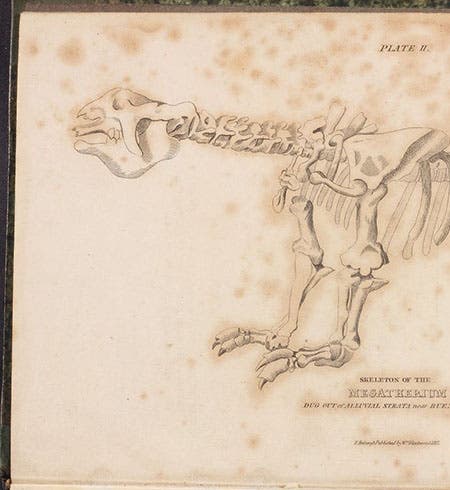
Megatherium, engraved frontispiece by William Lizars, Essay on the Theory of the Earth, translated from the French of M. Cuvier, by Robert Kerr, 1813 (The Linda Hall)
Robert Kerr, a Scottish surgeon and translator, was born on Oct. 20, 1757, in Bughtridge, Roxburghshire, in southeastern Scotland. He studied medicine at the University of Edinburgh and practiced as a surgeon at the Foundlings Hospital in that city. He must have shown some scientific talent or expertise before 1788, for in that year, he was elected a Fellow of the Royal Society of Edinburgh, the same year that James Hutton delivered his paper on his new “Theory of the Earth” to the Society members.

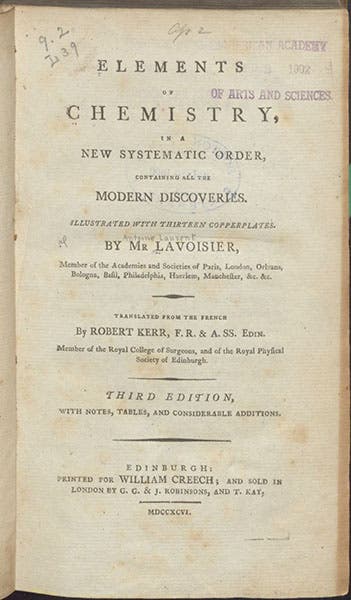
Title page, Elements of Chemistry: In a New Systematic Order, by Antoine Lavoisier, translated by Robert Kerr, 1796 (The Linda Hall)
Kerr's background little prepares us for the fact that, after Antoine Lavoisier published his revolutionary Traité élémentaire de chimie in 1789, proposing a new explanation of combustion involving oxygen and a new chemical nomenclature, Kerr immediately translated the work into English and arranged for its publication in Edinburgh in 1790, the first translation of Lavoisier's work anywhere. Kerr's translation was well received and went through many editions. We do not have the first edition, but do have the third, published in 1796 (second image), as well as a later edition of 1802.

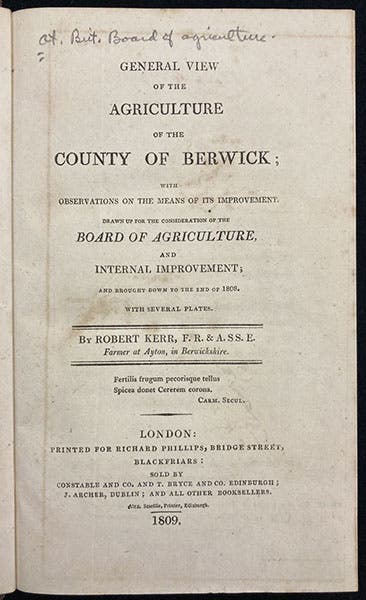
Title page, General View of the Agriculture of the County of Berwick, by Robert Kerr, 1809 (The Linda Hall)
Apparently, Kerr was encouraged by the success of his first translating venture, and he soon published (1792) the first two volumes of a proposed 4-volume English edition of the Systema naturae of Carl Linnaeus. This was a much older book – the definitive 10th edition had been published in 1758-59, and the original was in Latin. Since you had to be able to read Latin to use the Linnaean system, I am guessing the English version was less useful, sold fewer copies, and was left incomplete. We do not have a copy, so I cannot evaluate it further.

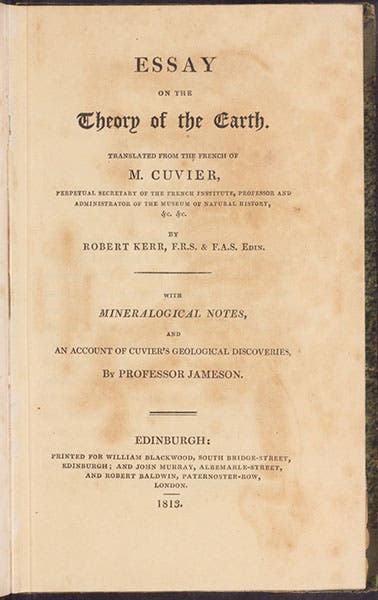
Title page, Essay on the Theory of the Earth, translated from the French of M. Cuvier, by Robert Kerr, 1813 (The Linda Hall)
We don't know much about what Kerr did for the next 19 years, except that he gave up his surgical practice and took over a paper mill in Berwickshire, not too far from his native Roxburghshire, an enterprise that subsequently failed. He re-emerged in 1809 with a book on the agriculture of the county of Berwickshire. This was part of a series sponsored by the Board of Agriculture on every British county, each by different authors, and we have the complete set in our collections, including Kerr's volume, which he apparently wrote for money. The title page tells us that he owned a farm in Ayton, in Berwick. In 1811, Kerr began publishing a collection of historic voyages, which grew to 18 volumes, although most of these appeared after Kerr's death in 1813. We do not own any of this set.

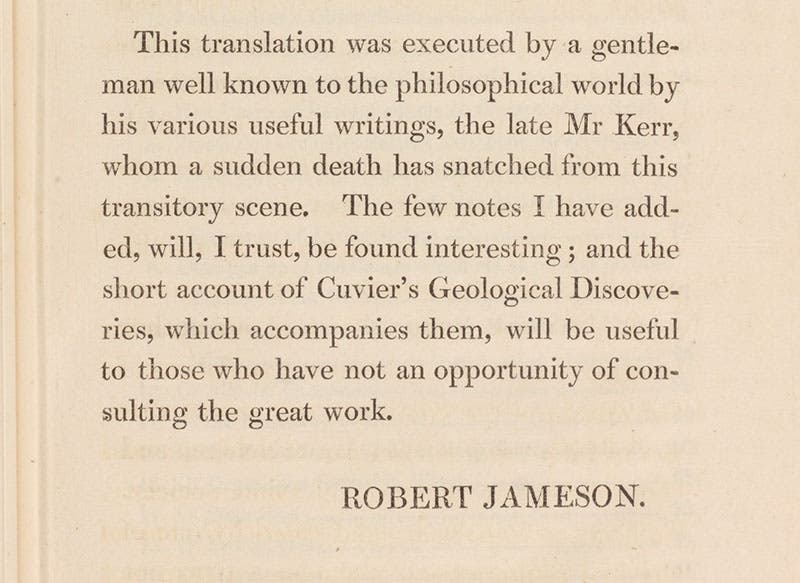
Last paragaph of preface by Robert Jameson, mentioning Robert Kerr, Essay on the Theory of the Earth, translated from the French of M. Cuvier, by Robert Kerr, 1813 (The Linda Hall)
In 1813, Kerr's most successful book was published, although he died before it appeared in print. In 1812, the French comparative anatomist Georges Cuvier had published a 4-volume work on fossil quadrupeds, such as mammoths, mastodons, and megatheria. He began his work with a hundred-page preface explaining his theory of the Earth's geologic history, which involved repeated revolutions and catastrophes, quite different from the uniformitarian view of Hutton. Kerr translated just the preface and published it as Essay on the Theory of the Earth in 1813. It had two plates, which were not part of Cuvier's preface, and for which Kerr was probably not responsible, but we show the first of them here anyway, since they may have helped the book reach a wide market. The Megatherium on the frontispiece (first image) was engraved by William Lizars, who was biding his time in Edinburgh, perhaps waiting for Audubon to come along. The Essay went through many editions, although Kerr's name disappeared from the title page. But since the editor (Robert Jameson) and the publisher (William Blackwood) remained the same, I assume the translation remains that of Kerr. Jameson had some nice things to say about Kerr in his preface to the first edition (fifth image).

Tombstone of Robert Kerr, Greyfriars Kirkyard, Edinburgh (Wikimedia commons)
Kerr was in some ways the English counterpart of Claudine Picardet, who translated many chemical treatises from English (and Swedish) to French in the same period, although she was a far better chemist than Kerr. Kerr was 55 years old when he died in 1813, and we have no portrait to remember him by. But he does have a distinguished tombstone in Greyfriars Cemetery in Edinburgh (last image).
William B. Ashworth, Jr., Consultant for the History of Science, Linda Hall Library and Associate Professor emeritus, Department of History, University of Missouri-Kansas City. Comments or corrections are welcome; please direct to ashworthw@umkc.edu.