Scientist of the Day - Robert Hood

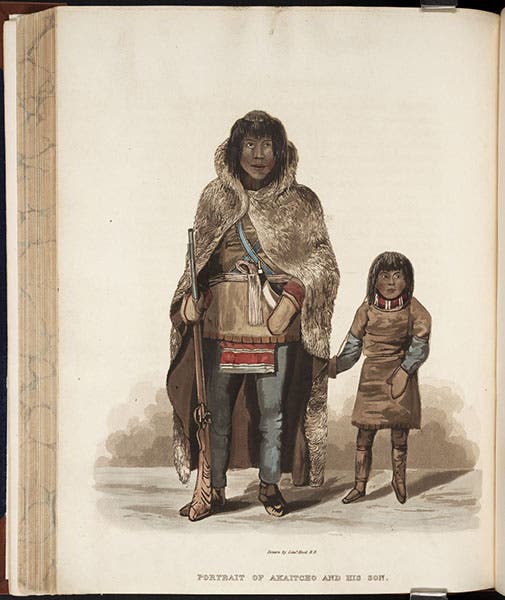
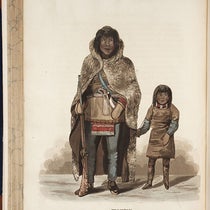
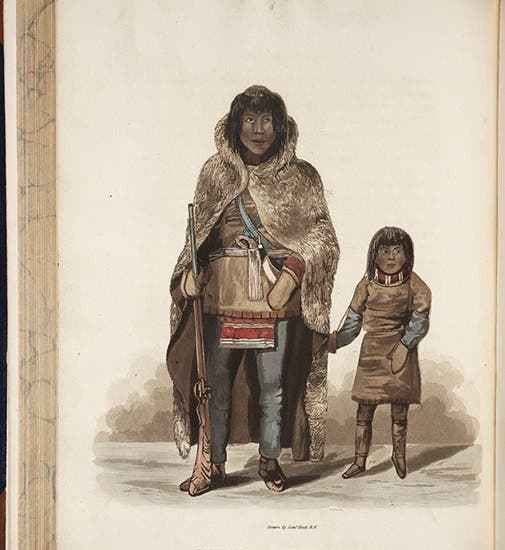
Akaitcho, an Inuit interpreter interpreter, and his son, hand-colored engraving after a watercolor by Robert Hood, Narrative of a Journey to the Shores of the Polar Sea, in the Years 1819, 20, 21, and 22, by John Franklin, p. 203, 1823 (The Linda Hall)
Robert Hood, an Anglo-Irish Royal Navy explorer, surveyor, and expedition artist, was born sometime around 1797 in Ireland. He entered naval service at a young age, as was the custom, and by the time he was 14, he had served in the Mediterranean, the Baltic, and South Africa. The excellence of his drawings, maps, and journals was noted by his superiors, and he was promoted to midshipman.

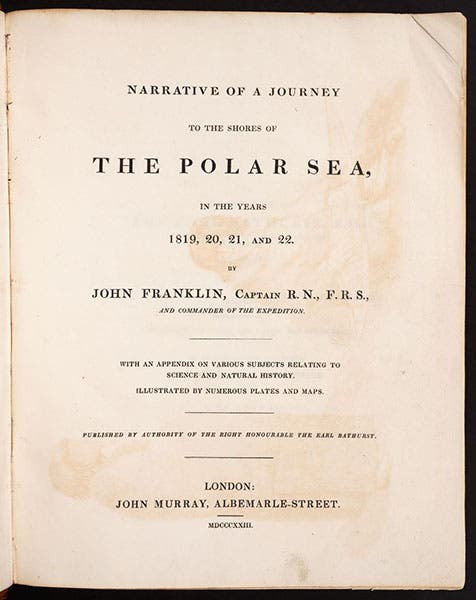
Title page, Narrative of a Journey to the Shores of the Polar Sea, in the Years 1819, 20, 21, and 22, by John Franklin, 1823 (The Linda Hall)
When the Napoleonic Wars ended in 1816, the Royal Navy was hard-pressed to keep its officers and seamen employed, and Admiralty Second Secretary John Barrow decided to make a assault on the Arctic in a search of a Northwest passage. After sending some ships north in 1818, Barrow chose to send a party overland into Hudson Bay Company territory into what is now the Northwest Territories and Nunavut, to see if the Arctic Ocean could be reached that way, and to map the shoreline for any future ships that might pass through. John Franklin, who had made one of the forays of 1818, was put in charge of this unusual land-based naval operation. Second in command was John Richardson, and the two midshipmen were Hood and George Back. We mention their names because all except Hood would become prominent Arctic explorers, Franklin especially so, when he and his entire crew disappeared 26 years later, in 1845.

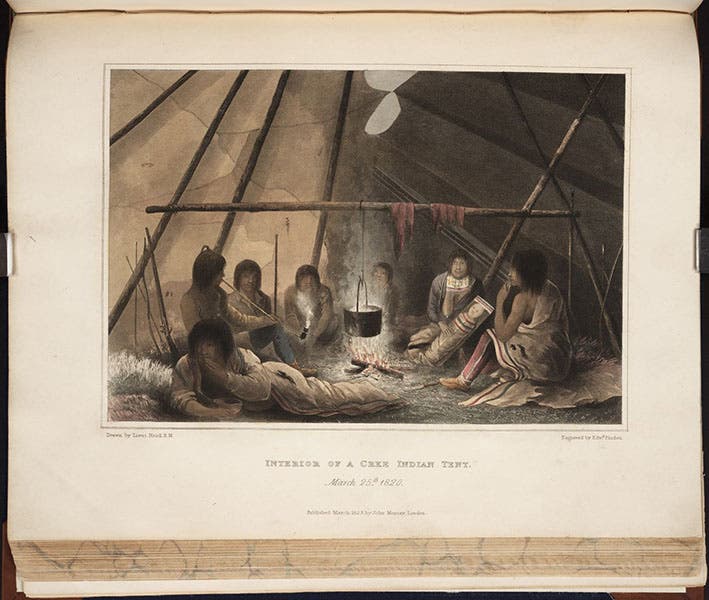
“Interior of a Cree Indian Tent, March 25th, 1820,” hand-colored engraving after a watercolor by Robert Hood, Narrative of a Journey to the Shores of the Polar Sea, in the Years 1819, 20, 21, and 22, by John Franklin, p. 169, 1823 (The Linda Hall)
Franklin's first overland expedition of 1819-22 was a disaster in nearly every way, except that they did make it to the mouth of the Coppermine River and did map much of the coast to the east. But they were short of men, short of boats, and especially, continually short of food, so that on the return from the north (down the newly discovered and named Hood River), they were reduced to eating "rock tripe," a lichen that was only barely edible.

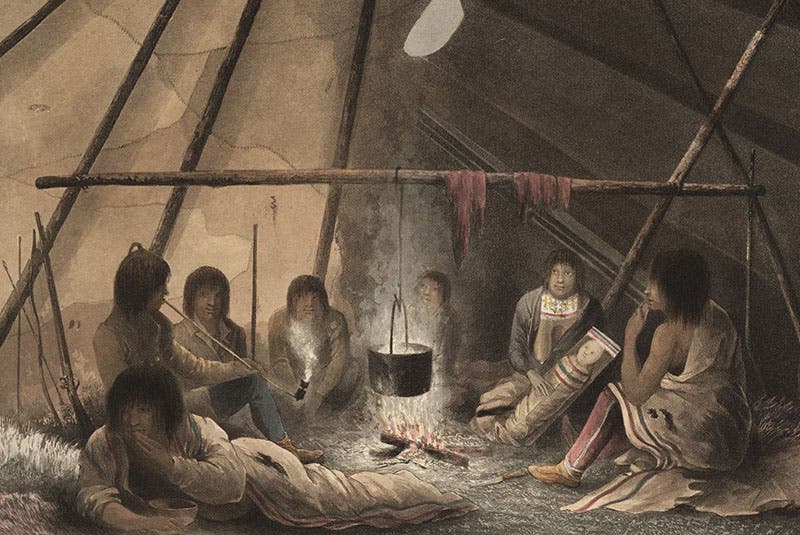
Cree Indian Tent interior, detail of a hand-colored engraving after a watercolor by Robert Hood, Narrative of a Journey to the Shores of the Polar Sea, in the Years 1819, 20, 21, and 22, by John Franklin, p. 169, 1823 (The Linda Hall)

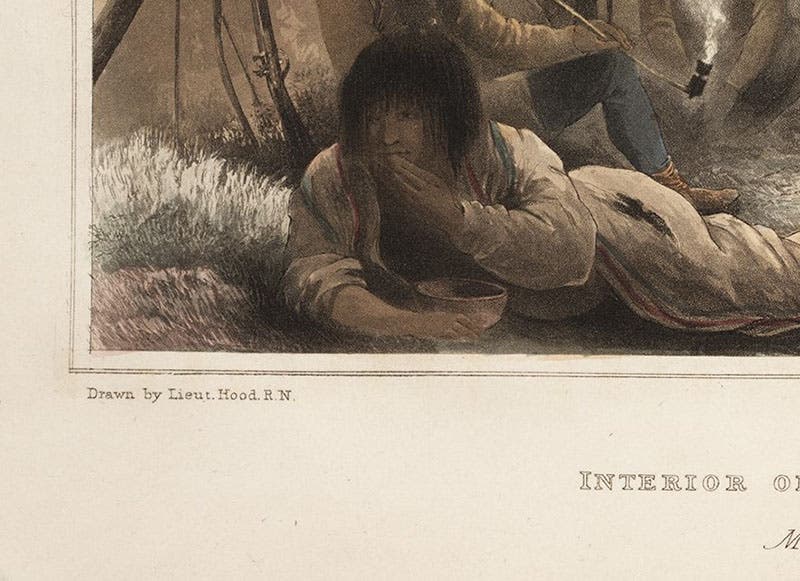
Signature of Robert Hood, detail of engraving, Narrative of a Journey to the Shores of the Polar Sea, in the Years 1819, 20, 21, and 22, by John Franklin, p. 169, 1823 (The Linda Hall)
Hood grew so weak that he and several others had to be left behind while the stronger went in search for provisions. On Oct. 20 or 21, 1821, Hood was murdered in his tent by a Canadian voyageur for, it is suspected, cannibalistic reasons. The murder was discovered almost immediately by Richardson, who executed the voyageur on the spot. For Hood, it was a sad end to what promised to be a stellar career, as he was a better artist than nearly all of the other talented naval personnel, like Back, who took their watercolors north.

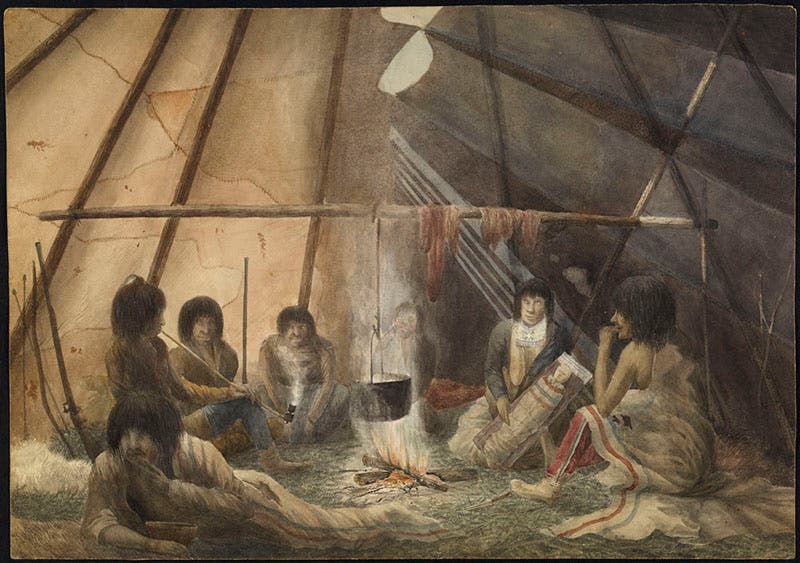
“The Interior of a Southern Indian Tent,” original watercolor by Robert Hood, 1820, Library and Archives Canada (LAC) (thediscoverblog.com)

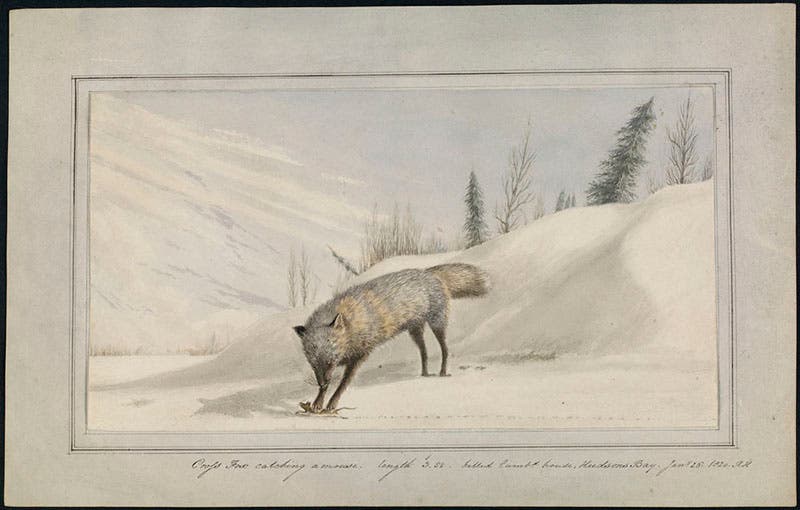
“Fox catching a Mouse,” original watercolor by Robert Hood, 1820, Library and Archives Canada (LAC) (thediscoverblog.com)
When Franklin published the narrative of his fiasco of an expedition (11 of the 20 participants died or disappeared), he chose 7 or so Hood drawings to be included as engravings, three of them selected to be hand-colored, and we show all three here. The first shows an Inuit interpreter and his young son. Another, the most ethnographically valuable, depicts the interior of a Cree tent (third-fifth images). We include two details, one of them showing Hood's signature. The original watercolor from which the engraving was made survives in the Library and Archives Canada (LAC), and we show that as well (sixth image), along with another surviving Hood watercolor that did not end up as an engraving, showing an Arctic fox catching a mouse (seventh image).

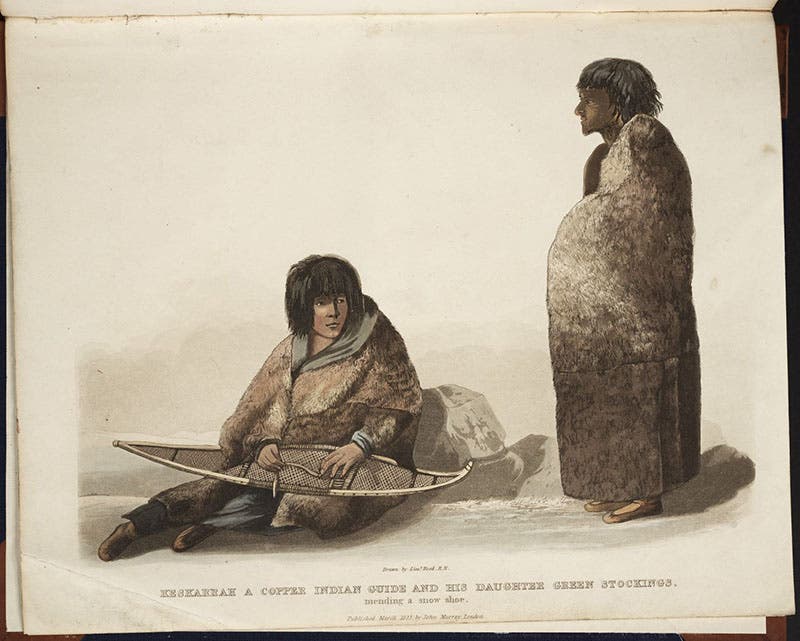
Keskarrah a Copper Indian Guide and his daughter Green Stockings mending a snow shoe,” hand-colored engraved frontispiece after a watercolor by Robert Hood, A Narrative of a Journey to the Shores of the Polar Sea, in the Years 1819, 20, 21, and 22, by John Franklin, 1823 (The Linda Hall)
The most poignant painting is the one Franklin chose for the frontispiece of his Narrative (eighth image). It shows a Copper Indian guide and his 15-year-old daughter, Green Stockings. Hood and Back both fell for the young woman, and a duel was avoided only when Back was sent on a mission to secure provisions. Hood and Green Stockings had a son, born in the spring of 1821, 6 months before Hood was killed. I do not believe the fate of mother or son is known.

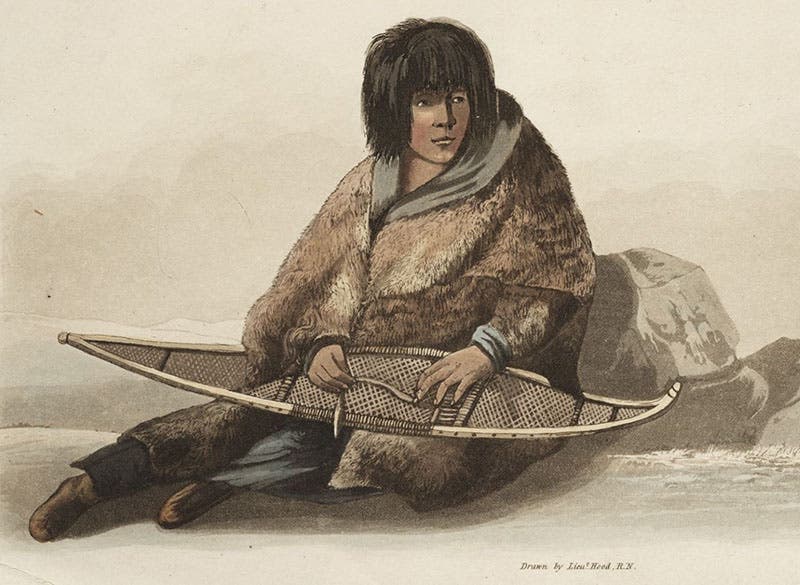
Green Stockings, a Copper Indian 15-year-old woman, mending a snowshoe, detail of a hand-colored engraved frontispiece with signature of Robert Hood, A Narrative of a Journey to the Shores of the Polar Sea, in the Years 1819, 20, 21, and 22, by John Franklin, 1823 (The Linda Hall)
We included Franklin's Narrative of his first expedition in our exhibition, Ice: A Victorian Romance (2008-09). But the illustrations we displayed were those of George Back, one of which (the forest scene) we later used for the Library's holiday card.
William B. Ashworth, Jr., Consultant for the History of Science, Linda Hall Library and Associate Professor emeritus, Department of History, University of Missouri-Kansas City. Comments or corrections are welcome; please direct to ashworthw@umkc.edu.