Scientist of the Day - François-André Michaux

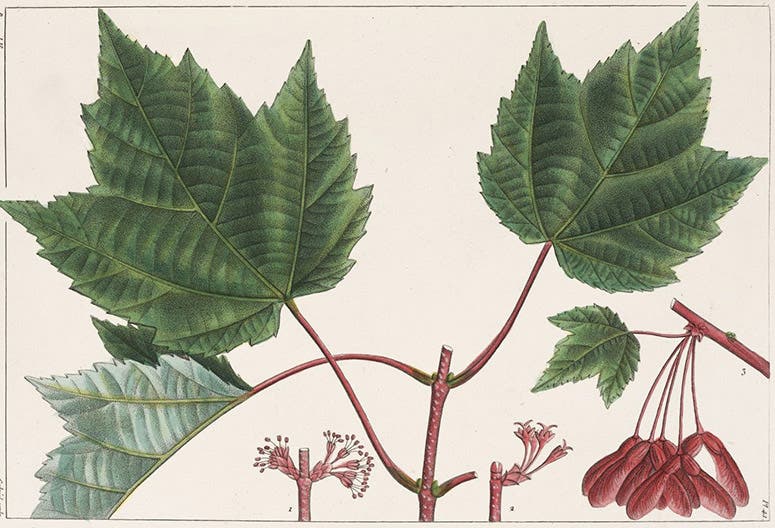
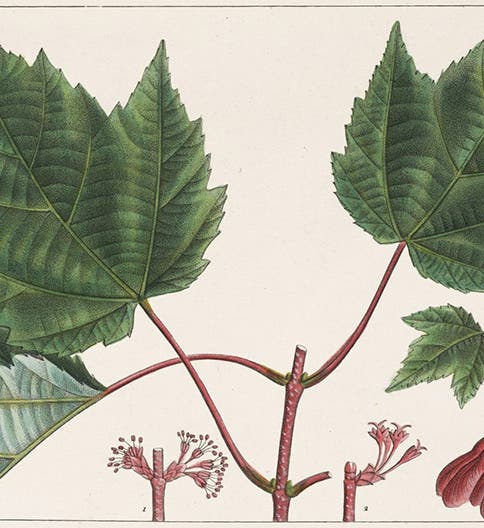
Red-flowering Maple, Acer rubrum, slight cropping of hand-colored engraving by Pancrace Bessa, The North American Sylva: or, A Description of the Forest Trees of the United States, Canada, and Nova Scotia, by François-André Michaux, vol. 1, plate 49 1865 (The Linda Hall)
François-André Michaux, a French botanist who spent part of his youth in the forests of North America, died Oct. 23, 1855, at the age of 85. His father, André, was also a botanist and had been sent to the new United States in 1785 by the French government to collect North American plants, especially trees, to replenish the forests that had been depleted by the ship-building needs of the French navy. André brought his 15-year-old son with him, and thus François began his lifelong association with American hardwoods.

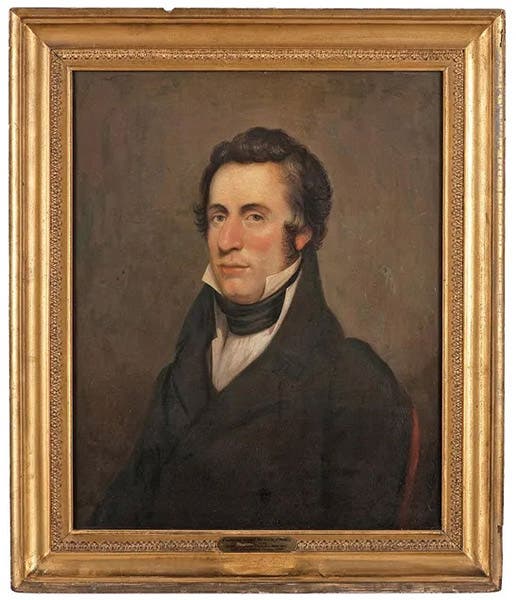
Portrait of François-André Michaux, by Rembrandt Peale, 1809-10, American Philosophical Society, Philadelphia (smithsonianmag.com)
François returned to France after 5 years to complete his education and help his father publish his beautiful book on the oaks of North America, Histoire des chênes de l'Amérique (1801), which we have in our collections and featured in posts in 2018 and 2024, and then assisted with the posthumous publication of André's Flora Boreali-Americana (1803), which we do not own.

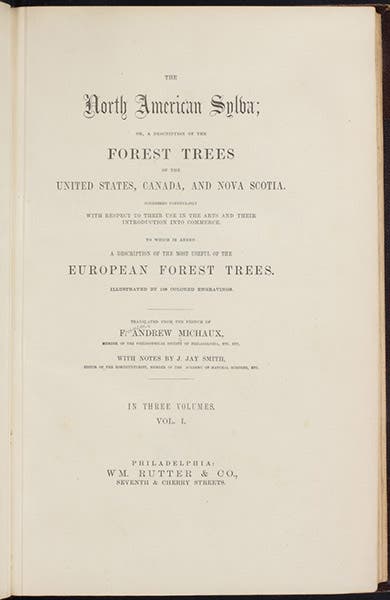
Title page, The North American Sylva: or, A Description of the Forest Trees of the United States, Canada, and Nova Scotia, by François-André Michaux, vol. 1, 1865 (The Linda Hall)

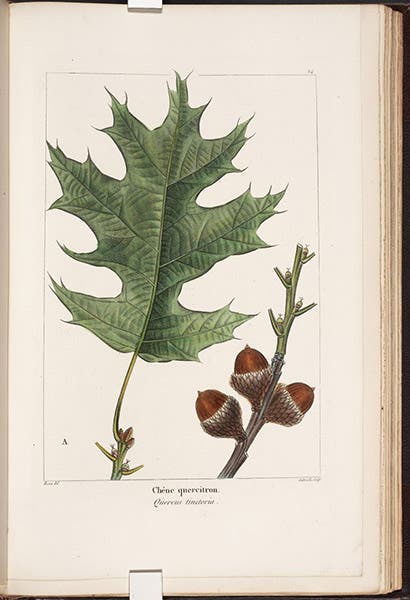
Black Oak, Quercus tinctoria, hand-colored engraving by Pancrace Bessa, The North American Sylva: or, A Description of the Forest Trees of the United States, Canada, and Nova Scotia, by François-André Michaux, vol. 1, plate 24, 1865 (The Linda Hall)
François-André Michaux returned to the U.S. many times, mostly to check on the two botanic gardens his father had started, in New Jesey and South Carolina, and to visit the American Philosophical Society (APS) in Philadelphia, which invited him into membership in 1809, but also to prepare his own 3-volume work on the trees of North America, Histoire des arbres forestiers de l'Amérique septentrionale (1810-13), published in French with engravings based on paintings by Pierre-Joseph Redouté and his younger brother Henri-Joseph, who had earlier illustrated the 1801 book on American oak trees by André. A third artist, new to the mix for the 1810 book but just as skilled, was Pancrace Bessa.

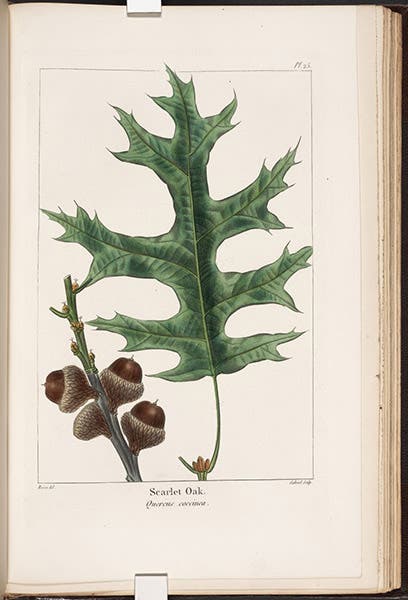
Scarlet Oak, Quercus coccinea, hand-colored engraving by Pancrace Bessa, The North American Sylva: or, A Description of the Forest Trees of the United States, Canada, and Nova Scotia, by François-André Michaux, vol. 1, plate 25, 1865 (The Linda Hall)

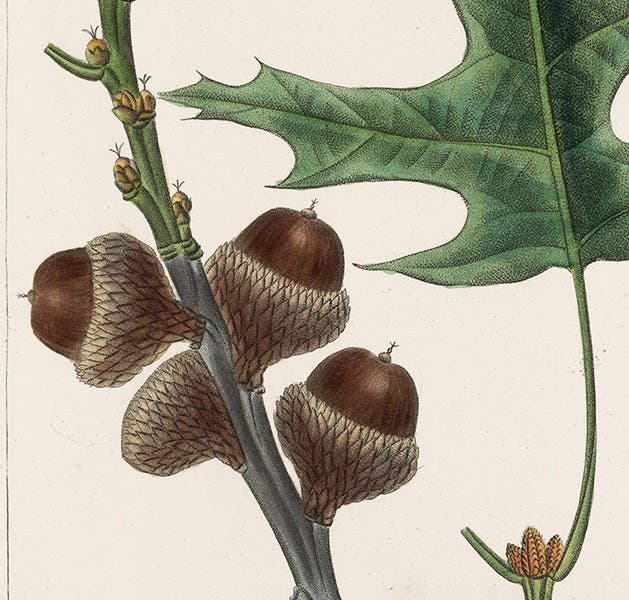
Acorns of the Scarlet Oak, Quercus coccinea, detail of hand-colored engraving by Pancrace Bessa, The North American Sylva: or, A Description of the Forest Trees of the United States, Canada, and Nova Scotia, by François-André Michaux, vol. 1, plate 25, 1865 (The Linda Hall)
The French edition of 1810-13, and the first English edition, called North American Sylva (1817-19), used the same engravings, and François continued to hold onto the copper plates, all 156 of them, and eventually gave them to the APS for safe-keeping. Because of this, when the Philadelphia printer Robert Smith decided in 1852 to reprint the 3 volumes by François with two new volumes on trees by Thomas Nuttall, he did not have to go far to find his printing plates, and when this edition was reprinted by William Nutter in 1865, the plates were still there. I mention all this because the only edition we have of François's book is the 1865 edition, and the impressions, taken from the original plates, are sharp and clean, and with the added hand-coloring, they are just gorgeous. You may judge for yourself, since everything on this page, except for the portrait and title page, is from a plate originally drawn by one of the Redoutés or by Bessa, and included in volume 1 of the 1865 Sylva.

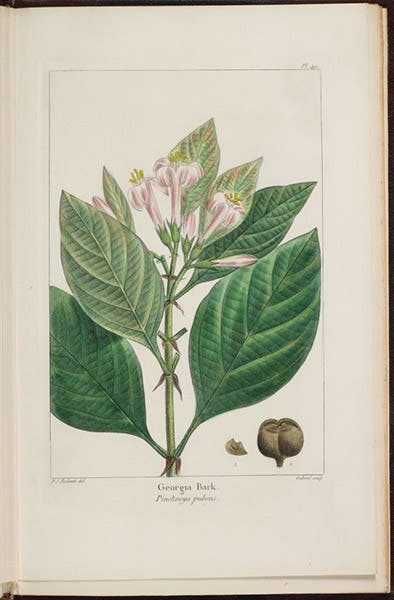
Georgia Bark, Pinckneya pubens, hand-colored engraving by P.-J. Redouté, The North American Sylva: or, A Description of the Forest Trees of the United States, Canada, and Nova Scotia, by François-André Michaux, vol. 1, plate 49, 1865 (The Linda Hall)

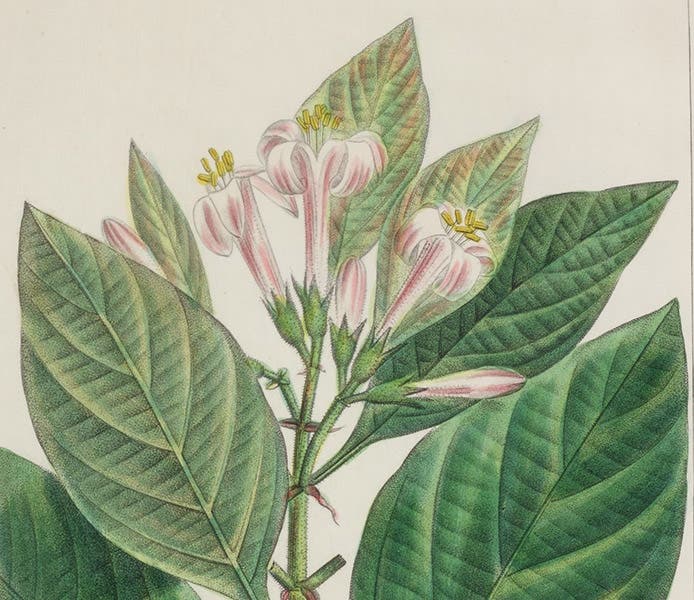
Flowers of Georgia Bark, Pinckneya pubens, detail of hand-colored engraving by P.-J. Redouté, The North American Sylva: or, A Description of the Forest Trees of the United States, Canada, and Nova Scotia, by François-André Michaux, vol. 1, plate 49, 1865 (The Linda Hall)
Michaux spent the last 35 years of his long life back in France, constructing arboretums and tending to his estate. According to the French Wikipedia, he bequeathed his entire fortune to the APS in Philadelphia. If this is true, one would hope to see a webpage or two devoted to their benefactor on the APS website, especially since they own the Rembrandt Peale portrait of Michaux that we used here (second image).
William B. Ashworth, Jr., Consultant for the History of Science, Linda Hall Library and Associate Professor emeritus, Department of History, University of Missouri-Kansas City. Comments or corrections are welcome; please direct to ashworthw@umkc.edu.