Scientist of the Day - Hypatia of Alexandria

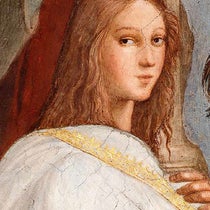
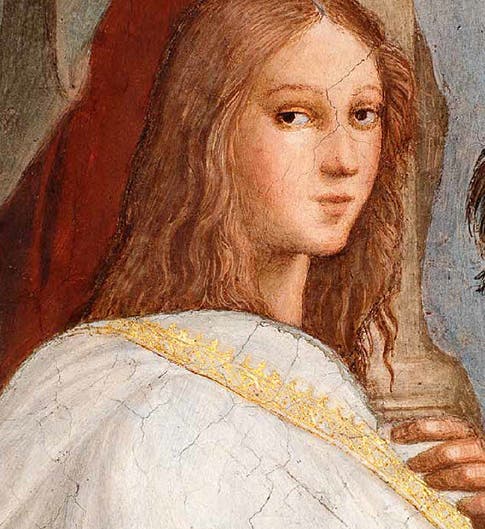
Detail of figure in the School of Athens, by Raphael, once thought to represent Hypatia of Alexandria, Vatican, 1509-11 (Wikimedia commons)
Hypatia of Alexandria, a Greek philosopher, mathematician, and astronomer, died in 415 CE at the hands of a Christian mob. Hypatia was the daughter of Theon of Alexandria, himself a noted mathematician and astronomer. Estimates of Hypatia’s year of birth vary between 350 and 370 CE, with 355 being a popular choice, which means she was somewhere between 45 and 65 years old when she was killed, probably about 60.
Hypatia was the head of a school of philosophy in Alexandria. There were only two highly reputed schools of philosophy left in the West in 390 CE – the other was in Athens – and Hypatia led one of them. There is contemporary evidence, including letters from one of her students, that she was held in high regard by both students and citizens, and a slightly later historian, Socrates of Constantinople (died ca 439 CE), sang her praises as philosopher and mathematician, and deplored the manner of her death.
In light of these accolades, it is interesting that we do not know exactly what Hypatia did by way of mathematical or astronomical pursuits. Her father annotated an edition of Ptolemy’s Almagest, and some historians think Hypatia did the computational work for one or more of the books (chapters), but we really don't know. Theon also compiled an edition of Euclid’s Elements, one that would later be printed, and Hypatia may have helped with this as well. But the truth is, no single piece of Hypatia's scientific work survives.
In philosophy, Hypatia was a Neoplatonist, following the teachings of Plotinus and Porphyry (3rd century CE), who believed that the world is an emanation from God, and that one could spiritually ascend the hierarchy of that emanation to achieve a communion with God. Some Neoplatonists were Christians – the two faiths were not incompatible – but Hypatia was not. She was a pagan, and her God was not the God of the Old or New Testament.
Alexandria, which was part of the Roman Empire, was pretty much a pagan place until 380 CE, although it also had a large Jewish population, but when the Empire became officially Christian in 382, the percentage of Christians in Alexandria rose steadily in ensuing years, and pagan-Christian relations grew increasingly violent.
Many pagans were followers of Iamblichus, a fourth-century Neoplatonist who emphasized the importance of ritual and animal sacrifice in worship of the One. This was called theurgy. Hypatia would have nothing to do with Iamblichus or theurgy, finding ritual unnecessary, but many Alexandrians disagreed, and flocked to the massive Alexandrian temple called the Serapeum, built long before to honor the Roman (originally Egyptian) god Serapis. In 391 CE or so, the Serapeum was stormed by a Christian mob, the statue of Serapis was toppled, and the rest of the building destroyed. The next year, the Serapeum was closed, along with all other pagan temples, by Roman authorities. That must have been unnerving for the pagan Hypatia, even though she had was not associated with the Serapeum.
Hypatia continued to teach for the next 20 years, and many of her students were Christians. But Christian-pagan relations grew more strained, and came to a head in 412 CE, when the new bishop and patriarch of Alexandria, Cyril, began to assert authority over a variety of civil matters, deliberately antagonizing the Roman governor, Orestes. Orestes may have been a former student of Hypatia; he often sought her advice, and thus she was perceived by Christian activists as an enemy. In March of 415, a zealot named Peter roused a mob of Christians into a frenzy, and they went looking for Hypatia. Unfortunately, she happened to be out in the city in a carriage; she was found by the mob, dragged from her carriage, and sliced to pieces by rioters wielding ostraca, shards of pottery that made handy weapons. It was a terrible way to die, especially for someone who was not guilty of anything.
The only bright side to the heinous actions of the mob was that Hypatia would become an instant scientific martyr and would never be forgotten. She is one of the few women of antiquity whose name is recognizable today, and she deserves her fame, for she was a remarkable person at a time when it was not easy for a woman to excel.
Many people may have first encountered the historical Hypatia in a film of 2009 titled Agora, which would have been a mixed blessing. The bright side is that Hypatia was sensitively and sympathetically portrayed by Rachel Weisz, and the film may may well help you appreciate Hypatia’s scientific abilities. The problem is that the science she espouses in the movie is quite inappropriate for the 5th century CE, as the cinematic Hypatia argues for a heliocentric astronomy, with planets moving in elliptical orbits, which is close to absurd for the time, and her classroom in the film was located in the Museum and Library of Alexandria, both of which had ceased to exist long before Hypatia's time. I tried to watch Agora again while writing this, but the rioting scenes are so poorly done that I had to turn it off. Watch it if you will, but you will not learn anything useful or true about the science of late antiquity in the viewing.
It would be nice if we had a portrait of Hypatia to put on our wall of fame, even a good imaginary one, but the best we can do is show a detail of Raphael's fresco, The School of Athens, in the Vatican, where the long-haired figure behind Pythagoras was once thought to represent Hypatia, although this is no longer the case (first image). You can see the figure in context in the third image in our post on Raphael.
Not surprisingly, there has been increased interest since the 1970s in Hypatia as a woman of science, and you can find many discussions of her achievements in chapters, articles, and books, much of it of dubious value. But I liked a recent scholarly biography: Hypatia: The Life and Legend of an Ancient Philosopher, by Edward J. Watts, (Oxford, 2017), which we have in the Library.
William B. Ashworth, Jr., Consultant for the History of Science, Linda Hall Library and Associate Professor emeritus, Department of History, University of Missouri-Kansas City. Comments or corrections are welcome; please direct to ashworthw@umkc.edu.