Scientist of the Day - Joe Hin Tjio

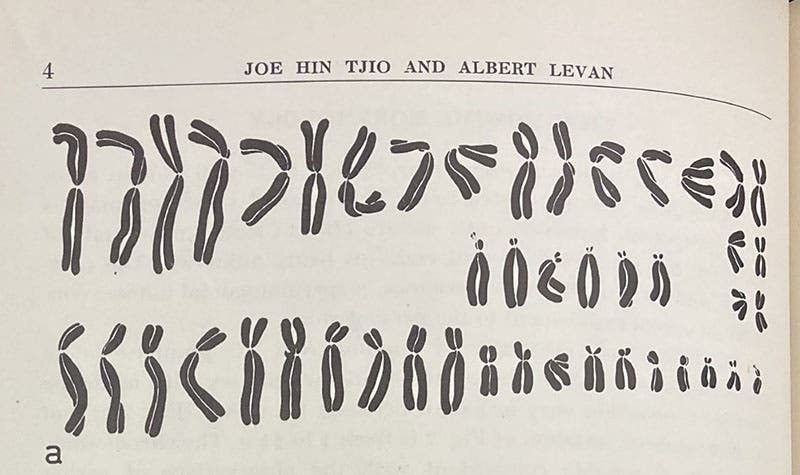
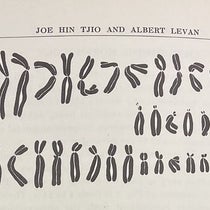
The 46 chromosomes of cell “a”, photographed and then rearranged, detail of plate in “The chromosome number of man,” by J.H. Tjio and A. Levan, Hereditas, vol, 42, p. 4, 1956 (The Linda Hall)
Joe Hin Tjio, an Indonesian/American cell biologist and geneticist, was born on Nov. 2, 1919, in Pacalongan, Java, in what was then the Dutch East Indies. His father was a photographer, a skill that must have been imparted to the younger Tjio, whose later career was influenced by his skill at photography, although at the cellular level.

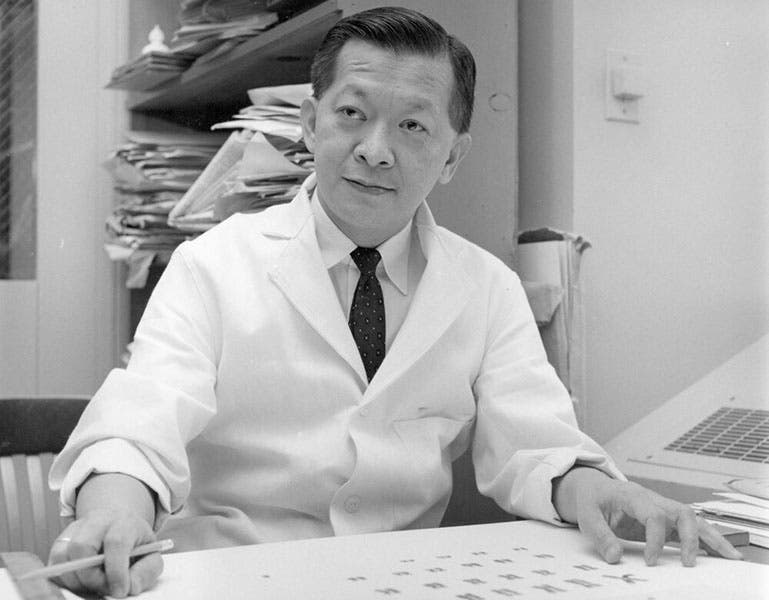
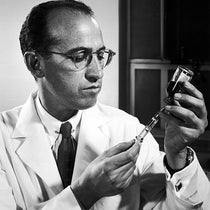
Joe Hin Tjio in the lab, undated photograph, Office of NIH History (sciencehistory.org)
Tjio (pronounced CHEE-oh) studied agronomy at Indonesian schools, was interred for three years in a Japanese prisoner-of-war camp during World War II, and then came as a refugee to the Netherlands. He worked on plant genetics for 10 years, in Spain, spending summers studying plant chromosomes in Sweden, working with an older geneticist, Albert Levan.

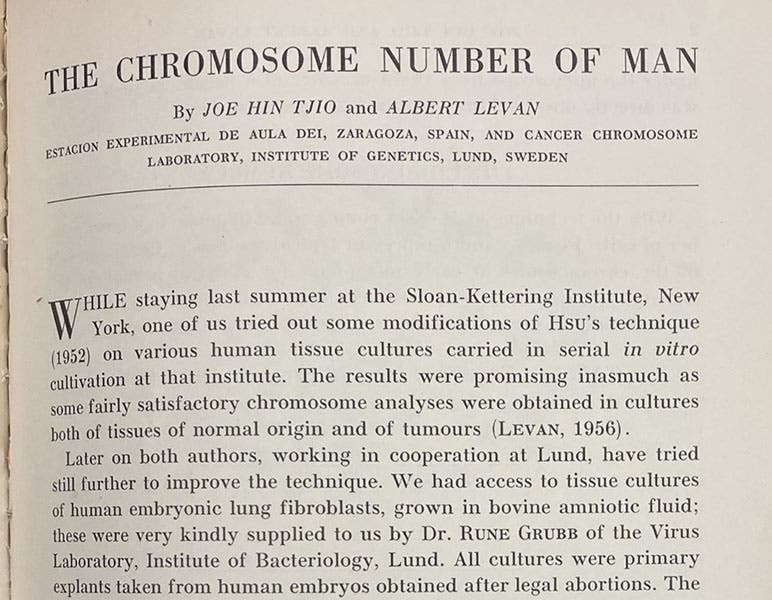
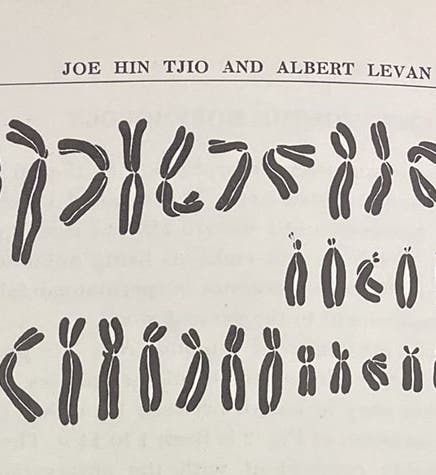
First paragraph, “The chromosome number of man,” by J.H. Tjio and A. Levan, Hereditas, vol, 42, p. 1, 1956 (The Linda Hall)
In the early 1950s, it was thought that humans had 24 paired chromosomes, 48 in all. Human chromosomes had first been successfully counted in the early 1920s, which was quite a achievement, since most of the time chromosomes in the nucleus are invisible, and it is only during cell division that they clump and become countable; it helps if the cells are embryonic, and if you have a microscope with a magnifying power of 3000 or better. Once the number 48 was established, everyone who counted human chromosomes for the next 30 years saw 48 of them.

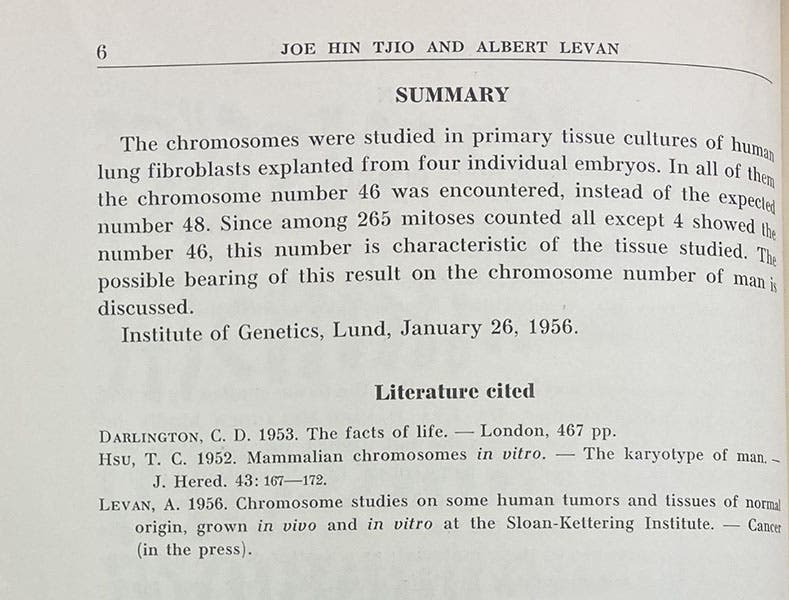
Concluding paragraph, “The chromosome number of man,” by J.H. Tjio and A. Levan, Hereditas, vol, 42, p. 6, 1956 (The Linda Hall)
During the Christmas break of 1955, Tjio was working in Levan's lab in Lund – Levan was away at the time – and he managed to take photomicrographs of the chromosomes of four different fetal cells. When he counted them, he saw 46, not 48. Thinking he might have missed a pair, he looked at other cells, hundreds of them, and nearly always – 98% of the time – he came up with 46. All the geneticists who had counted chromosomes for three decades had seen two chromosomes that simply were not there.

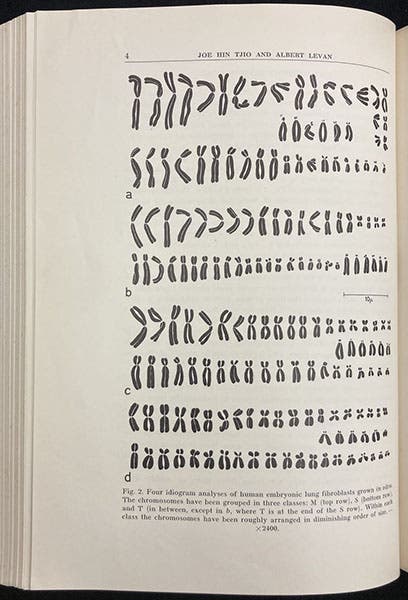
Entire plate showing the 46 chromosomes of four different embryonic cells, photographed and then rearranged, in “The chromosome number of man,” by J.H. Tjio and A. Levan, Hereditas, vol, 42, p. 4, 1956 (The Linda Hall)
Tjio published a paper, “The chromosome number of man.” in the Swedish journal Hereditas, in January of 1956. It is a marvel of conciseness, just 6 pages long, with 1 of those pages being photographs of his four cells, with the chromosomes rearranged for easier counting, all 46 of them (first and fifth images).
In his paper (co-written with his supervisor, who had no role in the discovery), Tjio noted that many of the published photographs that purport to show 48 human chromosomes in fact contain only 46. He cites as an example a photograph in C.D. Darlington's The Facts of Life (1953). Since we happen to have that book in our collections, I photographed the cited page and include it here (last image). Let the recounts commence.

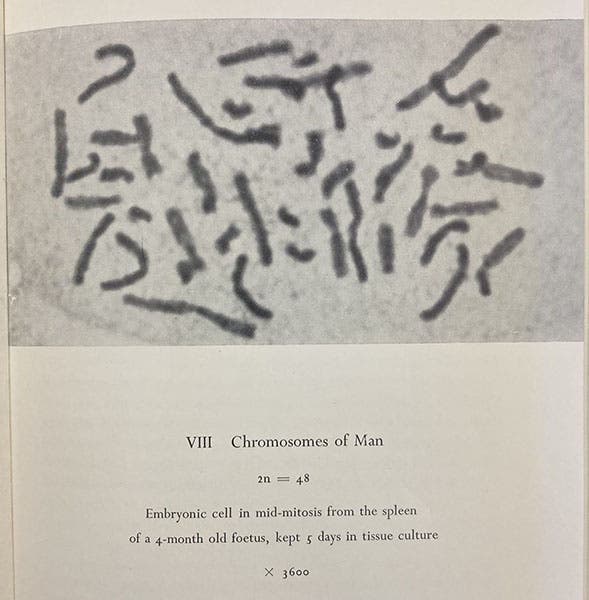
Photograph purportedly showing 48 human chromosomes, but which in fact contains only 46, in C.D. Darlington, The Facts of Life, p. 288, 1953 (The Linda Hall)
Tjio's discovery has become a classic example of the caveat that often we see what we expect to see, not what is really there, and it is hard to undercut one's expectations. Thousands of lab workers must have counted chromosomes over those 30 years, and they saw what they had been taught to see, 48 chromosomes. There is a lesson there for everyone, and Tjio became famous for providing it.
Tjio went on to have a long and fruitful career with the National institutes of Health in Bethesda, Maryland. He received a medal from President Kennedy in 1962. Tjio died on Nov. 27, 2001, at the age of 82.
William B. Ashworth, Jr., Consultant for the History of Science, Linda Hall Library and Associate Professor emeritus, Department of History, University of Missouri-Kansas City. Comments or corrections are welcome; please direct to ashworthw@umkc.edu.