Scientist of the Day - Rupert T. Gould

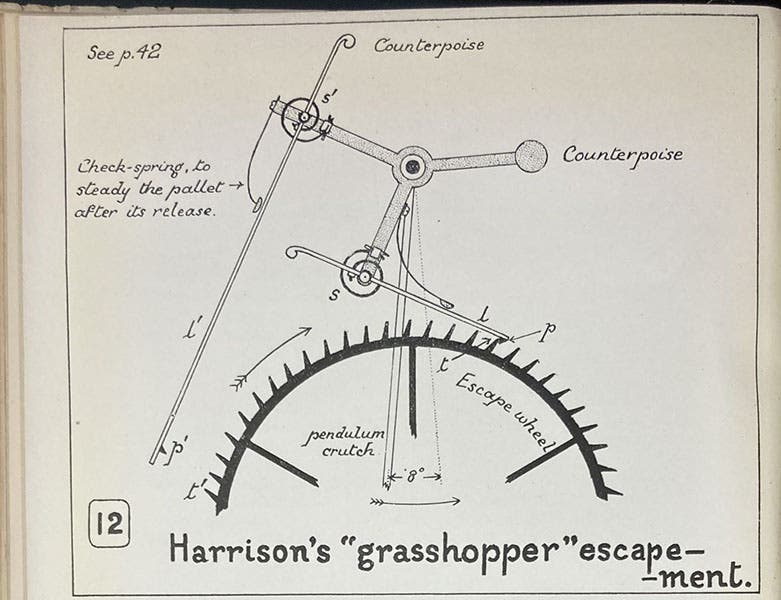
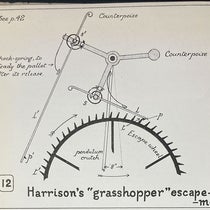
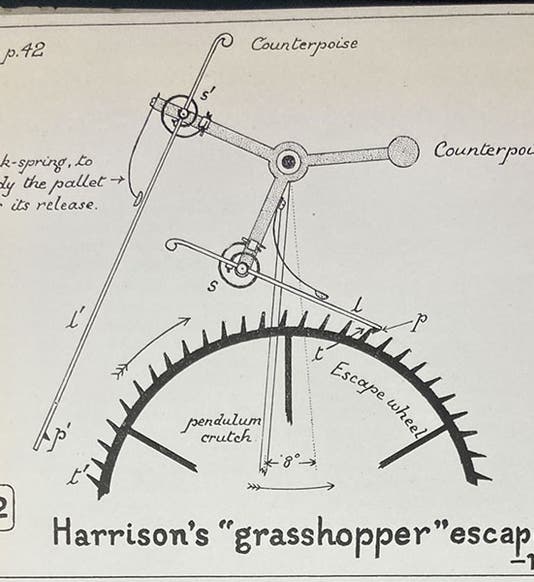
Harrison’s grasshopper escapement, drawing by Rupert Gould, in his The Marine Chronometer, its History and Development, fig. 12, opp. p. 42, 1923 (The Linda Hall)
Rupert T. Gould, an English naval officer and horologist, was born on Nov. 16, 1890, near Portsmouth. He was educated at Royal Navy academies and schools and was commissioned in 1907, becoming a navigation officer. He did fine until the advent of World War I, when he had a nervous breakdown, the first of several he would suffer during his life, and he had to retire into hydrography. He became interested in the history of marine navigation and especially time-keeping (horology), teaching himself to become an expert on marine clocks. And thus he encountered the crown Prince of horology, John Harrison.

Portrait of Rupert T. Gould, photograph, undated (Wikimedia commons)
John Harrison had solved the "longitude problem" of the 18th century by building a series of marine chronometers (clocks designed for time-keeping at sea) that were so precise that they allowed a navigator to determine Greenwich mean time to the second at sea. By comparing local time to Greenwich time, one could determine longitude at sea to within a mile or two, if the chronometer were accurate. Harrison's chronometer no. 4 (often called H4 or H-4), really a large watch, passed the test established by the Board of Longitude back in 1714, passed it twice in fact, and although he never officially won the Longitude Prize, he did receive the prize money. We have written a post on Harrison. Dava Sobel has written a book, Longitude, which I have recommended to you before, and recommend again.

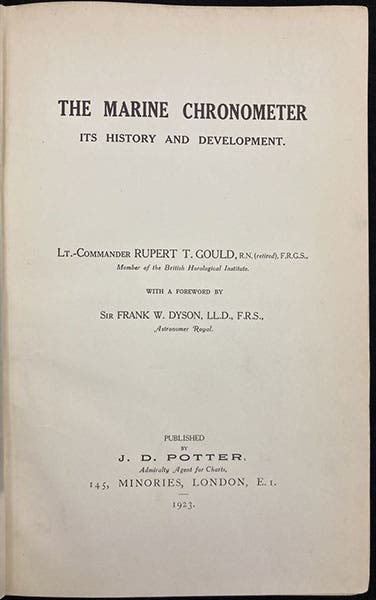
Title page, The Marine Chronometer, its History and Development, by Rupert T. Gould, 1923 (The Linda Hall)
Harrison's four chronometers had been retained at the National Maritime Museum, but they had never been conserved and were in poor condition when Gould encountered them. One of them, no. 1, was severely corroded. In 1920, Gould was given permission to conserve them and restore them to operating condition. He would do so over the next 13 years, beginning with no. 1, then no. 4, which won the prize, and finishing with the difficult and complicated no. 3, in 1933. It was a triumph of the first order in the world of horology. All are still on display, ticking away, in the Royal Museums Greenwich, where you may see them anytime you wish.

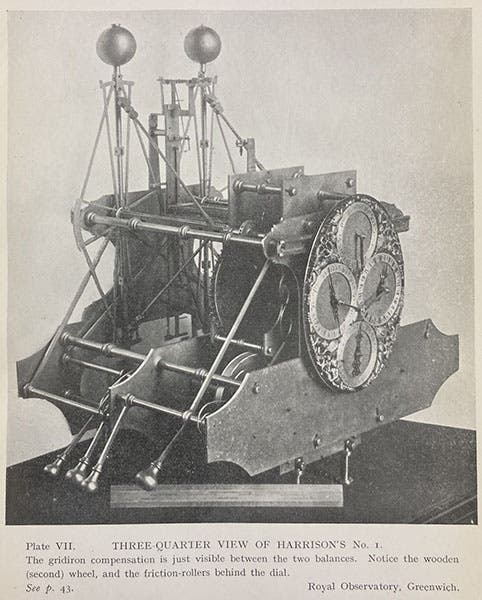
Three-quarter’s view of Harrison chronometer no. 1, photograph, The Marine Chronometer, its History and Development, by Rupert T. Gould, plate VII, opp p. 43, 1923 (The Linda Hall)
Three years into the conservation process, Gould published a book, The Marine Chronometer, its History and Development (1923). It is still the most important book ever published on the subject and has been often reprinted. We have a first edition in our library. The binding is not in the best condition, but it is a first edition, and the contents are in fine fettle. It contains many excellent photographs of the Harrison chronometers (and many others), but the most striking feature is surely the drawings by Gould, which are abundant and exceptionally clear, which is not easy to do with chronometers. The lettering is just beautiful. We include three of the plates of drawings here, the first one a detail. They remind me, in a way, of the drawings Russell Porter did of the 200-inch Palomar telescope, although Porter's drawings were hardly precision diagrams like Gould's. Anyway, Gould's is a beautiful and informative book, an achievement to rank alongside his conservation of the Harrison chronometers.

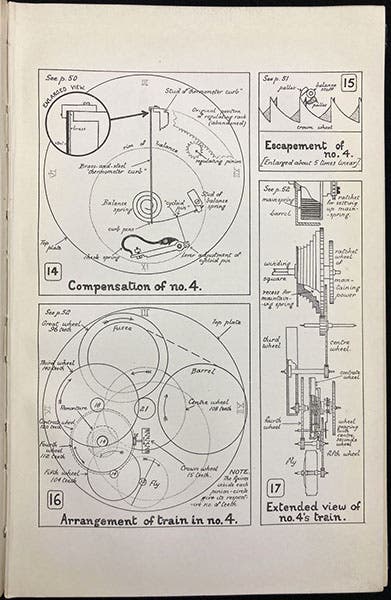
Details of the mechanism of Harrison’s chronometer no. 4, drawing by Rupert Gould, in his The Marine Chronometer, its History and Development, fig. 14-17, opp. p. 49, 1923 (The Linda Hall)
Gould was interested in many other subjects and wrote books about some of them, including tennis, and the Loch Ness monster, and he was a popular host and commentator on the BBC. He is often described as a polymath, but he wasn't, in the way we apply that word to Leibniz or Thomas Young. He just knew a lot of things about a variety of fields. But he knew the most about clocks.

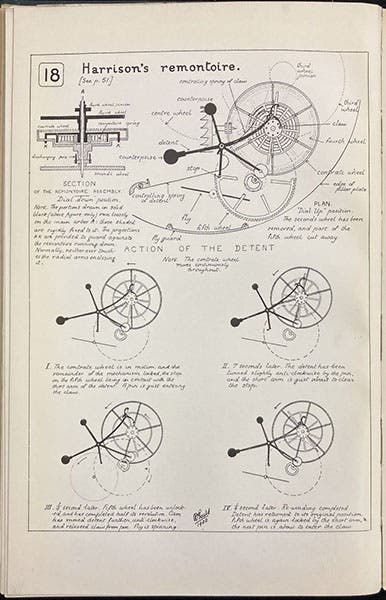
Harrison’s remontoire, drawing by Rupert Gould, in his The Marine Chronometer, its History and Development, fig. 18, opp. p. 52, 1923 (The Linda Hall)
A fairly recent book on Gould and Harrison is available, Time Restored: The Harrison Timekeepers and R.T. Gould, the Man who Knew (almost) Everything (2006), by Jonathan Betts, who, at the time of writing, was the keeper in charge of the Harrison chronometers, and thus quite appreciative of Gould’s achievement. And if you already have Dava Sobel’s Longitude (1995), as you should, might I suggest you return to it and reread the last chapter, which contains a sensitive portrayal and appraisal of Gould and what he did to preserve the legacy of John Harrison.
William B. Ashworth, Jr., Consultant for the History of Science, Linda Hall Library and Associate Professor emeritus, Department of History, University of Missouri-Kansas City. Comments or corrections are welcome; please direct to ashworthw@umkc.edu.