Scientist of the Day - Edwin Hall

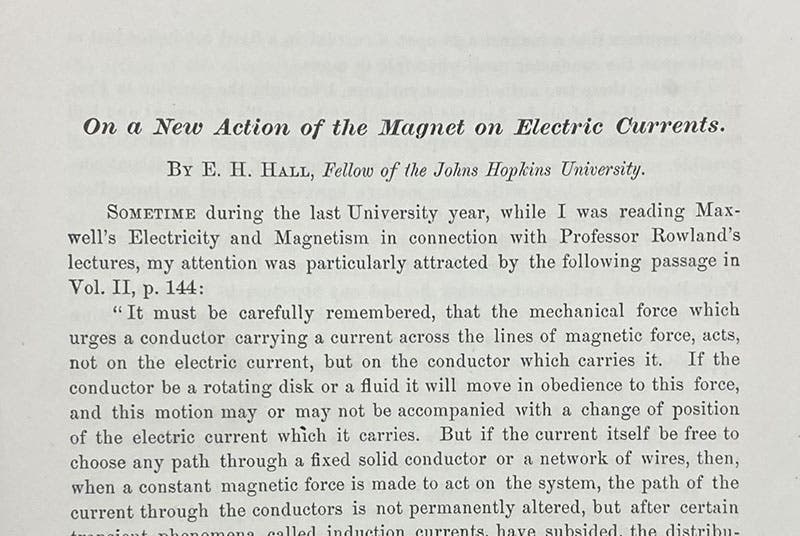
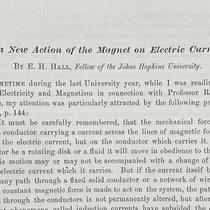
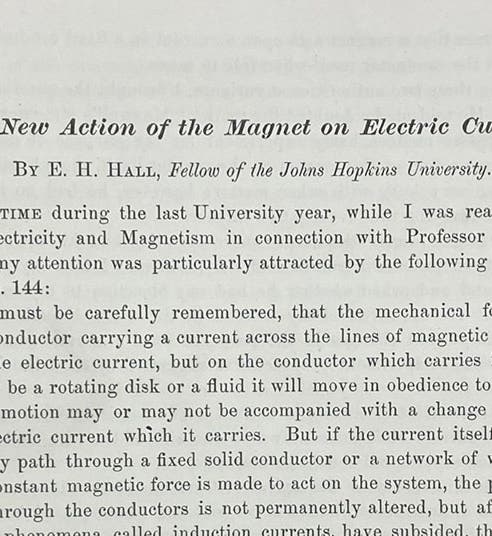
First paragraph of "On a new action of the magnet on electric currents," by Edwin H. Hall, American Journal of Mathematics, vol. 2, p. 287, Nov. 22, 1979, citing the passage in James Maxwell’s Treatise (1873) that inspired his experiment (The Linda Hall)
Edwin Herbert Hall, an American physicist, died on Nov. 20, 1938, at the age of 83. Hall was born on Nov. 7, 1855, in Gorham, Maine, in the southern part of the state, and then attended Bowdoin College, on the other side of Cumberland County (for more about 19th-century Bowdoin, see our post on Parker Cleaveland). Hall was not yet interested in science, but he was smart, and he graduated first in his class. He taught school for two years, found it unfulfilling, and started teaching himself physics. He was, I gather, a good instructor and a good pupil, for he impressed the professor of physics at Harvard, John Trowbridge, when Hall came calling, inquiring about graduate school.

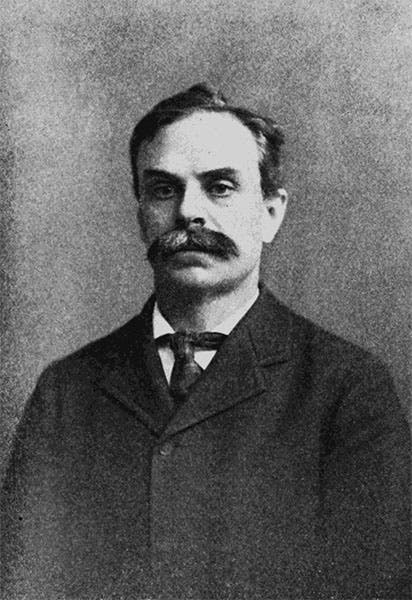
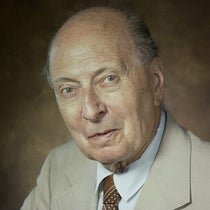
Portrait of Edwin Herbert Hall, photograph, undated, Johns Hopkins University (api.hub.jhu.edu)
Trowbridge told Hall to try Baltimore, where a new university had just been founded, Johns Hopkins, with a firm commitment to research and post-graduate education, and with a young professor of physics, Henry Rowland, who was making quite a splash in electromagnetism. Hall took his advice, enrolled at Hopkins, and set about making his way through James Clerk Maxwell's A Treatise on Electricity and Magnetism (1873), just as his advisor Rowland had done when the book first came out.
Hall came across a section in Maxwell's Treatise where he stated that a magnetic field would induce a current in a conductor only if the field is changing; a static magnetic field has no electrical effect. That struck Hall as unreasonable; if a current is already flowing through a wire, why shouldn't the field push the current to one side of the wire. He went to Rowland to ask permission to do an experiment to look for unexpected electrical effects in such circumstances. Rowland gave his permission, and had some suggestions as to the experimental setup, which turned out to be good ones.
For his experiment, Hall fastened strips of gold foil to glass slips and used a battery to send a current through the length of the foil. He then applied a magnetic field perpendicular to the foil. As he probed with a galvanometer, he discovered a small potential difference (a voltage) across the width of the foil. The current was being affected by magnetism after all. This makes sense if you know that electric current is a flow of electrons, which “feel” the presence of the magnet, but no one knew about electrons in 1879, so the Hall effect, as it came to be called, was a mystery. But it was real.
Hall published the results of his experiments in a short article, "On a new action of the magnet on electric currents," in the American Journal of Mathematics, a new journal conveniently founded in 1878 and published at Johns Hopkins. The Hall effect was announced in volume 2 in 1879 (first and third images). Hall then wrote up the results more fully for his PhD dissertation, which he published in two further articles in other more traditional journals. We have all three versions in our serials collections, but show here the first iteration in the Hopkins journal, in 1879.

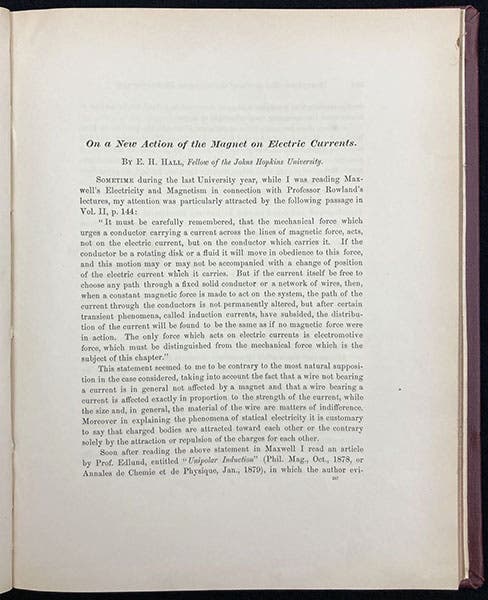
Entire first page, "On a new action of the magnet on electric currents," by Edwin H. Hall, American Journal of Mathematics, vol. 2, p. 287, Nov. 22, 1979; note that this was a luxurious quarto-sized journal, unusual in the U.S. for this time (The Linda Hall)
The Hall effect turned out to be quite useful in electronics, once we had electronics, and Hall-effect sensors are common when one needs to detect the presence of a magnetic field; you can find them in speedometers, speed governors, joysticks, and many other places.
Historians of education have pointed out that the discovery of the Hall effect is also significant in marking the birth of modern graduate education in the United States. Hall came to Rowland with an idea which they discussed; they worked out an experiment, and Hall was turned loose, with Rowland providing oversight, and Hall putting in the long hours. This is how graduate students in the sciences have been interacting with their mentors, and learning, for 150 years. But no one did it that way before Johns Hopkins University established that model, and Hall and Rowland showed how it might work.
Hall eventually did make his way to Harvard, succeeding Trowbridge as Professor of Physics there, but since he never again did anything as significant as his 1879 experiment, we can digress from his later career to consider the nature of his eponymic legacy.
There are many kinds of eponyms, but some of these are clearly preferable to others. A law, for example, such as Boyle's law or Kepler's area law, is forbidding, suggesting that some math is lurking just around the corner, which is ominous. Laws are not glamorous. The same is true with an eponymic number, such as Avogadro's number, or Planck's constant. That sounds boring. Better is something like Pascal's triangle, or Batesian mimicry, or a Fresnel lens, or the Foucault pendulum, because these sound mysterious, and make you want to know more. A lot of apparatus and tools are named after people, such as a Petri dish or an Erlenmeyer flask, but that's not very exciting, except for the Klein bottle. Möbius strip is good – why would someone have a strip named after them, one is prompted to ask. Aristotle's lantern is even better, since no one who is not an invertebrate zoologist is going to have a clue as to what that might be.
The second-best of all eponyms is the paradox, such as Olbers’ paradox (why is the sky dark at night?), or the Fermi paradox (where are all the aliens?), because they are, well, paradoxical, and provoke endless discussion.
But the best eponym of all is the effect. Coupled with a name, it suggests that someone has understood something about the world that was surprising. The Coriolis effect, the Mössbauer effect, the Zeeman effect – these immediately attract our attention. When you hear the term, Hall effect, you want to know, who was this guy Hall, and what did he discover that is so important that it has its own name? If you ordered a Hall-effect sensor from Amazon, could you do so without wondering about Hall? Even if you don't look him up, you know that this person made a difference, he understood something no one did before, and it was important enough to get its own name, his name. That is a better legacy than a tombstone, or a plaque.
William B. Ashworth, Jr., Consultant for the History of Science, Linda Hall Library and Associate Professor emeritus, Department of History, University of Missouri-Kansas City. Comments or corrections are welcome; please direct to ashworthw@umkc.edu.