Scientist of the Day - Jonathan Swift

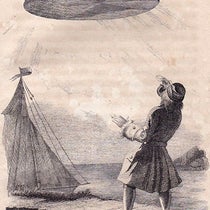
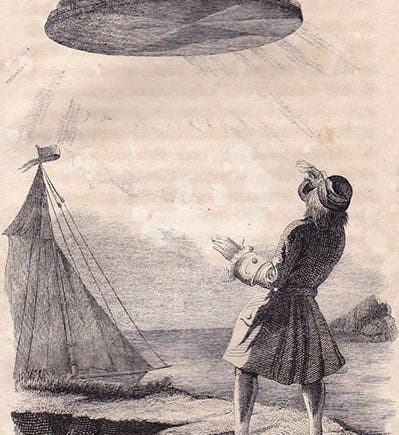
The Flying Island of Laputa, in an 1839 German edition of Gulliver’s Travels, by Jonathan Swift (Wikimedia commons)
Jonathan Swift, an Anglo-Irish writer, satirist, and Anglican cleric, was born on Nov. 30, 1667, in Dublin. Swift is one of the best-known English writers of the 18th century. So we will not spend time introducing him, but will leap right away to Gulliver's Travels, or, as it is given on the title page, Travels into Several Remote Regions of the World, in Four Parts. By Lemuel Gulliver, First a Surgeon, and then a Captain of Several Ships. It was published, without Swift's name attached, in 1726, exactly 300 years ago, as it happens. It was an immediate best seller, and as it is the book where Swift most directly engaged with the science of his era, we will focus on it here.

Portrait of Jonathan Swift, oil on canvas, by Charles Jervas, 1710, National Portrait Gallery, London (Wikimedia commons)
As the title states, Lemuel Gulliver undertook four voyages to countries never visited before (or since!). The first was to Lilliput. The Lilliputians were very small, and had small ideas and goals, so Gulliver was a giant in this land. Most people reading this already have "Lilliputian " in their vocabulary. In the land of Brobdingnag, however, Gulliver was the pygmy, and found himself in a land that scorned the governmental practices of European states. The fourth voyage, to the land of the Houyhnhnms, is the one most widely discussed by Swifties (the original ones), for the Houyhnhnms have the features of horses but are perfectly rational, while their subjects have human form but are, well, Yahoos, bestial and with few redeeming traits. Much discussion about whether we humans are intrinsically good or beyond redemption usually follows a reading of Gulliver's fourth voyage.

Title page and portrait, Gulliver’s Travels, by Jonahan Swift, first edition, 1726 (Wikimedia commons)
The third voyage, to Laputa, had long perplexed readers. The flying magnetic island is interesting, in a science-fictiony way, but the people of the non-floating island below, especially those in the Academy of Lagado, engage in activities that seem inane and bewildering, and just make no sense. One man attempts to extract sunbeams from cucumbers and store them in vials for later use. Another is breeding spiders to develop an alternative source for silk. A third has developed an alternative to plowing with oxen by sowing a field with acorns and allowing a slew of pigs to root the soil into shape. A fourth has developed a system for generating new doctrines by building a huge frame on which were strung bits of wood with words on them; rearranging the bits generates word-phrases and eventually, hopefully, new philosophies. There are dozens more examples of outlandish ideas and practices under investigation in the Academy of Lagado.

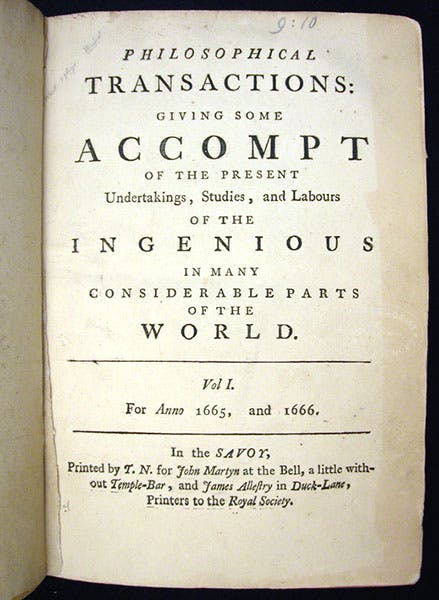
Title page, first volume of the Philosophical Transactions of the Royal Society of London, 1665-66 (The Linda Hall)
Until the 1940s, it was supposed that Swift had just made all these up, and hadn't been too clever about it. Then a literary historian, Marjorie Nicholson, one of the pioneers of the study of science and literature in early modern England, began to peruse the first 50 years of the Philosophical Transactions of the Royal Society of London, and she found a counterpart for nearly every activity described in the Voyage to Laputa, right there in the Phil Trans, as we tend to call that oldest of all scientific journals. Fellows of the Royal Society were doing experiments on sunlight, looking for alternatives to silkworms, trying to improve agriculture, and developing artificial languages. All Swift had to do was find an odd experiment in the Phil Trans, give it a satirical twist, and plug it into the Academy of Lagado. Swift was lampooning the New Science of his own time, and the social circle of Robert Boyle, Robert Hooke, and John Ray. Who knew that the New Science could so easily be made to seem ridiculous?
Swift did most of his writing far from London, in Trim, County Meath, Ireland, especially after he became Dean of St Patrick's Cathedral in Dublin. He died in 1745 and was buried at St. Patrick’s.
We have no edition of Gulliver’s Travels in our Library. But we do have several complete runs of the Phil Trans, 360 years of raw material for any would-be satirists of science
William B. Ashworth, Jr., Consultant for the History of Science, Linda Hall Library and Associate Professor emeritus, Department of History, University of Missouri-Kansas City. Comments or corrections are welcome; please direct to ashworthw@umkc.edu.