Scientist of the Day - Salisbury Cathedral Clock

The Salisbury Cathedral Clock, originally installed in 1386, now in the north aisle of the cathedral, recent photograph (Wikimedia commons)
One of the great inventions of the 14th century was the mechanical cathedral clock. Many of these were constructed in the late Middle Ages, but most disappeared or were replaced long ago, and often the ones that survive cannot be well dated, or in several cases even well identified. The Salisbury Cathedral Clock is perhaps the best and probably the oldest surviving representative of this group. Records tell us that a mechanical clock was installed in Salisbury Cathedral in 1386, and most experts believe that the clock that still survives at Salisbury is that very clock, with some replaced parts. The clock no longer resides in the bell tower, which was demolished, but rather right in the nave, along a side aisle, which is much more convenient for tourists, even if it would greatly confuse the English counterpart of Quasimodo.

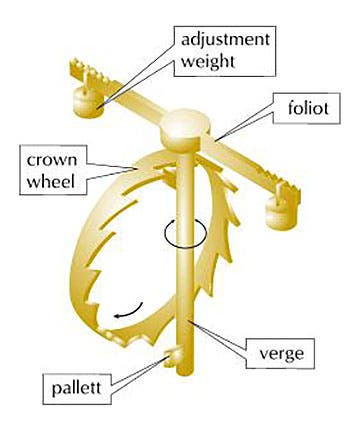
Diagram, verge and foliot escapement (bricksandbrass.co.uk)
These 14th-century mechanical clocks were made possible by the invention of the verge and foliot escapement in the first half of the century. The escapement is the regulator of the clock. The gear train was turned by hanging weights, but something had to control how fast the gears turned, and that is what the verge and foliot did, much better than any preceding regulator. The foliot is a horizontal rod, pivoted in the middle, with adjustable weights on each end, and it sits on top of a vertical rod called the verge, which is free to rotate back and forth. The verge has two tabs, called pallets, that engage a crown-shaped gear, mounted vertically (second image). A pallet at the top of the verge would engage a tooth at the top of the crown wheel and prevent it from moving; as the verge rotated, that pallet would disengage, allowing the crown wheel to rotate a little, until it was stopped by the pallet at the bottom of the verge. And so it went, tick, tock, as the verge rotated back and forth. A diagram of a verge and foliot can help, but it helps even more to see it turning back and forth, as in this video animation. The speed of rotation was determined by the moment of inertia of the foliot, swinging first one way, then the other, and could be (crudely) adjusted by moving the weights in or out.

Verge and foliot regulator on the Salisbury clock, recent photograph (Wikimedia commons)
The purpose of these first mechanical clocks was not to allow you to make it to the jousts on time. Their primary function was to mark the canonical hours that divide up the day for members of a religious order. The Benedictine Rule specified when to rise, when to eat, when to pray, and when to study or work, and a timekeeper was therefore essential for any religious order. The best part of the Salisbury clock and its kin was that it marked the hours in an unmistakable fashion – by sounding the bells. The Salisbury clock had a second gear train just for striking the bells. You will notice that the clock has no face or hands, and it is not clear that it ever had such accouterments. The hours were the only thing one needed to know, and the toll of a bell was a much better notification than the movement of a hand on a dial. This one-minute video shows the Salisbury clock in motion. The bell-striking mechanism (fourth image) is usually disabled, since the clock now sits in the nave, and it is quite noisy.

Striking chain of the Salisbury Clock, recent photograph (Wikimedia commons)
There are other notable 14th-century mechanical cathedral clocks. Richard of Wallingford designed a clock for the Abbey of St. Albans by 1336 (the date of his death) and it was completed about 1356, so it predated the Salisbury Clock by 30 years. It is noteworthy because Richard wrote a treatise on the design and construction of the clock, a treatise that still survives in the Bodleian Library at Oxford. However, The St. Albans clock no longer exists – in fact, it hasn't existed for nearly 500 years, being an early victim of the dissolution of the monasteries instigated by King Henry VIII about 1537. But because Richard's treatise survives, it is possible to recreate the clock, and several modern clockmakers have done so. We wrote a post on Richard of Wallingford not too long ago. The Salisbury clock, however, is believed to be the real thing, the very clock installed in the clock tower in 1386, with some restoration done in the intervening centuries. We would honor its maker today, instead of the clock, if we had any idea who constructed it. But we do not.


Salisbury Cathedral, by John Consable, oil on canvas, ca. 1825, Metropolitan Museum of Art, New York (wga.hu)
Finally, we should point out that, if you go to see the Salisbury Cathedral Clock, you will necessarily confront the Cathedral itself, which is absolutely magnificent, completed about 1320, some 60 years before the clock was installed. Unusually for a Gothic Cathedral, it has a fairly consistent style, since it was completed in a relatively short span of time. And it has never been more lovingly painted than by John Constable in 1825 (last image)
William B. Ashworth, Jr., Consultant for the History of Science, Linda Hall Library and Associate Professor emeritus, Department of History, University of Missouri-Kansas City. Comments or corrections are welcome; please direct to ashworthw@umkc.edu.