Scientist of the Day - Telstar 1

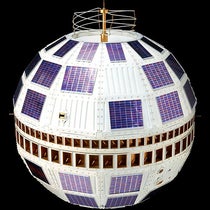
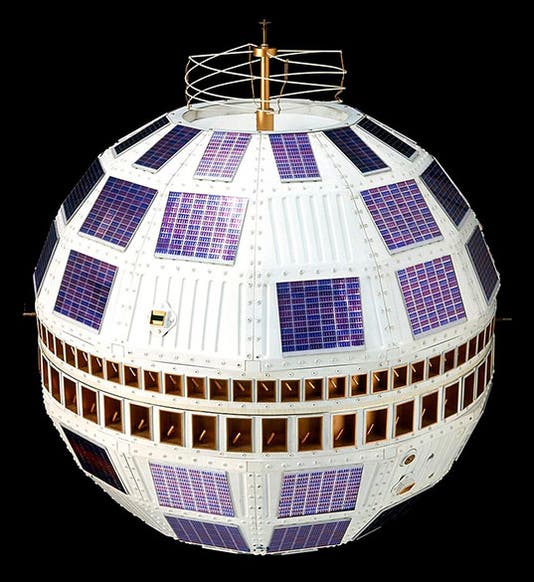
Telstar 1, launched into orbit on July 10, 1962, replica in Science Museum, London (Wikimedia commons)
Telstar 1, the world's first telecommunications satellite, was launched by NASA for AT&T and Bell Labs on July 10, 1962. It was not the first communications satellite – that honor goes to Echo 1, placed in orbit on Aug. 12, 1960. But Echo 1 was a passive satellite, a hundred-foot sphere of Mylar that merely reflected radio waves back down to Earth, without any electronic amplification (see our post on Robert Mackey and Arthur Crawford).

The massive horn antenna at Andover Station, Maine, built by AT&T and Bell Labs in 1962 to communicate with Telstar 1 (Wikimedia commons)
Telstar 1 was something quite different, a 34-inch aluminum and magnesium sphere covered with wave-guide antennas and solar cells, with rechargeable batteries and transistorized electronics (and a one-tube amplifier) inside, so that it could receive a signal from a broadcast in the United Stares, amplify it ten billion times, and retransmit it to receivers in France or England, at the speed of light.

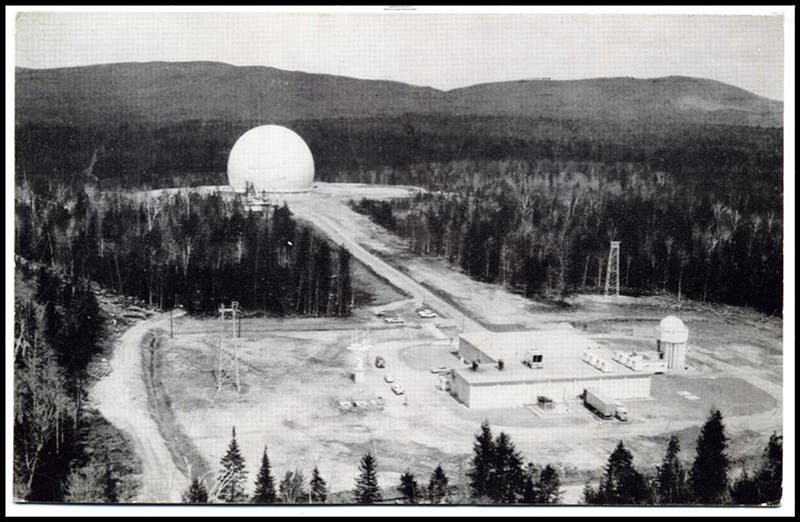
Andover Station, Maine; the giant horn antenna was under the 160-foot-tall Dacron dome in the distance, photograph, 1962, Maine Memory Network (mainememory.net)
Project Telstar required a powerful antenna, so one was constructed by Bell Labs and installed in Andover, Maine, chosen because it was so isolated that there was no radio noise or interference in the area. It was a horn antenna like the one Bell Labs had built in Holmdel, New Jersey, for Echo 1, but many times larger, and it could track Telstar as it moved across the visible sky. Telstar could relay telephone messages, photographs, even television broadcasts, but it could only do so when the antennas in Maine, and France and England (they had one antenna each) all had line of sight views of Telstar, which was not often. But it worked that first night, and on many other occasions. Everyone – Bell Labs, NASA, the government, the public – was impressed and excited by the dawn of a new age of international communication. A 3-minute newsreel of July 12, 1962, captured some of that excitement.

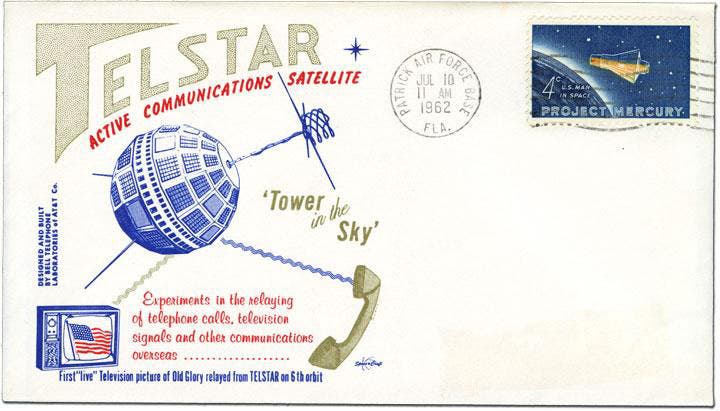
First-day cover commemorating the launch of Telstar 1, July 10, 1962, National Postal Museum, Smithsonian Institution (postalmuseum.si.edu)
Unfortunately, an unspecified number of boneheads in the Department of Defense decided to detonate a megaton nuclear warhead in the upper atmosphere over the central Pacific Ocean on July 9, 1962, in an operation known as Starfish Prime, and some other boneheads at Bell Labs and NASA decided it would be OK to launch Telstar 1 the next day, even though it was known that the explosion was going to increase manyfold the amount of radiation in the Van Allen belts through which Telstar would move (and other satellites were already moving). Sure enough, Telstar almost immediately saw its electronics corrupted, and within 7 months, it was dead in the ether, as were half of all the satellites in low-Earth orbit. Telstar was functionally replaced by other satellites, although physically it is still in orbit, one of the oldest pieces of space junk out there. And despite its untimely operational demise, it still is and always will be the first active communications satellite, out of the 8,000 or so that are now up there.

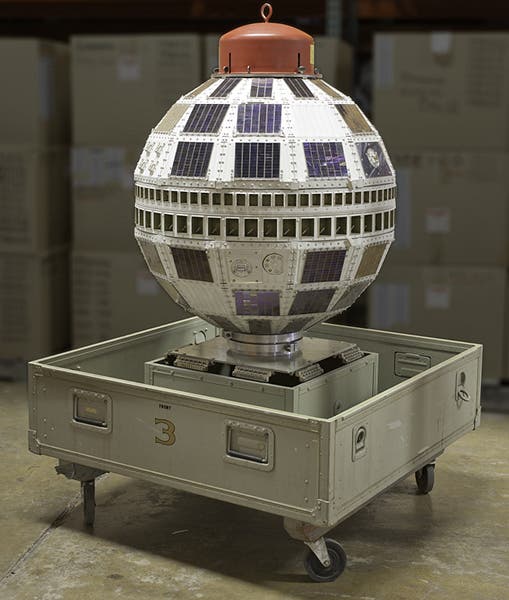
Backup Telstar satellite, National Air and Space Museum, Smithsonian Institution, Washington, D.C. (airandspace.si.edu)
The huge horn antenna at Andover was necessary because Telstar 1 had a low-power transmitter and an omni-directional antenna, so that the signal received at any point on Earth was barely detectable, and, to complicate matters, the satellite moved rapidly. So the receiver had to be large, and have the ability to track Telstar precisely, which the Andover horn was and did. But as satellite electronics improved, and satellites were moved to geo-stationary orbits that required little tracking, the unique facilities at Andover became unnecessary, and the huge antenna was eventually dismantled. Fortunately, the much smaller horn antenna at Holmdel, used to discover cosmic background radiation, has been preserved, a small monument to the birth of our satellite communications network (see our post on Robert Wilson and the Holmdel antenna).
A back-up Telstar is on display at the National Air and Space Museum, Smithsonian Institution, in Washington, D.C. (last image). The one on display at the Science Museum, London (first image) is a replica. To see the original, contact Elon Musk.
William B. Ashworth, Jr., Consultant for the History of Science, Linda Hall Library and Associate Professor emeritus, Department of History, University of Missouri-Kansas City. Comments or corrections are welcome; please direct to ashworthw@umkc.edu.