Scientist of the Day - Andrey Avinoff

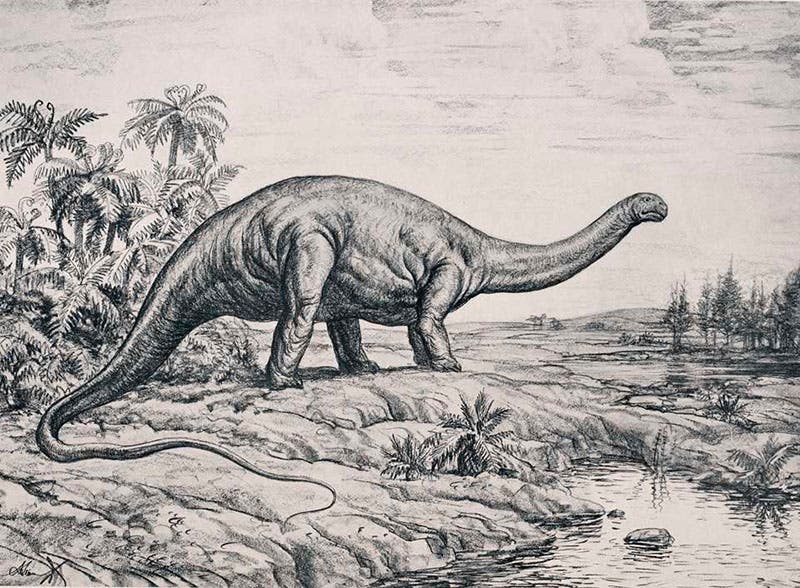
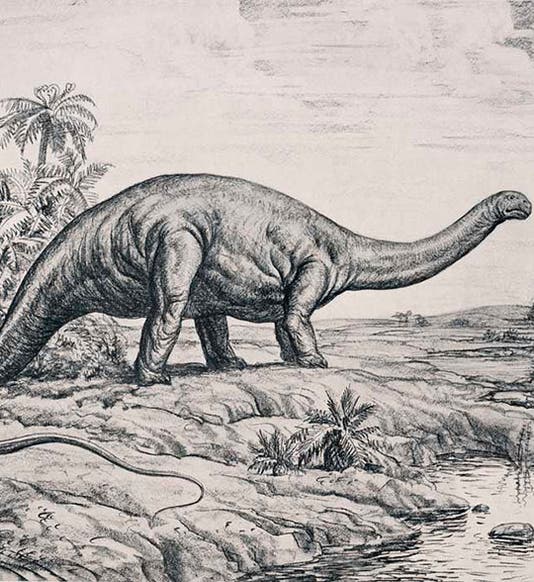
Life restoration of Apatosaurus, charcoal on paper, by Andrey Avinoff, printed as frontispiece in Memoirs of the Carnegie Museum, vol. 11, no. 4, 1936 (Linda Hall Library)
Andrey Avinoff, a Russian/American artist, lepidopterist, and museum director, died in New York City on July 16, 1949, at age 65. He had been born in Russia, in what is now Ukraine, in 1884, showing great artistic abilities and becoming part of what is often referred to as the Silver Age of Russian Art, with its center in St. Petersburg. He indulged his passion for butterflies by taking two long collecting trips to Turkestan and Kashmir/Tibet when he was in his mid-twenties, amassing the beginnings of a collection that would become one of the world’s finest. He also moved into the diplomatic service of the Tsar, Nicholas II, since he could speak perfect French, English, and Russian. He lived a social and intellectual life, and loved it.

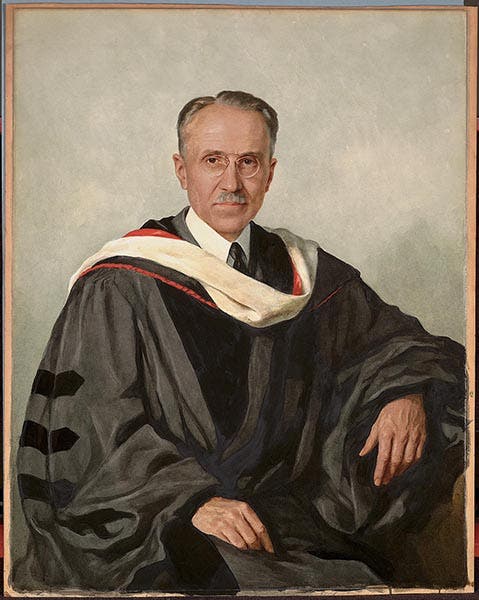
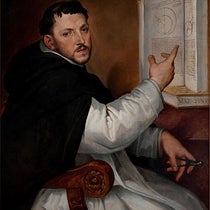
Portrait of Andrey Avinoff, watercolor on paper, by Elizabeth Shoumatoff, 1943, Carnegie Museum of Art, Pittsburgh (collection.carnegieart.org)
Avinoff’s world was turned upside down by the October Revolution of 1917. He was in the U.S. at the time on a diplomatic mission and never went home again. He lost his inheritance, his butterflies, his social life. Fortunately, his mother and sister and her family listened when he wired and said they should take the next train out of Russia. Eventually they joined him and made new lives in America.

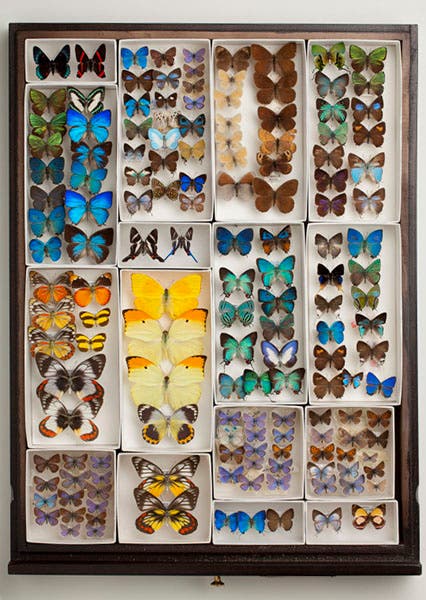
One drawer of many; butterflies collected by Andrey Avinoff, Carnegie Museum of Natural History, Pittsburgh (carnegiemnh.org)
Andrey's recovery and ascendance in the U.S. was remarkable. His only useful skills were languages and illustrating. The former did not pay but the latter did, and Andrey engaged in commercial artwork, at which he was quite good. He also knew more about butterflies than just about anyone, and somehow the Carnegie Museum in Pittsburgh heard about him and invited him to join their entomology department as an assistant. This was around 1923. He declined, because he was making more money doing commercial art. In 1926, the Director of the Museum, William J. Holland, a dinosaur man, retired, and amazingly, Avinoff was offered the position. He served as Director for 19 years, until 1945, when his health began to fail

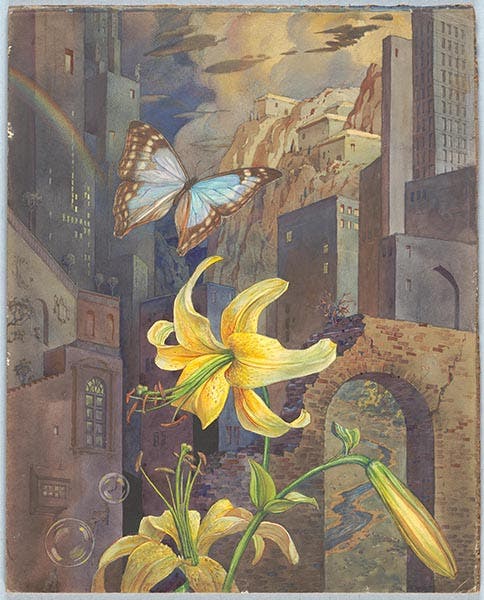
Morpho: Remembrance of Things Past, watercolor and graphite on paper, by Andrey Avinoff, 1943, Carnegie Museum of Art, Pittsburgh (collection.carnegieart.org)
I have been unable to discover how in the world Avinoff managed this rapid rise to respectability and a position of influence in American society. Clearly his diplomatic skills were considerable. He and Holland must have hit it off well. Avinoff did a drawing of Apatosaurus (Brontosaurus) for Holland that was included as the frontispiece to Holland’s monograph, which was finished by Chales W. Gilmore after Holland’s death and published in 1936. We exhibited this drawing in our 1996 exhibition, Paper Dinosaurs, and lead with it here (first image).

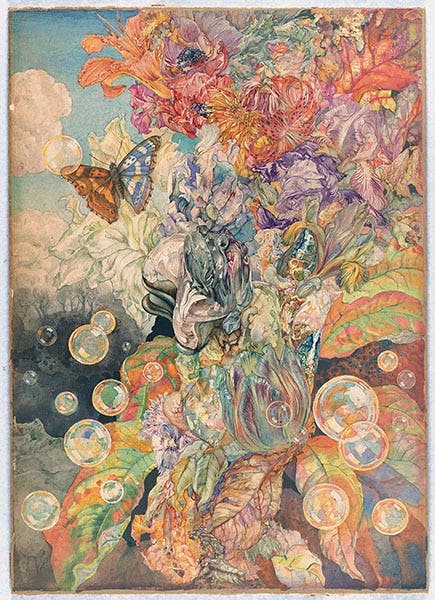
Iridescence, graphite, pen and ink, and watercolor on paper, by Andrey Avinoff, 1925-47, Carnegie Museum of Art, Pittsburgh (collection.carnegieart.org)
In addition to running the museum, Avinoff reconstructed his butterfly collection (third image), and he continued to paint – butterflies and flowers, mostly, but also many esoteric subjects as well. He built up a herbarium of flowering plants from Western Pennsylvania and drew them for a beautiful book, Wild Flowers of Western Pennsylvania and the Upper Ohio Basin, by Otto Emery Jennings (1953), which we do not have in our collections. Avinoff always painted in watercolor, and he adhered to a code of watercolor ethics unfamiliar to me. For example, he refused to highlight his flowers with white – the only white allowed was that of the paper beneath. His watercolors are extraordinarily good; there was a retrospective exhibition after his death, in 1953, and another 15 years ago at the Carnegie Museum of Art in Pittsburgh, which holds much of his artwork. The exhibition catalogue, Andrey Avinoff: In Pursuit of Beauty, by Louise Lippincott (2011), is really excellent. I am grateful to our Library President, Eric Dorfman, himself a former Director of the Carnegie Museum of Natural History, for lending me his personalized copy of the catalog.

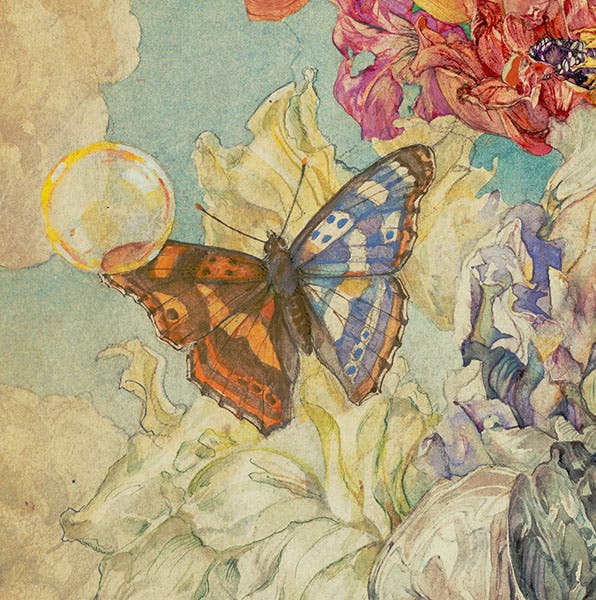
Detail of butterfly, from Iridescence, graphite, pen and ink, and watercolor on paper, by Andrey Avinoff, 1925-47, Carnegie Museum of Art, Pittsburgh (carnegieart.org/exhibition)
I tried to choose illustrations here that had scientific relevance, as well as aesthetic appeal. Iridescence (1943; fifth image) is hard to resist, since the butterfly included illustrates one of the fascinating features of butterflies – the colors of their wings change as the viewing angle changes, just as with soap bubbles. This painting, at the Carnegie Museum of Art, was used for the cover of the 2011 exhibition catalogue. We also show a detail of just the butterfly (sixth image)

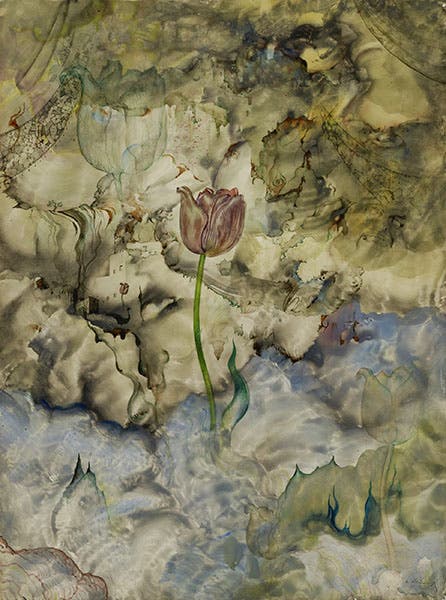
Emegence, watercolor, ink and pencil on paperboard, by Andrey Avinoff, undated, Smithsonian American Art Museum (americanart.si.edu)
Not all of Avinoff's artwork is in Pittsburgh. The Smithsonian American Art Museum has two watercolors, and we show both here. The first (seventh image) displays a single tulip; the texture of the surrounding vegetation is incredible and almost unique to Avinoff. And the other watercolor (eighth image), which the Smithsonian calls Tulips and the exhibition catalogue calls Tulips (Disintegration) (1949), shows what thoughtful artists paint when they are dying, and have mostly death and dissolution on their minds.

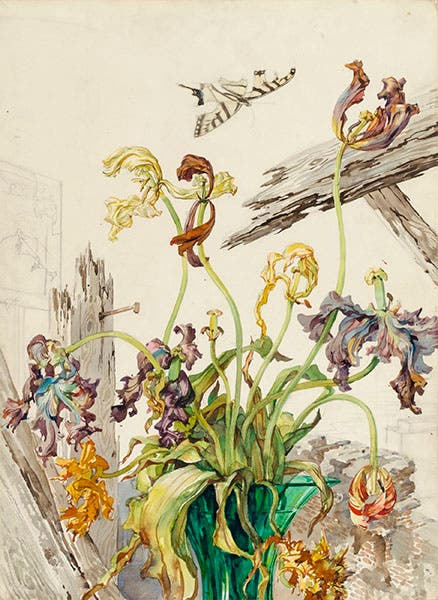
Tulips (Disintegration), watercolor and pencil on paperboard, by Andrey Avinoff, 1949, Smithsonian American Art Museum (americanart.si.edu)
Avinoff's sister, Elizabeth Shoumatoff, was a gifted artist herself; it was she who was famously painting a watercolor portrait of President Franklin D. Roosevelt in 1945 when he collapsed and died; the unfinished portrait of FDR is in the Little White House in Georgia. She also did a watercolor portrait of her brother Andrey that is truly compelling; we used it for our portrait here (second image).

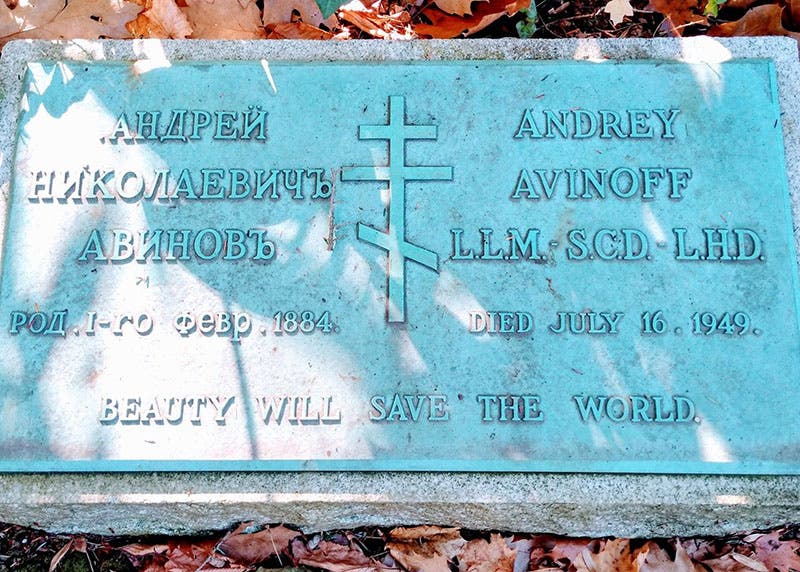
Tombstone of Andrey Avinoff, Locust Valley Cemetery, Nassau County, New York; his epitaph reads: “Beauty will save the world” (findagrave.com)
Andrey Avinoff was buried in the Locust Valley Cemetery in Nassau County, New York. His epitaph reads: “Beauty will save the world” (last image).
William B. Ashworth, Jr., Consultant for the History of Science, Linda Hall Library and Associate Professor emeritus, Department of History, University of Missouri-Kansas City. Comments or corrections are welcome; please direct to ashworthw@umkc.edu.