Scientist of the Day - Drummond Matthews

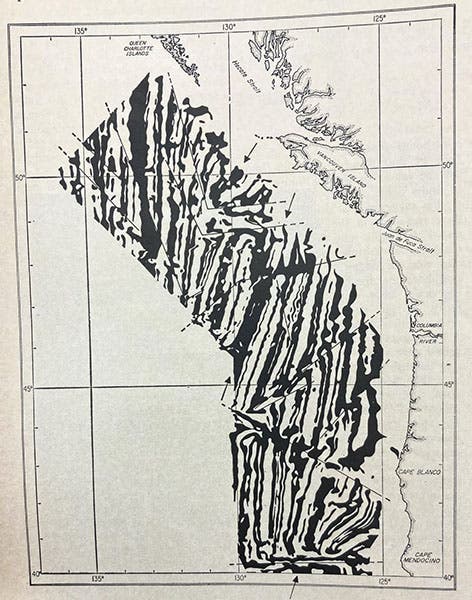
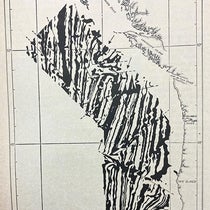
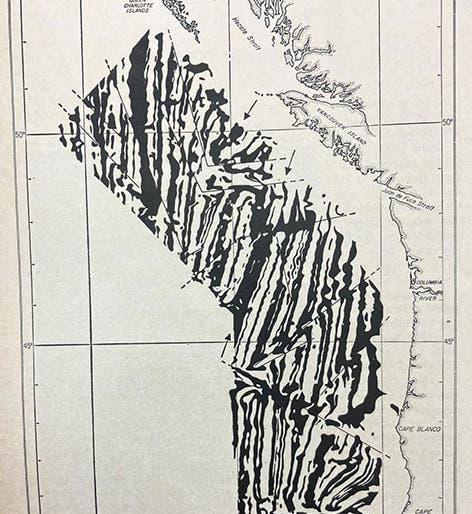
Magnetic field anomalies southwest of Vancouver Island, northeast Pacific Ocean, east and west of the Juan de Fuca ridge, illustrating the Vine-Matthews-Morley hypothesis, in “Spreading of the ocean floor: New evidence,” by F. J. Vine, Science, vol. 154, p.1406, 1966 (Linda Hall Library)
Drummond Hoyle Matthews, a British marine geologist and geophysicist, known to his colleagues as Drum, died on July 20, 1997, at the age of 66. He had studied at King’s College, Cambridge, and received his PhD in 1961. He spent the year 1962 surveying magnetically some seamounts in the Indian Ocean, along what is called the Carlsberg Ridge, and he was trying to make sense of the fact that there were lengthy blocks of ocean-floor basalt that were magnetized with a polarity directly opposite to similar blocks on either side. He and his first graduate student, Fred Vine, were trying to figure out what was going on. They were aided by their awareness of a proposal, made by American Harry Hess in 1960 and published in 1962, that the Atlantic Ocean seafloor was spreading, driven by magma welling up from the mantle at the ridge that ran down the center of the Atlantic Ocean floor. This concept of “seafloor spreading” (named by Robert Dietz) was brand new and had been initially rejected by most geophysicists. Also very recent was the proposal that the polarity of the Earth’s magnetic field had switched a million or so years ago, and a million years before that, and that a record of these reversals could be found in molten rock that solidified during the reversals.


Drummond Matthews (center), receiving an award in 1981; Fred Vine is on the right, photograph, 1981 (balzan.org)
Matthews and Vine realized by mid-1963 that, if sea floor spreading were true, and geomagnetic reversals were a fact, then the geomagnetic data made sense. They suggested, in a paper published in Nature in September, 1963, that magma welled up at mid-oceanic ridges and cooled, and the magnetite in the basalt aligned with the prevailing magnetic field. As new magma appeared at the ridge, it pushed apart the basalt blocks recently formed. If the magnetic field flipped, then the cooling magma would magnetically align with the new field, and the residual magnetism would be opposite to that of the blocks alongside. The result, after tens of millions of years, would be an alternating pattern, left and right of the ridge. If you colored a map of the remanent magnetism on an ocean floor, black for normal magnetism and white for reversed, the result would be a zebra pattern, symmetric on both sides of the ridge (first and fifth images). In the three years after the Vine-Matthew’s hypothesis was proposed, new data, especially from the northeast Pacific Ocean floor, showed exactly that. The Vine-Matthews hypothesis confirmed seafloor spreading and geomagnetic reversals, and set the stage for the discovery of transform faults (see our post on Tuzo Wilson), and the subsequent proposal of plate tectonics

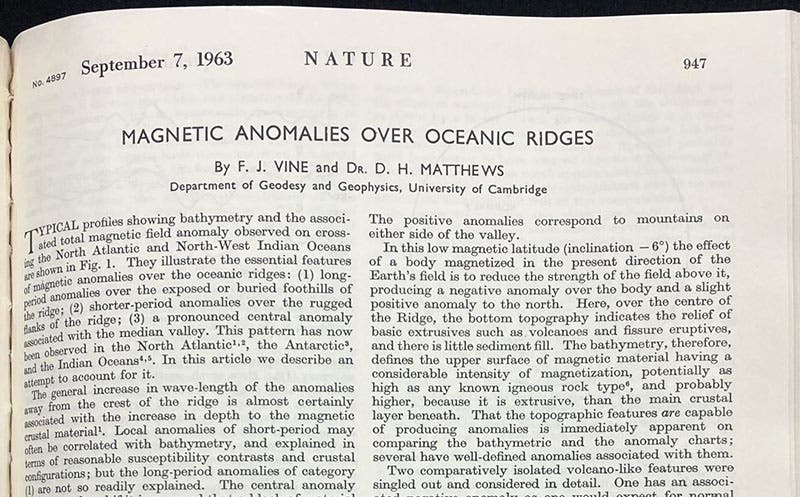
First paragraph, “Magnetic anomalies over ocean ridges,” by F. Vine and D. H. Matthews, Nature, vol. 199, p. 947, 1963 (Linda Hall Library)
It was soon realized that a Canadian geologist, Lawrence Morley, had proposed a scenario identical to that of Matthews and Vine, and had submitted a paper to Nature just before Vine and Matthews, but it had been rejected as lacking data. So now the Vine-Matthews hypothesis is usually referred to as the Vine-Matthews-Morley hypothesis (or, in Canada, as the Morley-Vine-Matthews hypothesis).

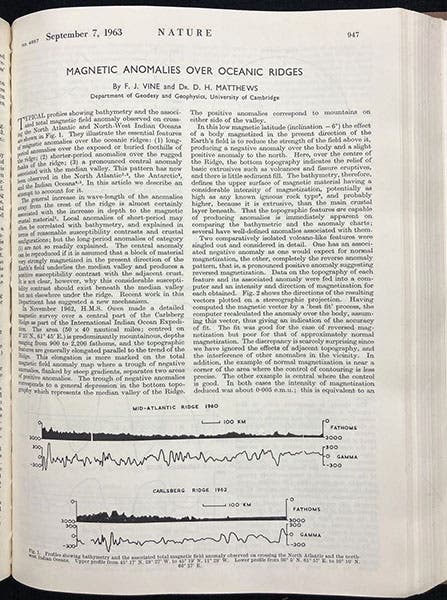
Full first page, showing the symmetric nature of the magnetic anomalies graphed at bottom, “Magnetic anomalies over ocean ridges,” by F. Vine and D. H. Matthews, Nature, vol. 199, p. 947, 1963 (Linda Hall Library)
The fact that Vine’s name always comes before Matthews’ tells us that the student did the bulk of the work in framing the hypothesis and accumulating defending data, and the graduate adviser did what graduate advisers are supposed to do – advised. Still, in 1989, Matthews received the Wollaston Medal from the Geological Society of London, which is just about the highest honor a British geologist can receive, so his work in helping establish plate tectonics as the guiding paradigm in geology was clearly understood and appreciated.

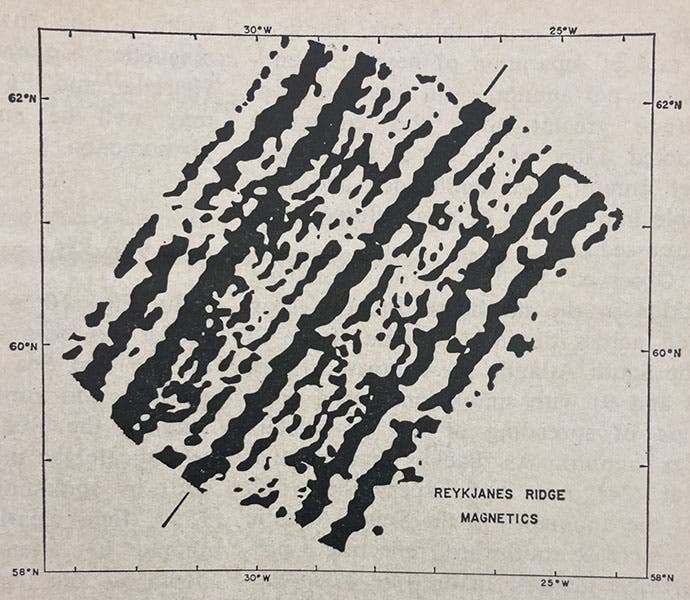
Magnetic anomalies over Reykjanes Ridge, southwest of Iceland, illustrating the Vine-Matthews-Morley hypothesis, in “Spreading of the ocean floor: New evidence,” by F. J. Vine, Science, vol 154, p.1407, 1966; the two black indicators mark the location of the ridge (Linda Hall Library)
The full story of the Vine-Matthews-Morley hypothesis and its reception is told in volume 4 of Henry Frankel's magisterial The Continental Drift Controversy (2012). I worked alongside Hank for 44 years and am still saddened by his untimely death in 2019. But what a monumental work he has left us! It was a pleasure to re-read large chunks of it while writing this piece.
William B. Ashworth, Jr., Consultant for the History of Science, Linda Hall Library and Associate Professor emeritus, Department of History, University of Missouri-Kansas City. Comments or corrections are welcome; please direct to ashworthw@umkc.edu.