Scientist of the Day - Zeno of Citium

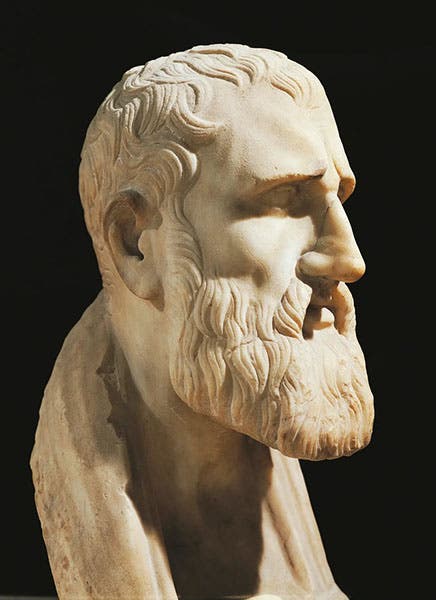
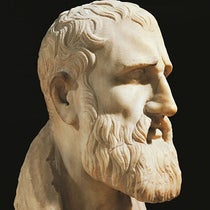
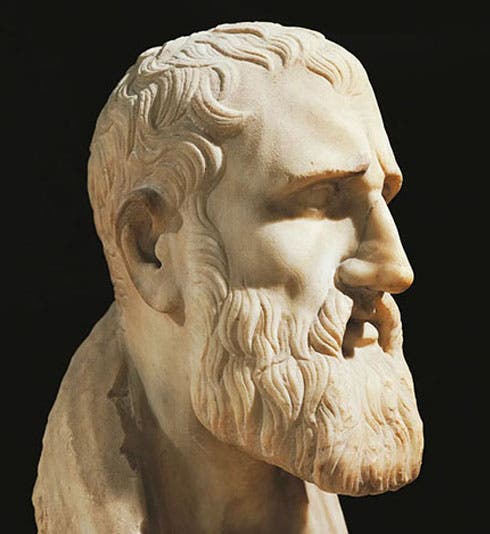
Bust of Zeno of Citium, Farnese Collection, National Archaeological Museum of Naples (thetimes.com)
Zeno of Citium, a Hellenistic philosopher, lived from ca 335 BCE to ca 262 BCE. Citium was a city in Cyprus, inhabited by both Greeks and Phoenicians, and Zeno’s ethnicity is not known, although he was often referred to as "the Phoenician” in later life. He journeyed to Athens as a young man (this would have been 20 years or so after the death of Aristotle) and came under the tutelage of Crates the Cynic, who turned Zeno into a philosopher. Zeno never felt comfortable with the "shamelessness" that went with Cynicism – he was a fairly modest man – but he was taken by the Cynic doctrine that one should live a life guided by virtue, in avoidance of pain and turmoil. Around 300 BCE, Zeno began teaching, and attracting his own students, at the Agora in Athens, at the structure called the stoa poikile, or painted portico, which still survives, although in ruins (second image). The philosophy he developed there was one of the most influential systems of thought in the Hellenistic and Roman world. It came to be known as Stoicism, and its adherents were called Stoics.
.jpg#/media/File:Athens_Agora_Stoa_Poikile_W_end_(1991).jpg)
Ruins of the stoa poikile, where Zeno of Citium taught ca 280 BCE, Agora, Athens, Greece (Wikimedia commons)
Like most Greek philosophers, Zeno had lots to say about Nature and physics (by which he meant the study of Nature). There were many natural philosophies swirling through 3rd century BCE Athens, including those of Plato, Aristotle, Epicurus, and several of the later Presocratics, especially Empedocles and Democritus. Epicurus, about 10 years older than Zeno, had embraced the atomism of Democritus, the idea being, I suppose, that if the world is determined by the mindless interactions of atoms, there is no point in fretting about it, since it is beyond our control, and we can get on with living our lives, avoiding pain and seeking happiness.
Zeno, for whatever reason, was more partial to the matter theories of Empedocles and Aristotle, which described the world we live in as an ever-changing mixture of four elements (earth, water, air, fire) and four qualities (hot, cold, wet, dry). Zeno, however, offered some new wrinkles. He thought all matter is pervaded by pneuma, a material soul, if you will, which gives life to everything, the universe included. For Aristotle, the heavens were an entirely different realm, their perfection providing a contrast with our imperfect elemental world. For Zeno and the Stoics, the heavens formed a close counterpart to our world, so much so that there is a correspondence between the Macrocosm and Microcosm, a concept introduced by Stoicism.
Zeno does not seem to have had much interest in the nuts and bolts of physics – observing and measuring Nature in order to understand her laws, if laws there are, and neither did other followers in what we call the early Stoa. But Stoicism flourished under Roman rule, during the late Republic and early Empire, the last century BCE and the first century CE, a period that we call the middle Stoa; Cicero was a Stoic, and so was Seneca. Both Cicero and Seneca wrote books presenting a Stoic view of the natural world, and their books survive.
The greatest Stoic natural philosopher left no books at all for posterity. His name was Posidonius. He was a geographer, astronomer, and mathematician. He measured the sizes of and distances to Sun and Moon, and the circumference of the Earth. He wrote dozens of treatises on assorted sciences, and was enthusiastically praised, not only by Cicero and Seneca, but later by Strabo and Ptolemy of Alexander, and, eventually, by Marcus Aurelius. But not a single one of his books survived. Posidonius was the lost Stoic. We will write a post on him when day, a post informed only by hearsay. That will be interesting.

Excavated ruins of the Villa of the Papyri, Herculaneum, which contains a carbonized papyrus of the History of the Stoa, by Philodemus of Gadara (and many other books by Philodemus) (Wikimedia commons)
To return to our subject for today, there is a seaside villa at Herculaneum that was covered by hot ash during the eruption of Mount Vesuvius in 79 CE, and when excavated, it was found to contain a large library. The ruin is thus called the Villa of the Papyri. All of the scrolls were carbonized by the heat, but not burned, since there was no oxygen. In the last few years, techniques have been developed to read the black-on-black scrolls, and one of those deciphered just last year (2025) was the History of the Stoa, by Philodemus of Gadara, written before 50 BCE. The book had been known before, but in an incomplete version. The copy at Herculaneum is more complete, and may shed further light on early Stoicism and on Zeno, its founder. Now if only a book by Posidonius would turn up in the Villa.
We do not have actual portrait busts of most ancient Greek natural philosophers, but there is one of Zeno that appears to be a genuine portrait of someone, and the inscription says Zeno, so why not? It was formerly in the Farnese collection, and is now in the Archaeological Museum of Naples (first image).
Incidentally, Zeno of Citium should not be confused with Zeno of Elea, the man of many paradoxes, who lived several centuries earlier. We have already published a post on that Zeno.
William B. Ashworth, Jr., Consultant for the History of Science, Linda Hall Library and Associate Professor emeritus, Department of History, University of Missouri-Kansas City. Comments or corrections are welcome; please direct to ashworthw@umkc.edu.