Scientist of the Day - Clifford Simak

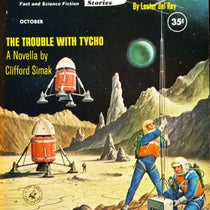
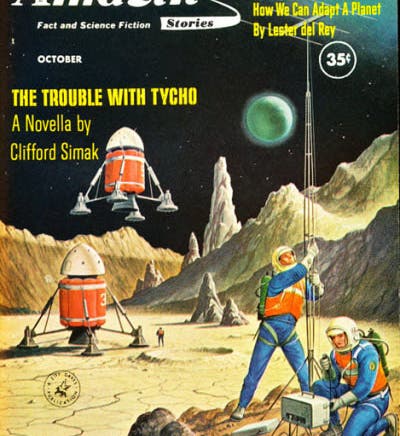
Front cover, Amazing Stories, Oct. 1960 issue, illustrating the novella, “The trouble with Tycho,” by Clifford D. Simak (Wikimedia commons)
Clifford D. Simak, an American science fiction writer and newspaperman, was born Aug. 3, 1904, in Millville, Wisconsin. Simak was one of the most prominent members of the "Golden Age" of science fiction (1937-1950), when editor John Campbell was redefining the field in his magazine, Astounding Stories. Simak developed a style that is often called "pastoral SF", since his characters tend to be simple country folk living in, say, rural Wisconsin, who somehow end up at the crossroads of some intergalactic encounter. His novel Way Station (1963) is set in exactly this way, as Enoch Wallace, a veteran of the Civil War, finds his shack transformed into a tiny Grand Central Station where extra-terrestrials come and go in secret, the bonus being that Enoch does not age, which arouses the suspicions of the government, suspicions that drive the story.

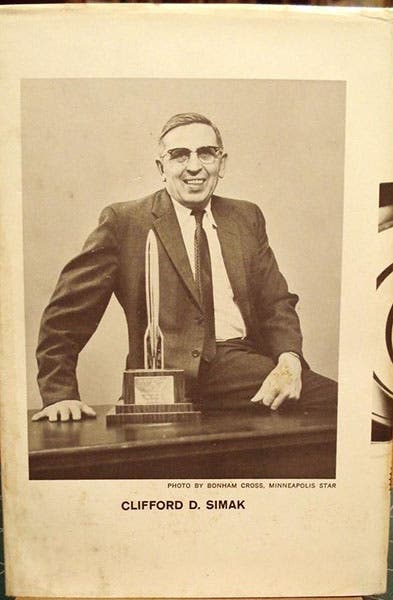
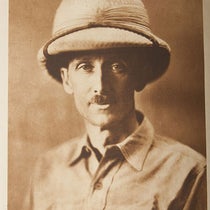
Portrait of Clifford D. Simak, rear of dust jacket, Way Station, by Clifford D. Simak, first edition, 1963 (worthpoint.com)
Way Station won the Hugo Award in 1963, given out annually by the World Science Fiction Society, beginning in 1962, which would ordinarily be a high honor, but this particular award has become somewhat notorious, since Way Station beat out Kurt Vonnegut's Cat's Cradle for the honor, and Cat's Cradle is now usually acknowledged as the better novel. In fact, the choice of Simak over Vonnegut in 1963 reminds some people of the Grammy Awards of 1989, when Jethro Tull unexpectedly beat out Metallica for the Best Hard Rock album of the year. Many found that scandalous, but I happen to think that the jury got it right.

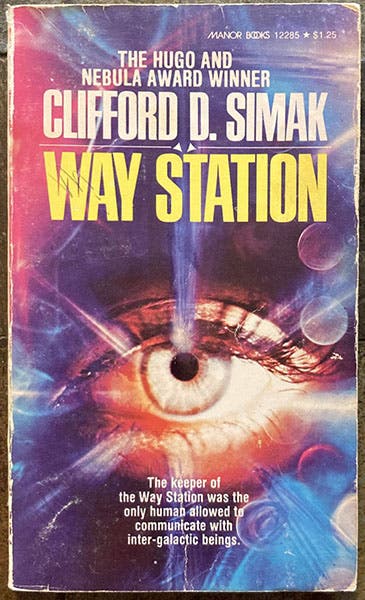
Front cover, Way Station, by Clifford D. Simak, paperback edition, 1963 (author’s copy)
I read Way Station decades ago, a $1.25 paperback that I still have (third image), which is the way most people read SF in those days (the short fiction first appeared in SF pulp monthly magazines, like Galaxy, which for some reason I never subscribed to, preferring the paperback anthologies that soon reprinted the better stories). Since I hadn't consumed any Simak in years, for this anniversary occasion, I read, for the first time, his short story "The grotto of the dancing deer," published in Analog Science Fiction in 1980. It won the Nebula Award that year, the other of the two highest honors meted out to SF authors, and so it appeared in the anthology Nebula Award Stories Sixteen (1982), which is where I found it. It is a sweet story about an archaeologist who discovers some cave paintings in a Spanish grotto, assisted by a quiet local who just wanders in. It turns out that the local is the very person who painted the murals some 22,000 years ago, and about the subtle way he allows our narrator to discover this very disturbing truth. So it is a story about time, and what it is like to live outside of time, if you are not a scientist, but just an ordinary artisan named Luis. I can't say as I would have chosen it as the SF short story of the year, but I did enjoy it. And I liked the fact that, as in all of Simak’s fiction, there were no space wars to be seen, or dystopian settings to be stumbled through.

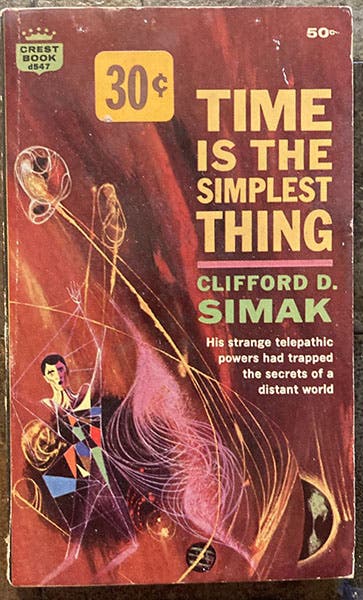
Front cover, Time is the Simplest Thing, by Clifford D. Simak, paperback edition, 1961 (author’s copy)
When the Science Fiction Writers of America (SFWA) decided in the mid-1970s to honor the founders of their field, they created the title of Grandmaster and began handing out this award in 1975. Simak was the third Grandmaster named, in 1977, beating Arthur C. Clarke and Isaac Asimov to that honor. Grandmaster number 1 was Robert Heinlein, followed by Jack Williamson.

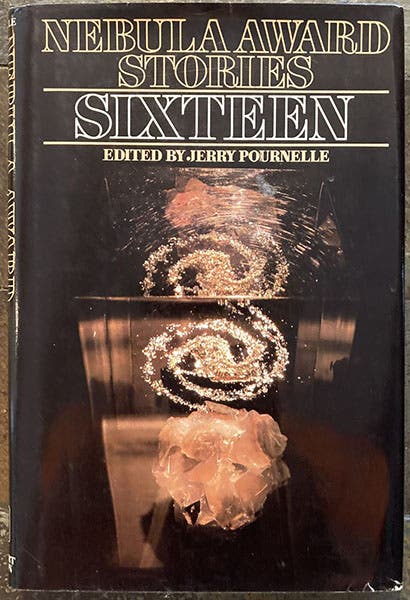
Dust jacket, Nebula Award Stories Sixteen, containing “Grotto of the dancing deer,” by Clifford D. Simak, ed. by Jerry Pournelle, 1982 (author’s copy)
Simak wrote until his death in 1988, and his later stories are just as powerful as those of his youth. If you read current science fiction, and have never read any of the grandmasters, you should check them out. Knowing more about the history of any genre or discipline is always a good idea. A first edition of Way Station might set you back a few thousand dollars (last image). But it reads just as well in a modem reprint.

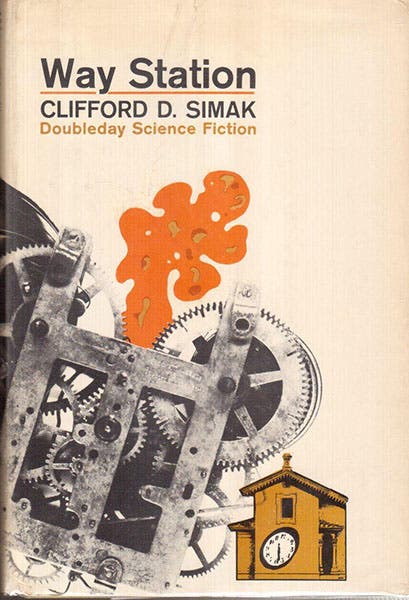
Dust jacket, Way Station, by Clifford D. Simak, first edition, 1963 (abebooks.com)
I have been in many towns in Wisconsin, those in reach of Madison, Milwaukee, or Hudson, where I have school ties or relatives, but I have never been in Millville, in the extreme southwestern corner of the state, although I have a mental image, since Millville is where Enoch Wallace has his space-gate of a house in Way Station. I hope there is a memorial there somewhere for Simak. A town of 179 souls can't have too many more notable former residents than our author. And perhaps the stargate is still there, hiding behind a bush, somewhere.
William B. Ashworth, Jr., Consultant for the History of Science, Linda Hall Library and Associate Professor emeritus, Department of History, University of Missouri-Kansas City. Comments or corrections are welcome; please direct to ashworthw@umkc.edu.