Scientist of the Day - Guillaume Rondelet

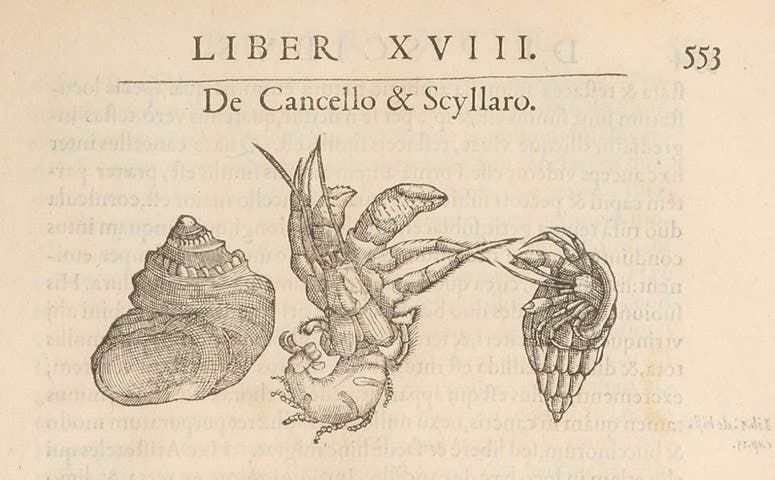
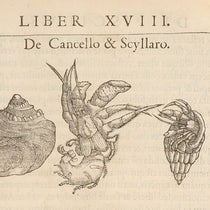
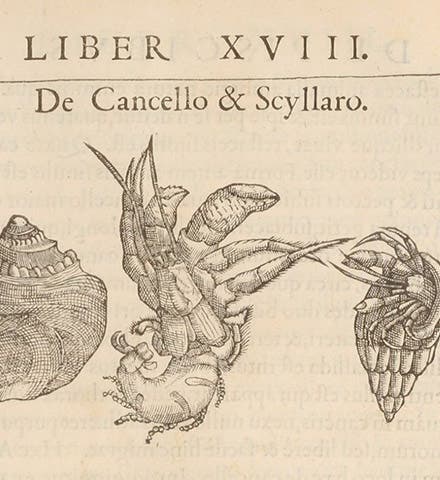
Hermit crab, woodcut, Libri de piscibus marinis, by Guillaume Rondelet, vol. 1, p. 553, 1554-55 (The Linda Hall)
Guillaume Rondelet, a French physician and naturalist, died on July 30, 1566, at the age of 58. He studied in Paris and received a degree in medicine at Montpellier in southern France, but he was never successful in private practice. However, he acquired a wealthy and powerful patron, a Cardinal, in the 1540s, probably by curing him or a family member of some nasty disease, which resulted in his appointment in 1545 as professor of medicine at Montpellier. Rondelet travelled to Italy with his benefactor in 1549 and there met naturalists such as Ulisse Aldrovandi, then beginning to compile an encyclopedia of the natural world.


Portrait of Guillaume Rondelet, woodcut in his Libri de piscibus marinis, vol. 1, preface, 1554-55 (The Linda Hall)
When he returned to Montpellier, Rondelet set about compiling his own encyclopedia, this one on creatures of the water, mostly fish, but also invertebrates and marine mammals and reptiles. The book was published in two volumes in 1554-55 as Libri de piscibus marinus (Books on marine fish). Its most significant feature is that all of the woodcuts – and there are hundreds of them – were drawn from life, which was a new feature of books on nature in the 1550s, also exemplified in the works of Conrad Gessner and Pierre Belon. We have written one post on Rondelet and showed a few of these marvelous woodcuts, all depicting fish.

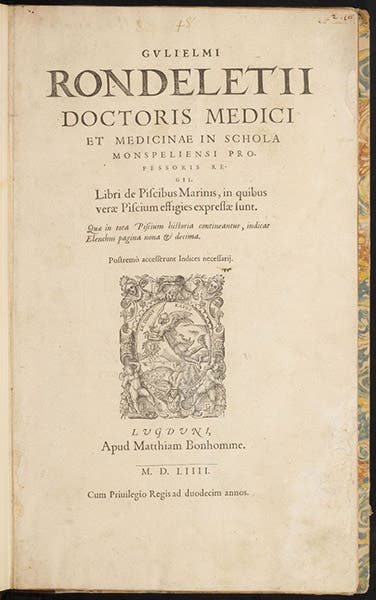
Title page, Libri de piscibus marinis, by Guillaume Rondelet, 1554-55 (The Linda Hall)
We did not mention, in our first post, that Rondelet was apparently an influential and inspiring teacher. Many of the great naturalists and physicians of the late 16th century spent some part of their educational years in Montpellier and studied under Rondelet, including Carolus Clusius, Felix Platter, and Volcher Coiter. So apparently his views on the importance of first-hand observation and depiction of nature were transmitted by both his book and his teachings.

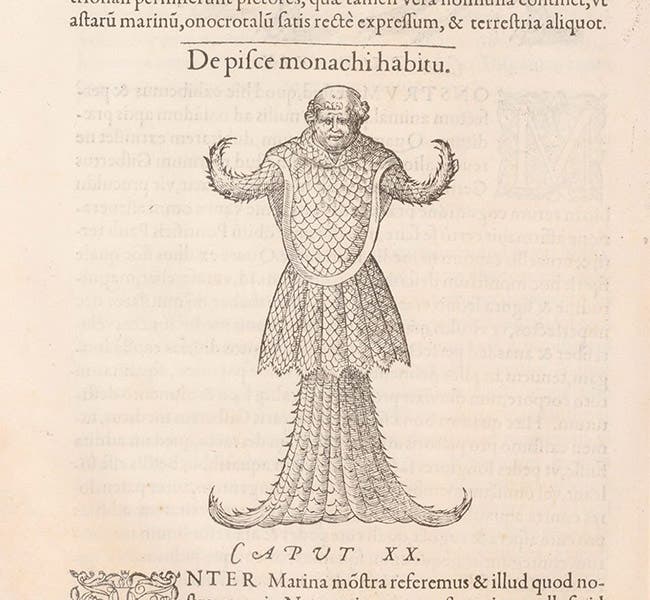
Monkfish, woodcut, Libri de piscibus marinis, by Guillaume Rondelet, vol. 1, p. 492, 1554-55 (The Linda Hall)
To illustrate this post, I selected a few woodcuts from Libri de piscibus marinis that do not depict fish, but show other kind of marine animals. I usually avoid mentioning the bishopfish and the monkfish when discussing Renaissance natural history, because they are too often used to show the "quaintness" and naïveté of Renaissances zoology, but I decided to include them here (fourth and fifth images), because the same two specimens appear in the contemporary works of Conrad Gesner and Pierre Belon, but with slightly different woodcuts in each case, suggesting that they all were derived from a fourth account of some oddities pulled from the sea or found on a beach, perhaps shriveled cuttlefish or mutilated rays.

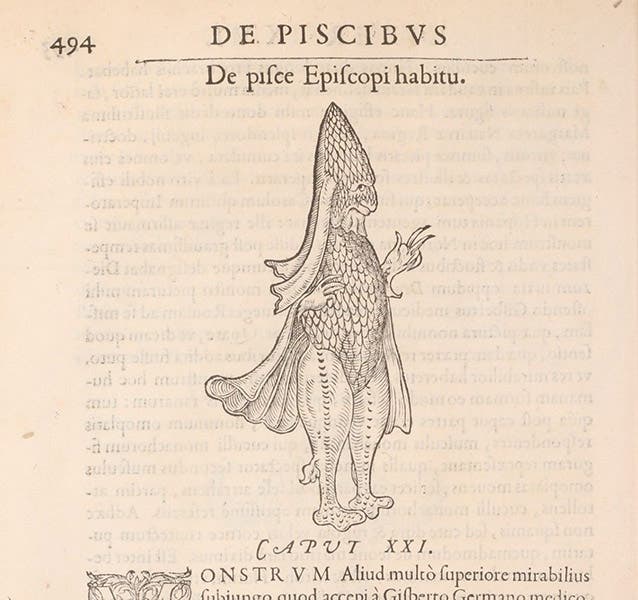
Bishopfish, woodcut, Libri de piscibus marinis, by Guillaume Rondelet, vol. 1, p. 494, 1554-55 (The Linda Hall)
We also present here some more conventional creatures found in Rondelet’s book, including a hermit crab (first image) and a paper nautilus (sixth image).

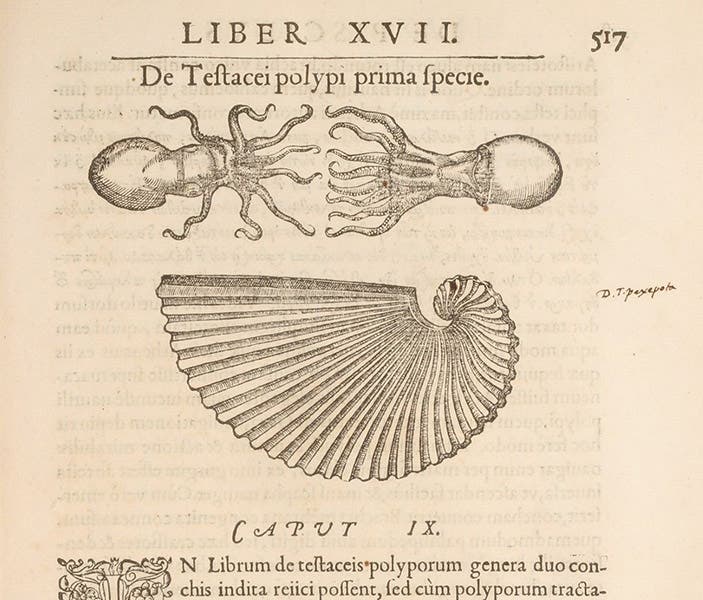
Paper nautilus and occupant, woodcut, Libri de piscibus marinis, by Guillaume Rondelet, vol. 1, p. 537, 1554-55 (The Linda Hall)
We did not show, the first time around, the title page of Rondelet’s book, or a portrait, two deficiencies that we remedy here. The portrait (second image) is a small medallion that is included in the prefatory matter of his book.
William B. Ashworth, Jr., Consultant for the History of Science, Linda Hall Library and Associate Professor emeritus, Department of History, University of Missouri-Kansas City. Comments or corrections are welcome; please direct to ashworthw@umkc.edu.