Scientist of the Day - Walther Flemming

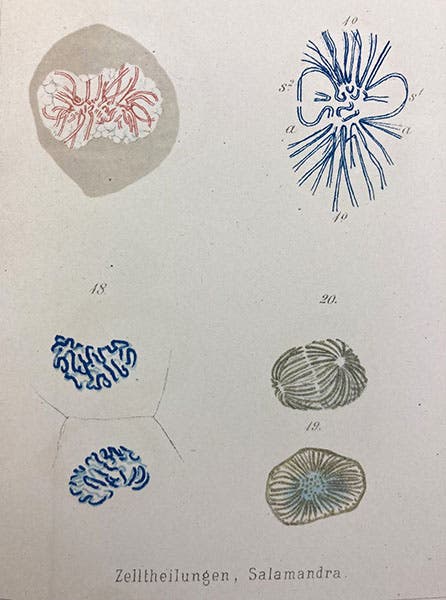
Chromatin at various stages of mitosis, detail of plate 18, “Beiträge zur Kentness der Zelle und ihrer Lebenserscheinungen,” by Walther Flemming, Archiv für Mikroskopische Anatomie, vol 16, 1879 (The Linda Hall)
Walther Flemming, a German cell biologist, died on Aug. 4, 1905, at the age of 62. He had been born in Sachsenberg in 1842, son of a pharmacist, and he studied medicine in Prague. He began teaching in Prague, and then took up a position at the University of Kiel, up near Denmark, where he would teach anatomy until his death.

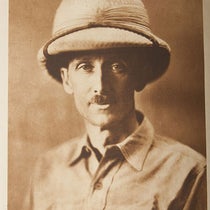
Portrait of Walther Flemming, photograph, undated but ca 1900, Bibliothèque interuniversitaire de santé, France (Wikimedia commons)
Flemming’s interests moved toward cytology, the study of the cell. The 1870s and early 1880s were a golden age for cytology, especially in Germany, due to the development of much improved compound microscopes by opticians such as Carl Zeiss, and by the invention of aniline dyes, which would color certain structures in the cell and make them stand out under the microscope.

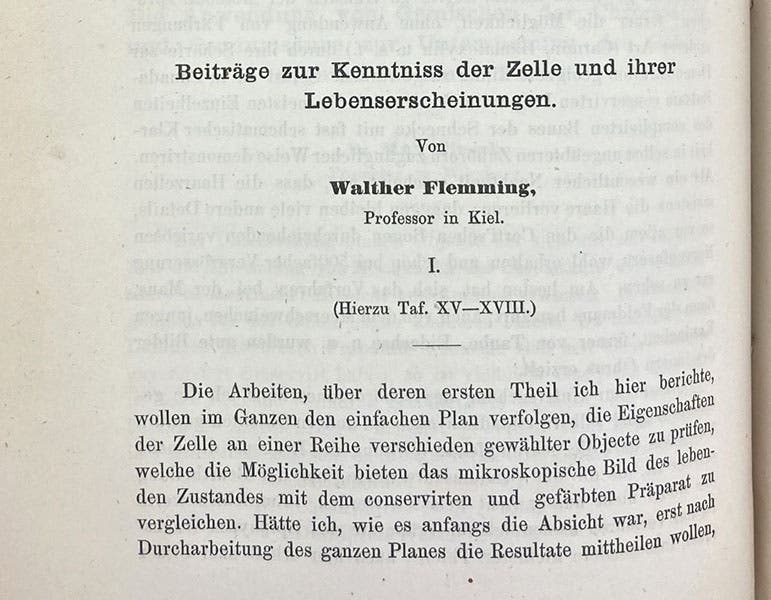
First paragraph, “Beiträge zur Kentness der Zelle und ihrer Lebenserscheinungen,” by Walther Flemming, Archiv für Mikroskopische Anatomie, vol 16, pp. 302, 1879 (The Linda Hall)
Flemming made two major discoveries about the nucleus of the animal cell, studying those of newts and salamanders. He identified a new substance in the nucleus, which he could follow through the process of cell division, because it took up aniline stain, and which he consequently named chromatin (colored substance). And he worked out the process of cell division, by which chromatin comes together in the nucleus, forms into rods that divide and move to opposite poles, each pole becoming the nucleus for one half of the divided cell. He named the process mitosis.

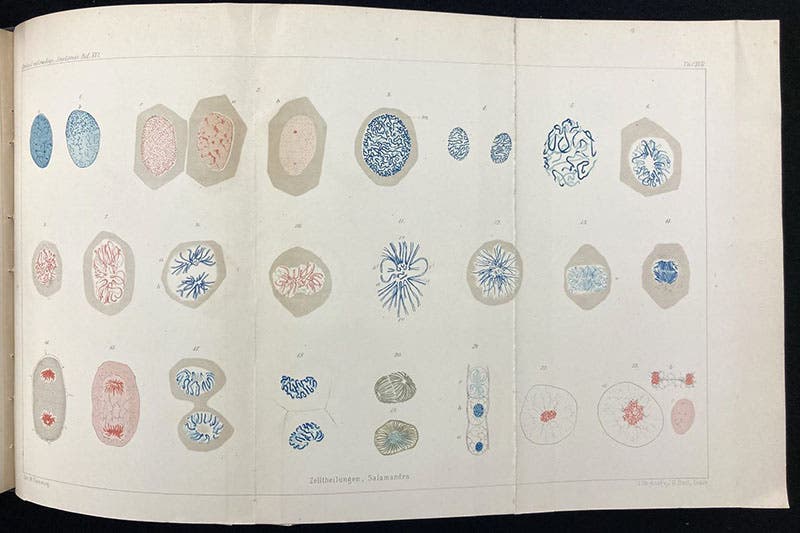
Twenty-five different stages of mitosis in a salamander cell (not in order), “Beiträge zur Kentness der Zelle und ihrer Lebenserscheinungen,” by Walther Flemming, Archiv für Mikroskopische Anatomie, vol. 16, folding plate 18, 1879; note the use of two different aniline stains (The Linda Hall)
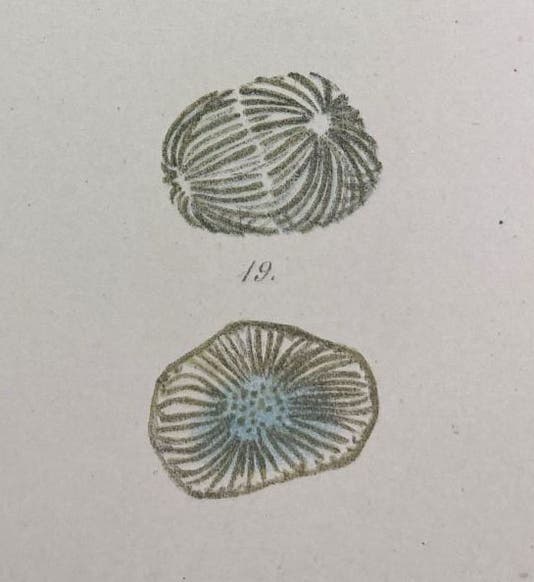
Flemming was also the first to observe that the chromatin rods divide longitudinally, and not transversely, as others maintained. This was a remarkable feat of observation by Flemming. You can see the longitudinal dividing in fig. 19 in our first image.

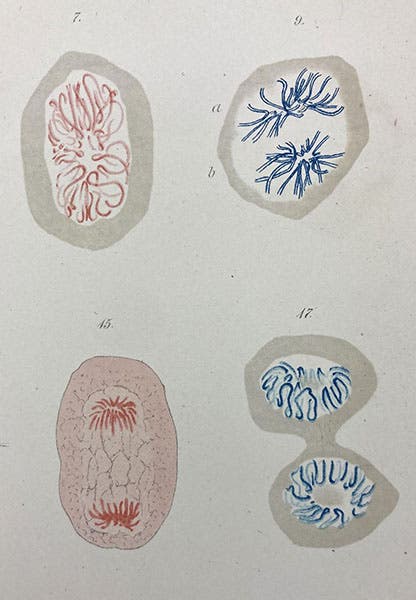
Another detail of plate 18, showing four more stages of mitosis in a salamander cell, “Beiträge zur Kentness der Zelle und ihrer Lebenserscheinungen,” by Walther Flemming, Archiv für Mikroskopische Anatomie, vol 16, 1879 (The Linda Hall)
Flemming’s discoveries were published in two papers in the Archiv für Mikroskopische Anatomie in 1879 and 1880, and in a book, published in 1882, Zellsubstanz, Kern und Zelltheilung (Cell Substance, the Nucleus and Cell Division). We have the two journal issues in our library, and show here images from the first, but we do not own the book, which we would like to obtain, since we have an otherwise excellent collection of the works that define the golden age of cell biology.

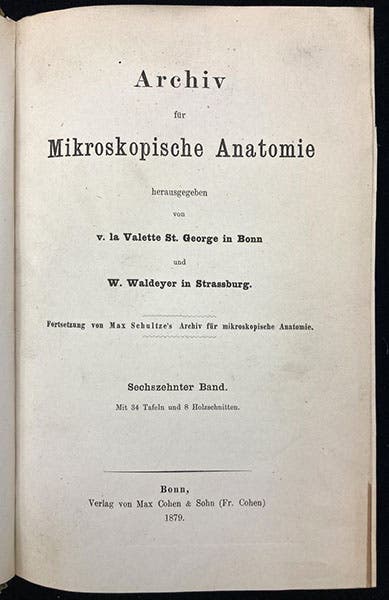
Title page of the journal in which Walther Flemming published his two important papers on chromatin and mitosis, Archiv für Mikroskopische Anatomie, vol 16, 1879 (The Linda Hall)
It should be noted that neither Flemming nor any other cytologist in 1880 was aware of the genetic importance of chromatin, since Gregor Mendel's pioneering work in genetics, although published in 1865, was unknown to the rest of the world until rediscovered in 1900. So the role of chromatin in inheritance was not understood by Flemming. The word chromosome, which we give to the chromatin structure, was also not coined until after Flemming. However, Flemming did understand the importance of the continuity of the cell nucleus in cell division, and he coined the phrase: omnis nucleus e nucleo (“every nucleus from a nucleus”), a variation on Rudolf Virchow's earlier discovery, “every cell comes from a cell.”
I would think that Flemming has a suitable grave memorial somewhere in Kiel, since he was quite well known and respected by the time of his death in 1905, but I could find no traces of it. Help me out, if you know anything about his final resting place.
William B. Ashworth, Jr., Consultant for the History of Science, Linda Hall Library and Associate Professor emeritus, Department of History, University of Missouri-Kansas City. Comments or corrections are welcome; please direct to ashworthw@umkc.edu.