Scientist of the Day - George of Trebizond

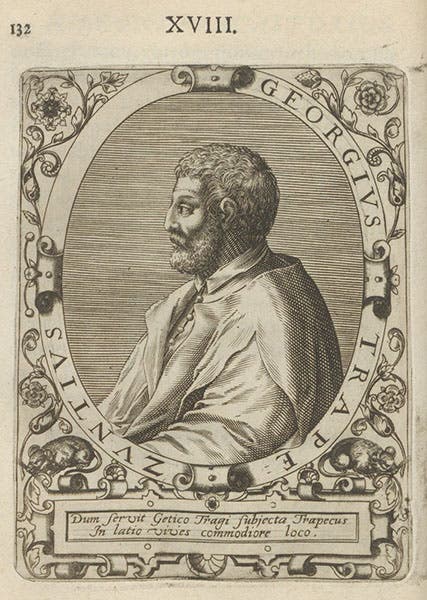
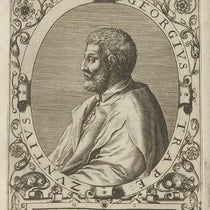
Portrait of “Georgius Trapezuntius,” engraving by Theodor de Bry, in Icones quinquaginta virorum illustrium, by Jean Jacques Boissard, vol. 1, p. 132, no. 18, 1597-99 (Linda Hall Library)
George of Trebizond, a Greek scholar sometimes referred to as Georgius Trapezuntius, was born in Crete around 1395. His ancestors had moved to Crete from the Trapezuntine Empire, a vestige of the Byzantine Empire, up on the Black Sea in Anatolia (modern Turkey), and he took that surname to honor his Byzantine heritage.
There was a famous Council in Florence in 1438-39, an attempt to reunify the Roman and Greek Orthodox churches, and many Greek scholars came to Italy for the occasion, George among them, although he may have come earlier. He learned Latin and would stay in Rome, Florence, or Naples for the rest of his life, writing a book on rhetoric that was widely printed (once printing was invented in 1455), and producing Latin translations of Greek scholarly works, especially those of Aristotle.

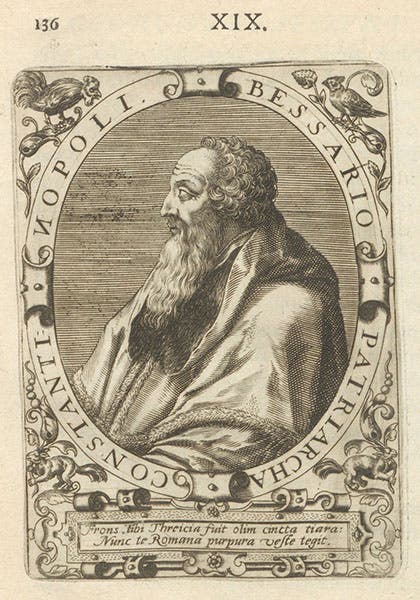
Portrait of “Bessario Patriarcha”, engraving by Theodor de Bry, in Icones quinquaginta virorum illustrium, by Jean Jacques Boissard, vol. 1, p. 136, no. 19, 1597-99 (Linda Hall Library)
Two books, however, got him into trouble. The first was a comparison between the philosophies of Aristotle and Plato, in which Trebizond was highly critical of Plato. Aristotle still ruled the university curriculum, but George may not have appreciated that there was a Platonic revival going on in Florence, thanks to Marsilio Ficino, and these budding Neoplatonists did not take kindly to the aspersions cast by Trebizond upon their new hero. Trebizond also ran afoul of Cardinal Bessarion, a legate of the Pope who collected Greek manuscripts, including those of Plato, and who was actually born in Trebizond, and he also did not appreciate the attack on Plato. In fact, he wrote a book, a Defense of Plato against the Calumnies [of Trebizond], in which he accused George of scholarly ineptitude. This did not help Trebizond's career.
The other work that got George into trouble was a translation from Greek into Latin of the great astronomical work from ancient times, the Almagest of Ptolemy of Alexandria. Ptolemy had been translated in medieval times by Gerard of Cremona, but this was a translation from Arabic, which had been translated from Persian, so it was several times removed from the original Greek. Trebizond by 1461 had produced a translation direct from Greek to Latin, and that should have been a good thing. Unfortunately, a young German named Johannes de Monte Regio (now known as Regiomontanus) had been brought by Bessarion to Italy from Vienna, primarily to translate a Greek manuscript of the Almagest that Bessarion had acquired. Regiomontanus first had to learn Greek, which might have put him at a disadvantage, but he was a brilliant astronomer and mathematician, which Trebizond certainly was not, and Regiomontanus soon realized that the new translation by Trebizond was seriously flawed. Indeed, in a manuscript written in 1471, Regiomontanus called Trebizond a "most shameless and vicious windbag."
As a result of the acrid criticisms of his scholarship, Trebizond was fired by the Pope and was forced to leave Rome entirely, being taken in by the King of Naples, although he returned to Rome in later life, dying there, by many accounts, in 1486, but possibly as early as 1473.

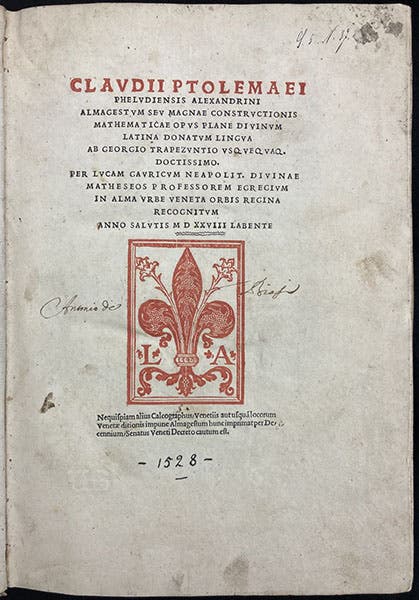
Title page, Almagestvm sev magnae constrvctionis mathematicae opvs … latina donatvm lingva ab Georgio Trapezvntio, by Ptolemy of Alexandria, 1528 (Linda Hall Library)
Regiomontanus completed his own translation of Ptolemy's Almagest, which was far superior to that of George of Trebizond, and he intended to publish it himself at the print shop he set up in Nuremberg in the early 1470s. However, in 1476, Regiomontanus made a trip to Rome, summoned there by the Pope, who wanted advice on the calendar problem faced by the Church. After just a few months there, Regiomontanus fell ill and died, only 40 years old. He was probably felled by the plague. However, a rumor circulated that he had been poisoned by relatives of George of Trebizond, who resented Regiomontanus's attacks on the patriarch of their family.

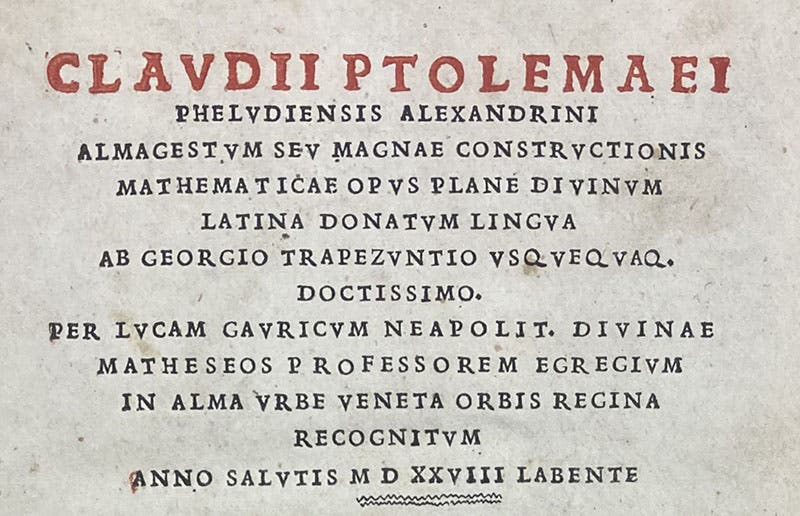
Detail of title page, with George of Trebizond named as translator in the sixth line, Almagestvm sev magnae constrvctionis mathematicae opvs … latina donatvm lingva ab Georgio Trapezvntio, by Ptolemy of Alexandria, 1528 (Linda Hall Library)
The great irony is that when Ptolemy's Almagest was finally printed in 1515, the manuscript of Regiomontanus was unavailable, and so the medieval translation of Gerard of Cremona was used. And when a rival edition was printed 13 years later, in 1528, the printer used Trebizond's translation, flawed though it might have been, rather than that of Regiomontanus, which was still unavailable to printers (third and fourth images).
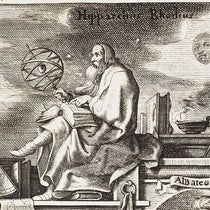
The portrait book of Jean-Jacques Boissard, Icones quinquaginta virorum illustrium (1597-99) has engraved portraits, by Theodor de Bry, of George of Trebizond and Basilios Bessarion, and we include both here. There is also one of Ptolemy. But there is no portrait of Regiomontanus. One wonders why not. You can see a portrait, part of a woodcut title page, in our post on Regiomontanus.
William B. Ashworth, Jr., Consultant for the History of Science, Linda Hall Library and Associate Professor emeritus, Department of History, University of Missouri-Kansas City. Comments or corrections are welcome; please direct to ashworthw@umkc.edu.