Scientist of the Day - Frank Chapman

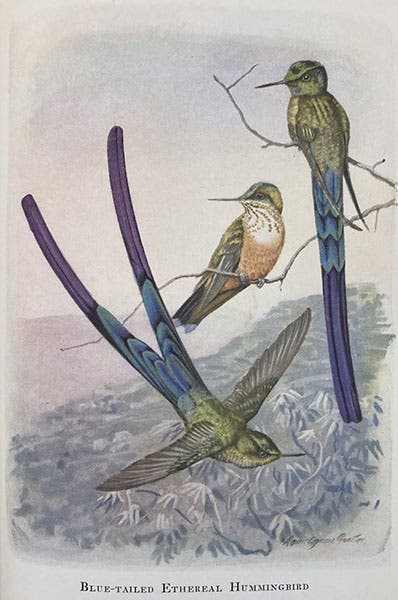
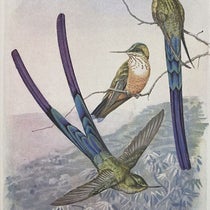
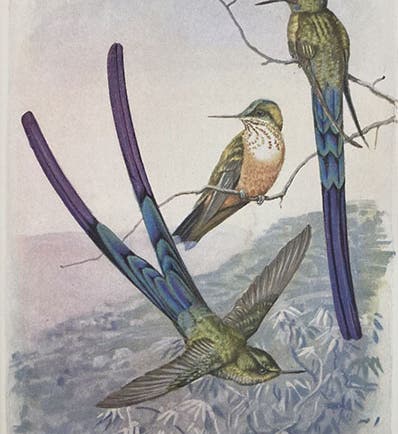
Blue-tailed ethereal hummingbird, by Louis Agassiz Fuertes, in Autobiography of a Bird-Lover, by Frank M. Chapman, p. 352, 1933 (Linda Hall Library)
Frank Michler Chapman, an American ornithologist, was born on June 12, 1864, in West Englewood, New Jersey. He started his working life as a banker, but, driven by his love of birds, gave it up in 1888 to become a lowly paid assistant curator at the American Museum of Natural History (AMNH) in New York, where he would eventually rise to become Curator of Birds, one of the rare paying positions for a birder in the United States.

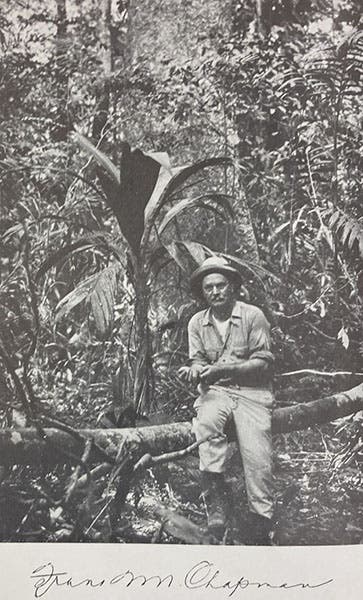
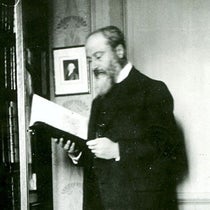
Frank M. Chapman at Barro Colorado, Lake Gatun, Panama, photograph, frontispiece to Autobiography of a Bird-Lover, by Frank M. Chapman, 1933 (Linda Hall Library)
So he was clearly good at his job. Where he stood out was in his desire to interest the general population in birds, by writing popular handbooks – he practically invented the field guide. He sought out and encouraged bird illustrators for his books, looking for the next Audubon, and finding him in Louis Agassiz Fuertes, whose work he first encountered at a birders' conference in 1895 and whom he promoted and used to illustrate many of his books and articles (first and fifth images).

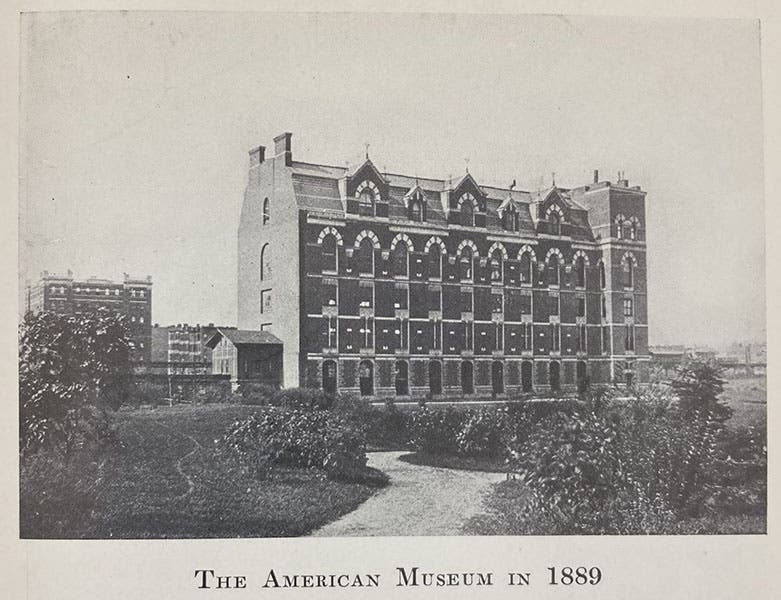
The American Museum of Natural History in Central Park, New York City, as it looked when Frank Chapman first went to work there in 1888, photograph, Autobiography of a Bird-Lover, by Frank M. Chapman, 1933 (Linda Hall Library)
Chapman also encouraged the AMNH to sponsor its own bird collecting expeditions, instead of just buying from private collectors. He himself made many trips to Central and South America, and sent others all around the world. He thought it was important to establish geographic ranges for all species, what we call biogeography, in order to understand bird evolution. To that end, Chapman instituted the Christmas Bird Count in 1900, a census that is still undertaken annually.

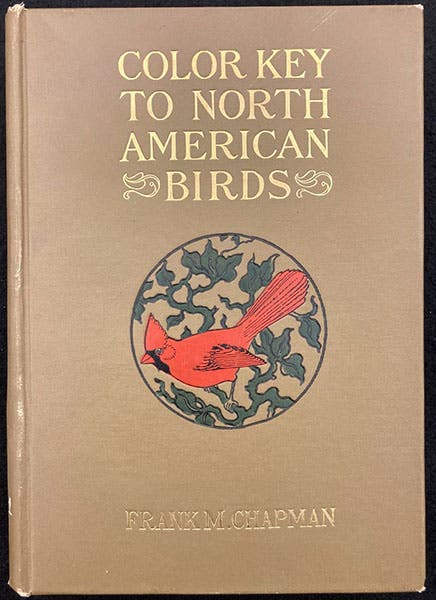
Cover, Color Key to North American Birds, by Frank M. Chapman, rev. ed., 1912 (Linda Hall Library)
To improve the "display, inform, and entertain" function of a museum, Chapman encouraged the organization of bird exhibits into interacting habitats, in ways which are common now in natural history museums, but was rare in 1910. He was in a way the museum counterpart to Carl Hagenbeck, our subject two days ago, who invented the modern habitat zoo.

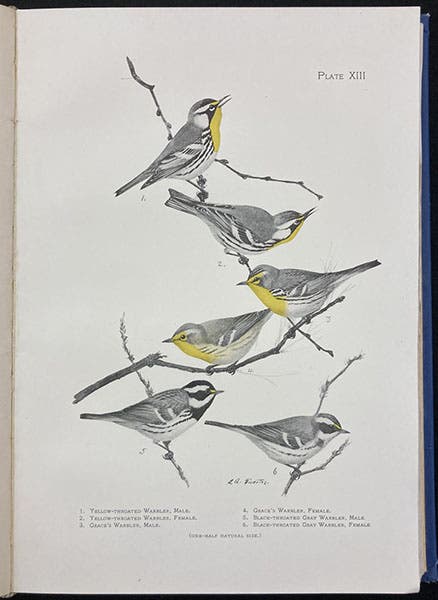
Six warblers, by Louis Agassiz Fuertes, frontispiece to The Warblers of North America, by Frank M. Chapman, 1907 (Linda Hall Library)
Chapman also founded and edited a magazine, Bird-Lore, with an intended audience of bird lovers rather than ornithologists, who were served by Ibis and The Auk. Our first issue of Bird-Lore is from volume 5, 1903 (sixth image), but we have a nearly complete run after that until 1940, all edited by Chapman, when it morphed into Audubon Magazine.

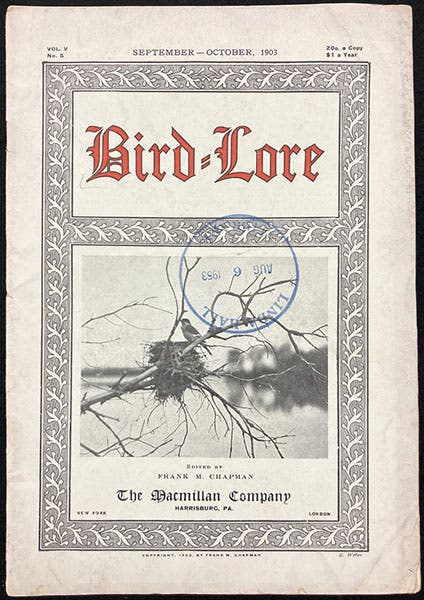
Cover of an issue of Bird-Lore, ed. by Frank M. Chapman, vol. 5, no. 5, October 1903, (Linda Hall Library)
One of Chapman’s great coups was to acquire for the AMNH in 1932 the complete bird collection – 280,000 skins – of Baron Lionel Walter Rothschild of Tring in England, for which he found a donor willing to pony up $225,000. At the time I wrote my post on Rothschild, I did not know why Rothschild sold his prized collection - I cited "financial problems". But it turns out Baron Walter was being blackmailed by a former mistress (and her husband), wanted to avoid scandal at all costs, and needed hush money. Whether Chapman knew why the birds were up for sale, I do not know. In his Autobiography, he says the collection was a gift from Rothchild's wife!

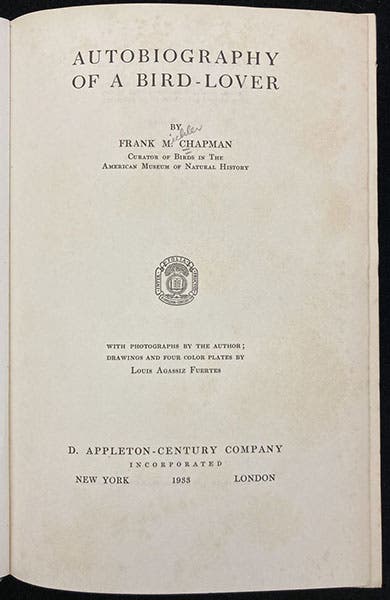
Title page, Autobiography of a Bird-Lover, by Frank M. Chapman, p. 352, 1933 (Linda Hall Library)
We have quite a few of Chapman's books in our collections, as well as the just-mentioned Autobiography of a Bird-Lover (1933). We displayed some of his field guides, such as his Warblers of North America (1907), in a 2016 exhibition called Drawn from Nature: Art, Science, and the Invention of the Bird Field Guide, curated by Eric Ward (eighth image).

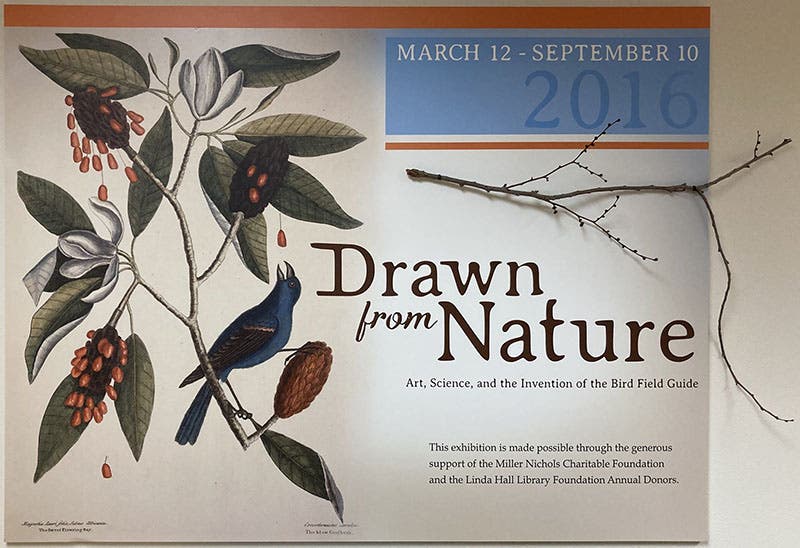
Exhibition title panel, Drawn from Nature: Art, Science, and the Invention of the Bird Field Guide, curated by Eric Ward, panel design by Melissa Dehner, 2016 (Linda Hall Library archives)
Our portrait (second image) comes from the frontispiece to Chapman's Autobiography. It shows him at age 62, on the island of Barro Colorado in the middle of Lake Gatun in Panama, where Chapman built a home on the edge of the jungle, to which he would later retire. He died on Nov. 15, 1945, and was buried in the family plot in West Englewood.
There is an excellent four-page discussion of Chapman, focusing on his role in collecting Central and South American birds, in an exhibition catalog that I highly recommend, Aves: A Survey of the Literature of Neotropical Ornithology (2011), by Tom Taylor.
William B. Ashworth, Jr., Consultant for the History of Science, Linda Hall Library and Associate Professor emeritus, Department of History, University of Missouri-Kansas City. Comments or corrections are welcome; please direct to ashworthw@umkc.edu.