Scientist of the Day - Hanno the elephant

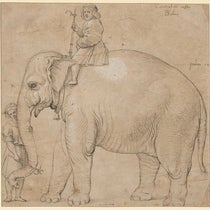
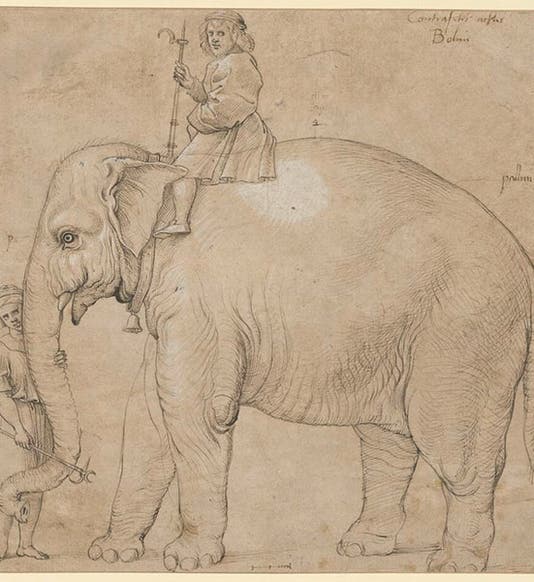
Drawing of Hanno the elephant in Rome, ink on brown paper, Raphael or his workshop, 1515, Kupferstichkabinett, State Museum of Berlin (Wikimedia commons)
Hanno the elephant died on June 8, 1517, in his enclosure near the Vatican. Hanno had been a post-coronation gift to newly elected Pope Leo X, by king Manuel I of Portugal. Hanno was brought to Rome in 1514 by the Portuguese ambassador, either acquired or purchased in India. He was 4 years old when the Pope first laid eyes on him, and it was love at first sight, at least on Leo's part. He had special living quarters built near the Apostolic Palace, and he would show Hanno off to visitors one day a week Hanno apparently came to Rome with that name (Aano in Italian), which means "elephant" in one of the languages of India.
.jpg#/media/File:Portrait_of_Pope_Leo_X_and_his_cousins,_cardinals_Giulio_de'_Medici_and_Luigi_de'_Rossi_(by_Raphael).jpg)
Portrait of Pope Leo X, with two of his cardinal cousins, oil on panel, by Raphael, 1518, Uffizi Gallery, Florence (Wikimedia commons)
Hanno was a white elephant, or at least a light color, although no one in Rome had any standard of comparison. He was apparently playful, and would spray water over any gathered crowd, and dance about. Leo had an odd predilection for court buffoons, and he would often parade them about Rome on Hanno’s shoulders. There is a watercolor in the Vatican archives that shows such an occasion (third image). Other drawings survive as well, including a nice one in Berlin that is attributed to Raphael or Giulio Romano (first image).

The buffoon poet Baraballo, a favorite of Pope Leo X, aboard Hanno the elephant, Rome, watercolor, Biblioteca Apostolica Vaticana, repoduced in black-and-white in The Pope’s Elephant, by Silvio Bedini, p. 97, 1998 (Wikimedia commons)
King Manuel, the next year (1515), sent an Indian rhinoceros to Pope Leo to join Hanno, perhaps perversely, as elephants and rhinos were supposed to have an innate antipathy for one another. Unfortunately, the ship from Lisbon was wrecked on the Italian coast, and the rhino drowned. Fortunately, a drawing was made, which Albrecht Dürer of Nuremberg turned into a memorable woodcut. We told that story in a post on Dürer.
Hanno lived just three years in Leo’s care. He became constipated in the early summer of 1517, and the nostrums of the papal pachydermic physicians were of no avail, or perhaps exacerbated the problem, and Hanno died on this day in 1517. Leo was immensely saddened, and Hanno was buried in the Belvedere gardens. A large in memoriam fresco portrait of Hanno was placed right on the entrance wall of St. Peter’s along with an inscribed epitaph. They were removed and lost during the rebuilding of St. Peter’s, but drawings survive of both the mural and the inscription.
Leo X survived Hanno by just 4 years, but not before the scourge of Martin Luther raised his voice in objection to Leo's sale of indulgences to replenish church coffers, and pretty much ruined Leo's life and legacy. Fortunately, Leo had Raphael around (until 1520) to paint handsome portraits of His Holiness and make us forget his sins and woes (second image).

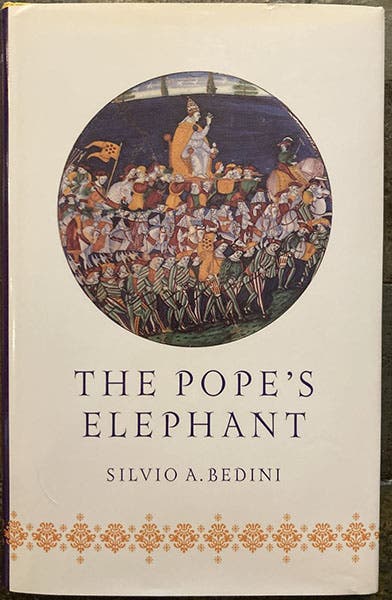
Dust jacket of The Pope's Elephant, by Silvio Bedini, U.S. edition, 1998 (author’s copy)
We know a great deal about Hanno because the eminent historian, Silvio Bedini, Keeper of Rare Books at the Smithsonian Institution, spent years in the Vatican Archives ferreting out every document referencing Hanno and Leo, and writing a book, The Pope's Elephant, published in the U.S. in 1998. I wouldn't call it an easy read – Bedini was the consummate scholar – but it is certainly definitive. The dust jacket of the U.S. edition (fourth image) shows a majolica plate, made around 1516, that depicts Hanno leading a procession that includes a litter-borne Pope Leo X (fifth image). The original is supposedly in the Victoria and Albert Museum in London, although I have never come any closer to it than the dust jacket of Bedini's book.


Majolica platter depicting Hanno the elephant and Pope Leo X, 1516, Victoria and Albert Museum, as depicted on the dust jacket of The Pope's Elephant, by Silvio Bedini, U.S. edition, 1998 (author’s copy)
Hanno is on a short list of historic named exotic animals, which would include his fellow elephants (elephellows?) Jumbo and Hansken, and Clara the rhino, about all of whom we have written posts at one time or another. Dürer’s rhino would lead this list, if it had had a name.
William B. Ashworth, Jr., Consultant for the History of Science, Linda Hall Library and Associate Professor emeritus, Department of History, University of Missouri-Kansas City. Comments or corrections are welcome; please direct to ashworthw@umkc.edu.