Scientist of the Day - Edwin Clark

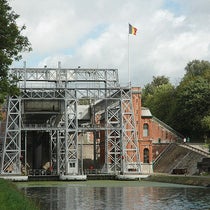
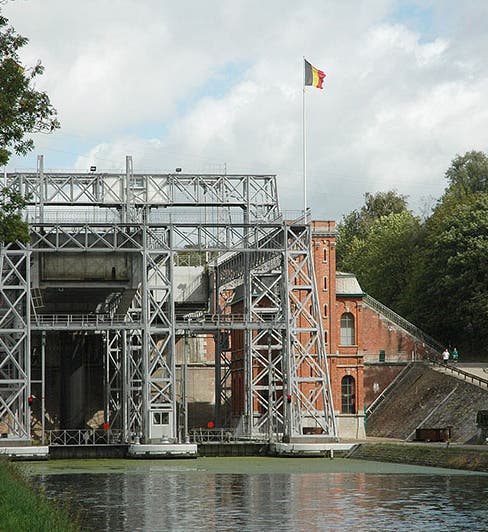
Boat Lift no. 1, Canal du Centre, Wallonia, Belgium, modern photo (Wikimedia commons)
The first boat lift on the Canal du Centre in Wallonia, Belgium, opened for traffic on June 4, 1888. It was designed and built by Edwin Clark of England, the senior member of the engineering firm of Clark, Stansfield, and Clark. Edwin Clark virtually invented the boat lift as an alternative to a series of locks to raise and lower canal boats. Canals that connected two river systems with different elevations often had to rise or fall in a hurry, sometimes fifty feet or more, which was inconvenient and time-consuming if one used a cascade of locks.

Hydraulic engine in the first boat lift, for raising one of the caissons, Canal du Centre, Wallonia, Belgium, modern phoo (Wikimedia commons)
Such was the case in Anderton in Cheshire, England where the Trent & Mersey Canal is 50 feet higher than the River Weaver. In the 1870s, Clark, at the request of Principal Engineer Edward Leader Williams, designed a boat lift with two large water-filled caissons that went up and down, carrying canal boats, balancing each other, and operated by hydraulic rams. The Anderton Boat Lift was opened in 1875 and was a great success, and is still operating, and it inspired most of the boat lifts built in the next 40 years, including the lifts on the Canal du Centre in Belgium.

A hydraulic ram for raising one of the caissons, Lift no. 1, Canal du Centre, Wallonia, Belgium, modem photo (Wikimedia commons)
In this instance, they needed to raise and lower canal boats more than 215 feet, four times what the Anderton Boat Lift provided. So Clark designed a series of 4 boat lifts, one raising boats 52 feet, and the other three 55 feet each. The first lift was finished in 1888, but for various reasons, the complete system of four lifts did not go into operation until 1917. Authorities thought about tearing them down in the 1970's, since they could no longer carry the now-larger commercial canal boats. Thankfully, preservationists went into action and successfully petitioned UNESCO to make the four locks of the Canal du Centre a World Heritage Site, which it became in 1998. All the locks have been repaired and are operational, carrying pleasure boats up and down, while the massive new Strépy-Thieu lift takes care of the commercial boats at one fell swoop. Here is a 3-minute video from the WHS website of a recreational boat being raised in one of the Canal du Centre boat lifts.
.JPG#/media/File:01_Houdeng-Goegnies_050323_(2).JPG)
Boat Lift no. 1, view from top level, Canal du Centre, Wallonia, Belgium, modem photo (Wikimedia commons)
Edwin Clark was a remarkable hydraulic engineer who does not get nearly the credit he deserves. It was Clark who, in the late 1840s, as a young man, figured out a way to raise into position the tubes of the Britannia Bridge and the Conwy Bridge in Wales, using hydraulic lifts, and at the request of Robert Stephenson. We have discussed these bridges several times, in a post on Clark and in one on Robert Stephenson.
We have also written a post on the Peterborough Lift Lock in Canada. The engineer there, Richard Birdsall Rogers, was directly inspired by the Anderton Boat Lift and the first of the Canal du Centre boat lifts.
Clark died on Oct. 22, 1894, at the age of 80. I could not find the location of his grave, nor a portrait. The village of Marlow on the Thames, where Edwin Clark lived and died, does not even list Clark among their “Notable People” in their Wikipedia article. There is a blue plaque on the last house Clark lived in, but it only appears only once in a Google search, and that appearance is copyrighted. You can see it here.
Edwin Clark really needs a fan club to promote him.
William B. Ashworth, Jr., Consultant for the History of Science, Linda Hall Library and Associate Professor emeritus, Department of History, University of Missouri-Kansas City. Comments or corrections are welcome; please direct to ashworthw@umkc.edu.