Scientist of the Day - Otto Loewi

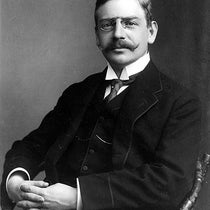
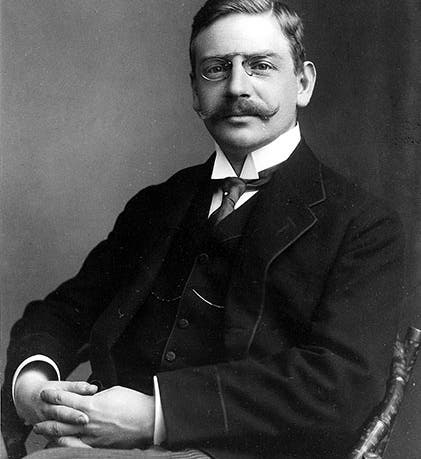
Portrait of a younger Otto Loewi, photograph, undated (Wikimedia commons)
Otto Loewi, a German/Austrian/American pharmacologist, was born in Frankfurt on June 3, 1873. He studied medicine at Strasbourg, but decided that he preferred working in the lab, rather than treating patients. He was especially interested in discovering the chemicals that regulate human physiology, which led him to pharmacology, a discipline he pursued at the University of Marburg.
In 1902, Loewi had the good fortune to spend a year in the London laboratory of Ernest Starling, who that very year discovered the second known hormone, secretin, and the first to be called a hormone, since Starling invented the word. While in London, Loewi met Henry Dale, with whom he would later collaborate. Loewi returned to Austria to become professor of pharmacology at the University of Graz, where he would remain until the Nazis invaded Austria in 1938.

Otto Loewi (right) and Henry Dale in Stockholm in 1936, for the award of the Nobel Prize in Physiology/Medicine, photograph (Wikimedia commons)
In the early 20th century, most physiologists believed that neurotransmission – the process by which impulses travel along nerves and across synapses – is entirely electrical. Loewi, as a result of experiments performed on frog hearts, wondered whether chemicals might be involved. In investigating the effect of the vagus nerve on the beating of the heart (it slows it down), he found that fluid from a slowed frog heart would slow down a second heart. At first he called the chemical produced by the vagus nerve “Vagusstoff;” it was later identified as acetylcholine. In 1921, he proposed that the vagus nerve communicates with the heart by producing acetylcholine, which slows the heart rate. The neurotransmitter was not an electrical pulse, but a chemical.
Loewi's announcement was widely criticized by other experimenters, especially neuroscientists, who claimed either that Loewi's experiments could not be reproduced, or that his discovery did not apply to other types of neurotransmission. Many thought neurohumors, as chemicals like acetylcholine were called, would operate too slowly to produce fast-reflex action. But Loewi persisted, and joined forces with Dale, and they ultimately prevailed, sharing the Nobel Prize in Physiology/Medicine in 1936 for their discovery of the chemical nature of nerve transmission.

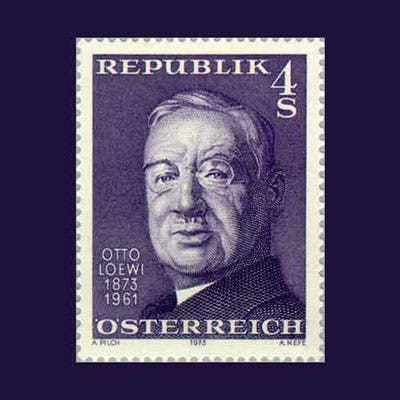
Postage stamp issued by Austria in 1973, honoring the centennial of the birth of Otto Loewi (mintageworld.com)
Loewi always claimed that the idea for the frog-heart experiment came to him in a dream. In fact, he said he had to sleep twice, because the first night, he scribbled notes that he couldn't read in the morning, so he had to dream it again. If you believe the story, or any other tales of dream-inspired story scientific discoveries, such as August Kekulé and the benzene ring, or Dmitrii Mendeleev and the periodic table, you are welcome to them.

Gravestone of Otto Loewi (foreground), Woods Hole Village Cemetery, Woods Hole, Mass. (findagrave.com)
Loewi chose to leave Graz when Hitler annexed Austria in 1938, going first to Belgium, then England, and then to the United States, where he was offered a position (thanks to the Rockefeller Foundation) at NYU's College of Medicine. He spent his summers at Woods Hole Biological Laboratory in Massachusetts. Loewi died on Christmas Day, 1961. There is a bust of Loewi at Woods Hole, it is said, but I can find no image anywhere. Help me out, if you can; I do like memorial busts. In lieu of the bust, we show his headstone at Woods Hole Village Cemetery (last image).
William B. Ashworth, Jr., Consultant for the History of Science, Linda Hall Library and Associate Professor emeritus, Department of History, University of Missouri-Kansas City. Comments or corrections are welcome; please direct to ashworthw@umkc.edu.