Scientist of the Day - Kip Thorne

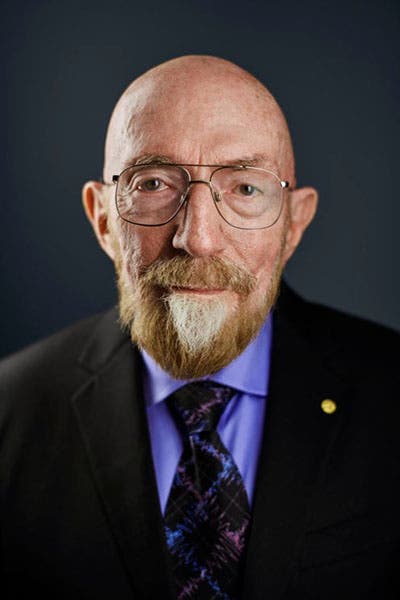
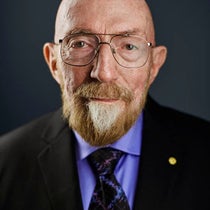
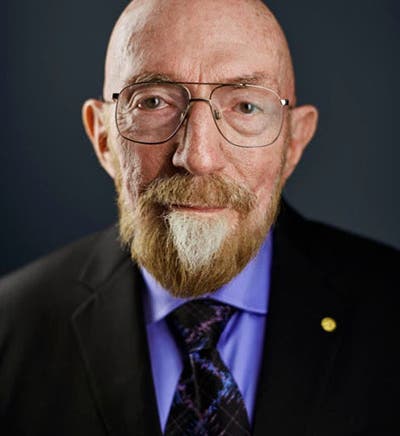
Kip Thorne at the time of receiving the Nobel Prize in Physics, 2017 (nobelprize.org)
Kip Thorne, an American astrophysicist, was born June 1, 1940, in Logan, Utah. He studied physics at Caltech, and did his doctoral work at Princeton, where he studied under John Wheeler, who was probably the world's leading expert on gravitation and Einstein's general relativity. General relativity was under attack in many quarters in the 1959s and 60s (general relativity is always under attack, it seems), and Wheeler was the one who not only defended Einstein, but pursued the implications of gravity as a curvature of space/time. Wheeler did not discover black holes, but he named them, and studied the physics of black holes, along with Stephen Hawking, and he passed on his enthusiasm to Thorne, who would become the world's principal authority on general relativity. The two men (and a third) wrote the principal textbook on the subject, Gravitation, in 1973, which has taught several generations of students.
_main_lecture_hall_1972.jpg#/media/File:%C3%89cole_de_Physique_des_Houches_(Les_Houches_Physics_School)_main_lecture_hall_1972.jpg)
Kip Thorne in 1972 (second from right) (Wikimedia commons)
Most of the thinking and writing of experts in general relativity lies well beyond the ken of the rest of us, but Thorne has gone out of his way to communicate general relativity to the general public. He first became interested in popular science when a friend, Carl Sagan, who was writing Contact in the early 1980s, wrote to him and wanted to know what would happen to his SETI scientists if he sent them into a black hole. Thorne explained that a black hole would rip his voyagers apart, but a wormhole, a prediction of general relativity, might do the job.

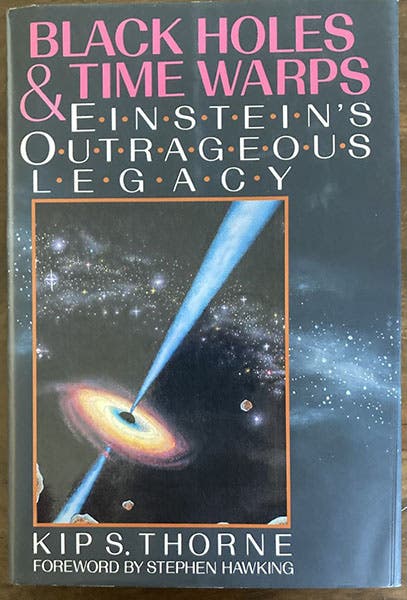
Dust Jacket, Black Holes and Time Warps: Einstein’s Outrageous Legacy, by Kip S. Thorne, 1994 (author’s copy)
Sagan revised his book accordingly, and Thorne now became interested in the challenge of conveying the implications of general relativity to a wider audience. He wrote Black Holes and Time Warps, published in 1994, which explained black holes, white holes, wormholes, and the physics of time travel, which wormholes make theoretically possible, to the world. The book was a great success. I bought a copy when it came out and enjoyed it very much.
Thorne then made it known that he would like to be utilized as a consultant in the production of science fiction films that utilized general relativity. I do not believe Thorne was involved in the making of the film Contact (1997), but when Christopher Nolan wanted to make a movie involving wormholes, called Interstellar (2014), he brought in Thorne as the resident expert. Thorne must have liked seeing his ideas on film, for he resigned his position as the Feynman Professor of Physics at Caltech (granted, he was well beyond retirement age at the time) to pursue science in film and popular culture. He wrote a second book, the Science of Interstellar (2014, which I have not read), and he was brought in to consult on a second Nolan film, Tenet (2020), which explored the possibility of moving backward through time and interacting with those moving forward. I did not understand Tenet at all, but I enjoyed the presentation of bullets going backward through time. I do not believe Thorne has written a book on the physics of Tenet. Perhaps it will come to us from the future.
And we should mention that in between Interstellar and Tenet, Thorne was awarded a share of the 2017 Nobel Prize in Physics, for the first detection of gravitational waves.
.jpg#/media/File:Kip_Thorne_in_2022_Home_03_(3x4_cropped).jpg)
Kip Thorne in 2022, photograph (Wikimedia commons)
Thorne is happily still active, 86 years old today, and still seeking to enlighten the rest of us about general relativity. I look forward to his next enterprise, whatever that may be.
William B. Ashworth, Jr., Consultant for the History of Science, Linda Hall Library and Associate Professor emeritus, Department of History, University of Missouri-Kansas City. Comments or corrections are welcome; please direct to ashworthw@umkc.edu.