


Scientist of the Day - Louis Agassiz

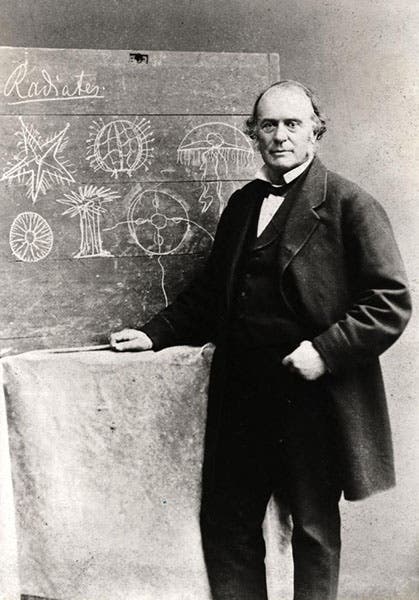
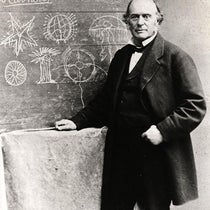
Portrait of Louis Agassiz, photograph, 1870 (neh.gov)
Louis Agassiz, a Swiss/American naturalist, was born May 28, 1807, in the canton of Fribourg. He had a distinguished career in Europe, writing a masterful (and beautifully illustrated) treatise on fossil fish (1833), and topping this with Studies on Glaciers (1840), in which he proposed that Earth geo-history had been punctuated by global ice ages. We discussed ice ages in our first post on Agassiz in 2015, and his publication on fossil fish in a second post just last year.

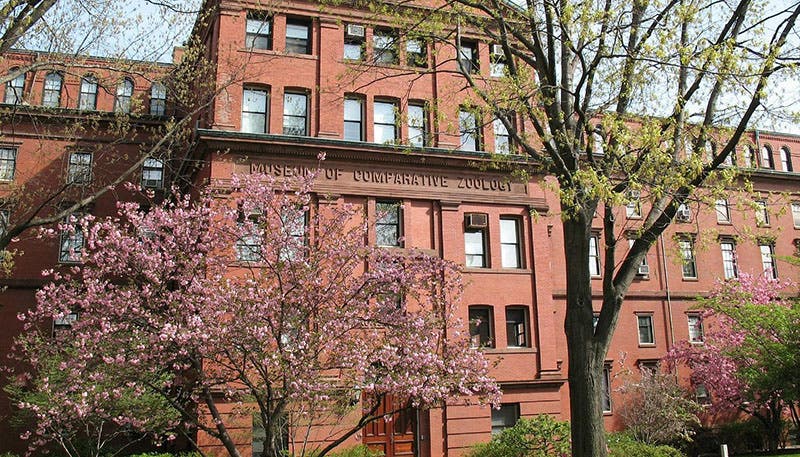
Museum of Comparative Zoology, Harvard, recent photograph (tripadvisor.com)
In 1846, Agassiz was invited to give a series of lectures (the Lowell Lectures) in Boston. He was lionized by the American public, drawing almost 5000 people to each of his lectures, and like the smart cookie he was, he decided to stay, especially when Harvard offered him a professorship and the prospect of a zoological museum. He never went back to Switzerland. The wife he left behind died, and his three children joined him in Cambridge. His plans for a Museum of Comparative Zoology were realized in 1859, when the first version was built of what would eventually grow into a colossal five-story quadrangle, in due course named the Agassiz Museum of Comparative Zoology.

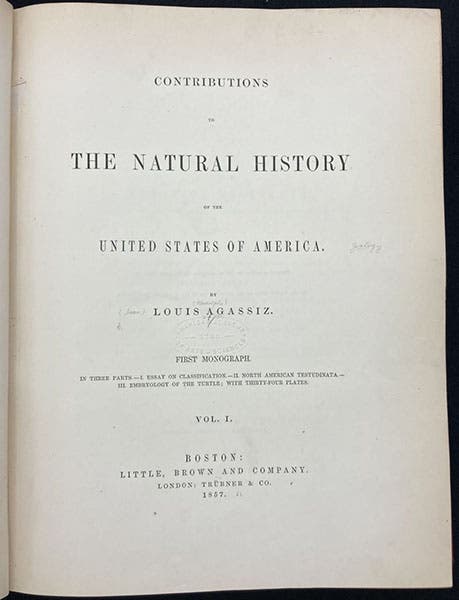
Title page, Contributions to the Natural History of the United States of America, by Louis Agassiz, vol. 1, 1857 (Linda Hall Libay)
However, something else appeared in 1859 that would eventually create problems for Agassiz – the first edition of Charles Darwin’s Origin of Species. Agassiz believed that God created every species and a geographical region for it to inhabit, according to a divine plan, and he strongly resisted Darwinism, in his teaching and in his many public appearances. His colleague at Harvard, Asa Gray, himself a minister, could not accept Darwin’s mechanism of natural selection, but evolution explained geographical distribution so much better than any other hypothesis, that it had to be correct. Agassiz, however, never gave up on a divine plan, and he gradually lost students and support until his death in 1873.

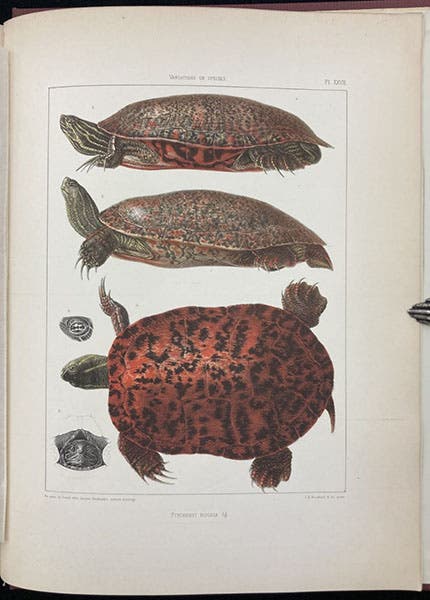
Turtles, hand-colored lithograph after drawings by Jacques Burkhardt, Contributions to the Natural History of the United States of America, by Louis Agassiz, vol. 1, plate 27, 1857 (Linda Hall Libay)
Agassiz did have some significant publications during his American years. His Contributions to a Natural History of the United States of America (1857-62) is quite impressive, even though he only published four of an intended ten volumes, and the Essay on Classification that opens volume 1 is an important enunciation of how he thought God had organized his Creation. Each volume contains plates by his lifelong illustrator, Jacques Burkhardt, some of which are colored and spectacular (fourth image)

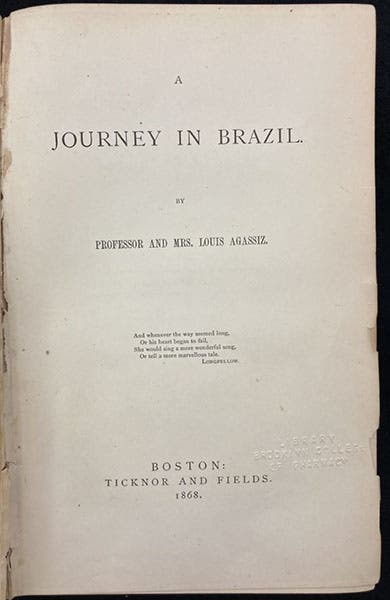
Title page, A Journey in Brazil, by Louis and Elizabeth Cabot Cary Agassiz, 1868 (Linda Hall Library)

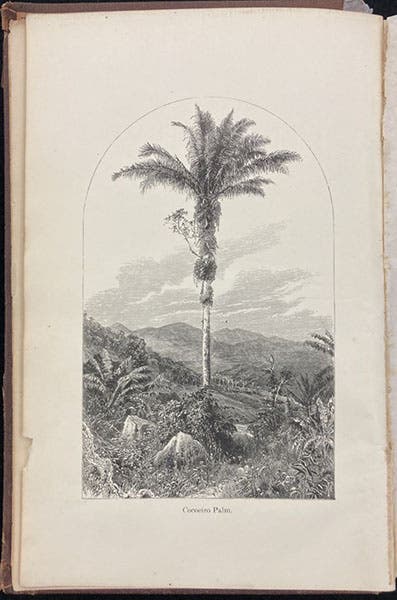
A palm in Brazil, frontispiece wood engraving after a drawing by Jacques Burkhardt, A Journey in Brazil, by Louis and Elizabeth Cabot Cary Agassiz, 1868 (Linda Hall Library)
Agassiz also made a trip to Brazil with his second wife Elizabeth in 1865-66, and they wrote a book about their adventures, A Journey in Brazil (1868), which has both their names on the title page (fifth image), but its chatty style indicates that Louis had little to do with its composition. He did, however, send back thousands of Brazilian fish, pickled in barrels of whiskey, which the Museum had scant room to store.

Headstone of Louis Agassiz at Mount Auburn Cemetery, made fom a glacial stone from a moraine in the Alps of his native Switzerland (Wikimedia commons)
When Agassiz died in 1873, he was buried in Mount Auburn Cemetery in Cambridge, with a glacial erratic for a headstone (seventh image). He was eulogized widely – his pre-Darwin contributions to science were significant ones – but lately Agassiz has run into difficulties. He had some strong views on race, believing that each race was a separate creation and thus a separate species, with the white race superior to all others. His racism has angered various modern groups who want to rewrite the 19th-century chapters of America's sorry racial history and expunge figures like Agassiz, who held views that are now abhorrent to most of us. So schools named after Agassiz are being renamed, and busts and statues removed. One can sympathize with the feelings behind such actions, but I am not sure that imposing 21st-century standards on the 19th century is a good idea, in a historical sense, although I confess that I refuse to write about Nazi scientists who espoused a pure, German science that excluded Einstein and all other Jewish scientists, so perhaps we are all a little guilty of trying to whitewash the past to make it more palatable.
None of the criticism directed at Louis Agassiz has been aimed at his son Alexander, who took over directorship of the Museum after Louis died, and whom we featured in a post in March 2026.
William B. Ashworth, Jr., Consultant for the History of Science, Linda Hall Library and Associate Professor emeritus, Department of History, University of Missouri-Kansas City. Comments or corrections are welcome; please direct to ashworthw@umkc.edu.


![Net for truncated cuboctahedron, an Archimedean solid, Quatuor his suaru[m] Institutionum geometricarum libris (Four Books on Measurement), by Albrecht Dürer, p. 156, 1534 (Linda Hall Library)](https://preview-assets-us-01.kc-usercontent.com:443/9dd25524-761a-000d-d79f-86a5086d4774/05d51aeb-2dd1-4949-880d-ec62209058fd/durer1.jpg?w=210&h=210&auto=format&fit=crop)